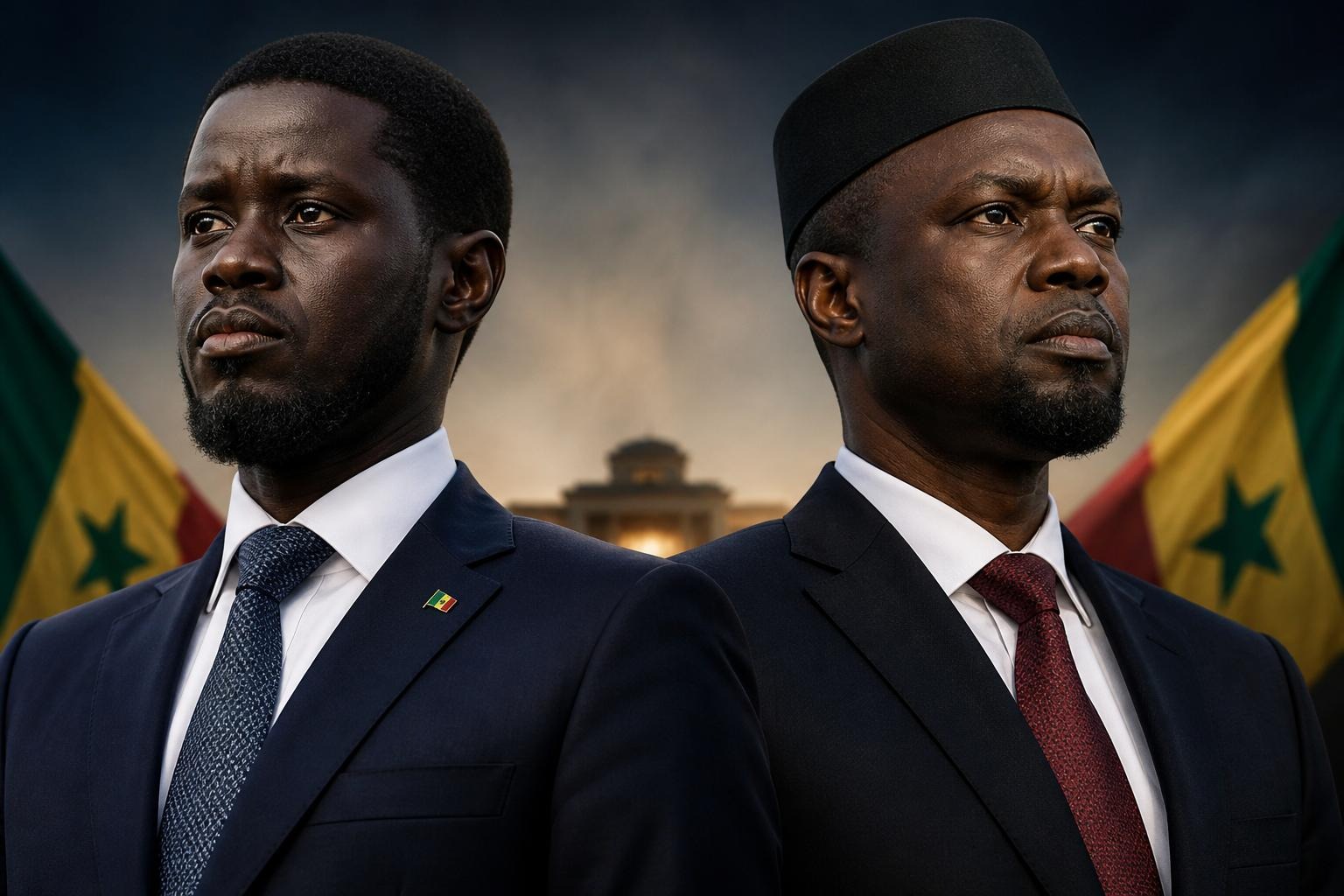
Senegal’s leadership tested as Diomaye Faye charts a new course
A Shift in Senegal’s Political Landscape
The initial honeymoon period at the pinnacle of Senegalese leadership appears to be giving way to the harsh realities of realpolitik. The weekend of May 2-3, 2026, represented a significant symbolic turning point in the dynamic between President Bassirou Diomaye Faye and his Prime Minister, Ousmane Sonko. By publicly acknowledging disagreements with the Pastef party and declaring himself “ready for separation” if national interests demanded it, the head of state shattered the illusion of an unbreakable partnership. As presidential independence clashes with party loyalty, Sénégal holds its breath, witnessing what could be the start of an unprecedented political realignment.
A Weekend of Decisive Statements
A single remark, made during a discussion with the national media, ignited a firestorm. Previously, the official narrative had carefully cultivated the image of a unified team—a “pair” where mentor and disciple moved in lockstep towards their promised reforms. That tone has now shifted dramatically. When questioned about the mounting friction between his government’s direction and the sometimes-fiery statements from Pastef officials, President Faye responded with unexpected resolve. He underscored that he had formally stepped away from the party to serve as the president for all Senegalese citizens. His words reverberated like a thunderclap across Dakar’s political landscape when he stated that while his dedication to their shared project was absolute, his ultimate responsibility was to the people. By clarifying that he would not hesitate to formalize a separation if party logic conflicted with his vision for the state, he definitively established his authority.
The Shadow of Ousmane Sonko: An Ever-Present Prime Minister
To grasp the full extent of this tension, one must look at the origins of this administration. President Faye was elected on a slogan that essentially promised a vote for him was a vote for Sonko, forcing him to navigate the constant media presence of his Prime Minister. The charismatic leader of Pastef has never truly shed his role as party chief, frequently holding rallies and making direct public statements that have, at times, appeared to bypass official palace communications. Over recent months, strategic differences have emerged on critical issues. The management of national debt and engagement with international financial bodies highlight this growing divide, with the Prime Minister advocating for a radical break while the President favors a more diplomatic and pragmatic approach. Furthermore, government appointments have become a source of friction, pitting the presidential desire to appoint technocrats against party pressure to reward long-time activists. Finally, the stark contrast between Ousmane Sonko’s fiery style and the calm solemnity Bassirou Diomaye Faye seeks to project has become unmistakable.
Is a Political Divorce Now Unavoidable?
While it may be premature to declare a split is imminent, it is now an acknowledged political possibility. Circles close to the Prime Minister’s office have tried to downplay the President’s comments as a mere clarification of roles, but the message from the presidency suggests a more profound shift. By stating his readiness to part ways, the head of state is sending an unambiguous signal to his own political base: the presidency will not be held captive by any single interest group. This development plunges Sénégal into a period of institutional uncertainty. The nation has a history of turbulent executive duos, and many now fear a potential deadlock within the state apparatus. Should a break occur, the President would face the immense challenge of governing without the full backing of the Pastef party’s activist network, compelling him to forge new alliances or rule by decree.
The Stakes of Presidential Autonomy
The challenge for Bassirou Diomaye Faye is twofold: he must reassure international partners of the country’s stability while simultaneously demonstrating to his citizens that he is firmly in control. Public opinion is now fractured. A segment of the youth, loyal to Ousmane Sonko’s charismatic appeal, may interpret this move towards independence as a betrayal. Conversely, another portion of the populace, more focused on constitutional order, applauds the emergence of a president who is finally embracing the full scope of his official duties. The President is engaged in a high-stakes political chess match. He needs to assert his authority without triggering a major social crisis that his opponents could easily exploit. The question is no longer about the personal relationship between the two men, but whether the state’s framework can sustainably support two distinct centers of power.
Observers of the political scene are witnessing the end of a certain idealism. Politics is less about fraternity and more about the management of power. Bassirou Diomaye Faye has served a reminder that the Constitution grants him prerogatives he is now determined to exercise independently. The partnership that was a tool for winning the election now appears to be an obstacle to governing. Sénégal is entering a new phase of maturity where the state must take precedence over the party, and the President has just drawn a clear line in the sand.
