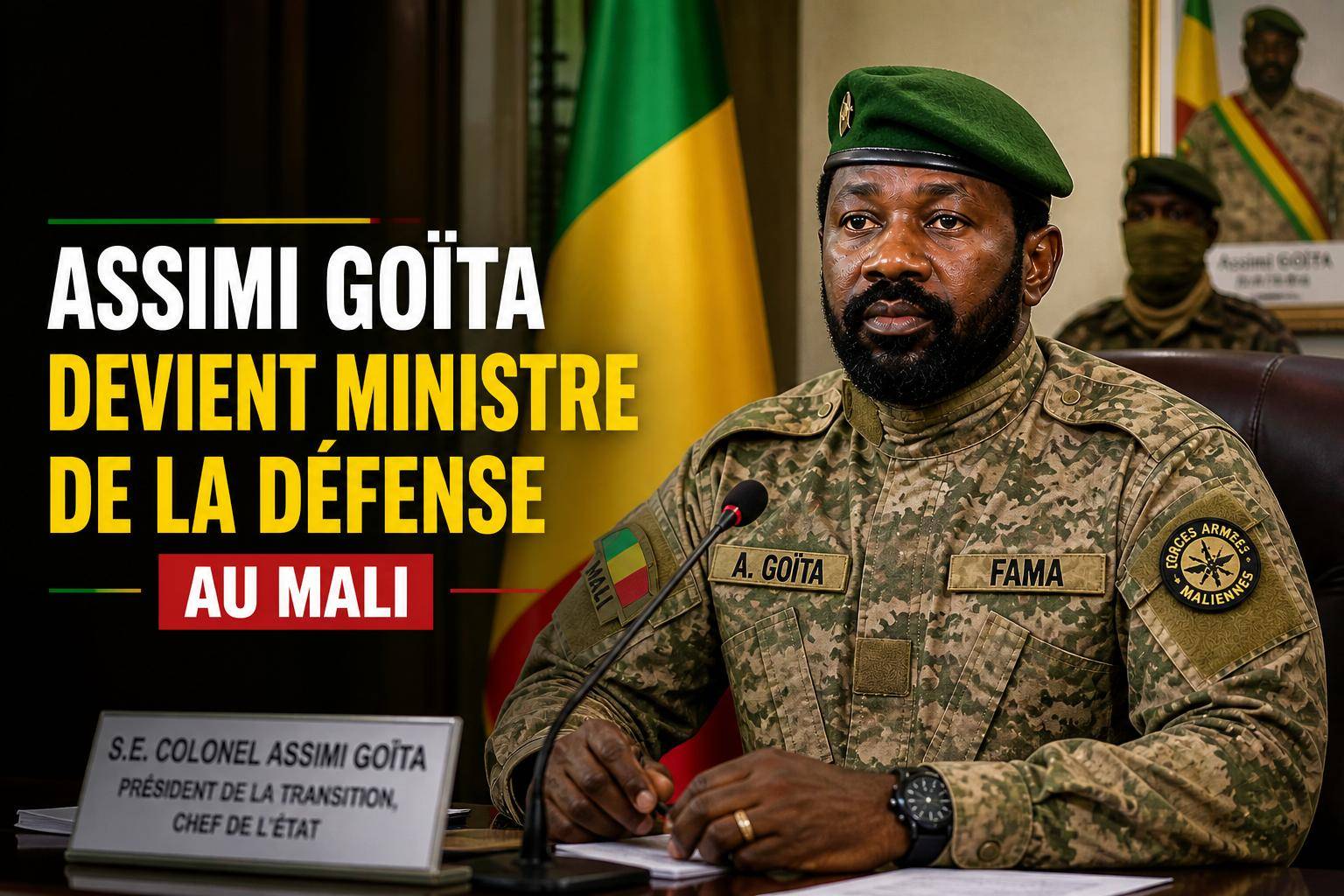
Mali’s assimi goïta consolidates power amidst koulouba’s security challenges
By officially assuming the responsibilities of Defense Minister in addition to his duties as Head of State, Colonel Assimi Goïta completes a significant centralization of authority in Bamako. This decision, far from being a mere administrative adjustment, reveals underlying vulnerabilities: a faltering chain of command and a military strategy that appears to be losing momentum. Between the recent setback in Kidal, which fell under the control of the JNIM and the FLA, and the contested effectiveness of the Russian partner, Mali is entering an unprecedented period of instability.
Currently, in Bamako, all decision-making converges at Koulouba. By combining the presidency with the defense portfolio, Colonel Assimi Goïta no longer solely crafts political direction; he becomes the primary operational commander of the armed forces. For many regional observers, this move suggests growing mistrust within the inner circle of power.
Within a protracted transitional context, this extreme centralization raises a critical question: how can a single individual manage state affairs, regional diplomacy, and the tactical intricacies of an asymmetric war? This accumulation of mandates appears to be a risky gamble. By removing ministerial buffers, Goïta now stands directly on the front line. Every reversal on the battlefield will no longer be attributed to a subordinate but will be perceived as a direct failure of the Head of State.
The illusion of Kidal: from reconquest to loss of control
Just a few months ago, official channels grandly proclaimed the “liberation” of Kidal. It was hailed as a symbol of regained sovereignty, the transition’s trophy. However, the reality on the ground has swiftly dashed these aspirations. The city, a strategic stronghold in the North, has reverted to the control of armed groups, notably the Group for the Support of Islam and Muslims (JNIM) and forces from the Coordination of Azawad Movements (CMA/FLA).
This reversal is not merely symbolic; it carries significant tactical weight. The insurgent takeover of Kidal demonstrates that the Malian army, despite rhetoric of increased strength, struggles to maintain reconquered positions long-term. The void in public administration and security allowed for a rapid reoccupation by jihadist groups and separatist rebels. The JNIM, in particular, seems to have refined its strategy, isolating garrisons and cutting supply lines, transforming Bamako’s victories into fleeting successes.
The shadow of Wagner: a Russian partner losing steam?
Another cornerstone of Goïta’s security strategy is the partnership with Russia, embodied by the Wagner paramilitary group (now operating under the Africa Corps label). While this choice was marketed as a sovereign alternative to the former colonial power, France, its results on a strictly security level have yet to deliver convincing outcomes.
The Russian partners, though present on the most active fronts, seem to favor a scorched-earth approach that, far from bringing peace, further alienates and radicalizes local populations. Reports of human rights abuses are escalating, creating a fertile ground for the recruitment of terrorist groups. More gravely, the technical efficacy of these instructors is being questioned by the ease with which Malian army convoys fall into deadly ambushes. Can Russia, itself embroiled in its own conflict in Europe, genuinely offer Mali the necessary air and technological support to counter the JNIM’s mobility? This remains highly uncertain.
Regional diplomacy in tatters
This security crisis unfolds amidst growing diplomatic isolation. By withdrawing from ECOWAS to form the Alliance of Sahel States (AES), Mali gambled on security self-reliance. But reality remains stubborn: borders are porous, and terrorism knows no national limits.
By cutting itself off from regional cooperation mechanisms, Bamako deprives itself of vital intelligence and logistical support from neighboring states. Goïta’s accumulation of posts is perceived by neighboring capitals as an authoritarian hardening, making dialogue even more complex. Mali finds itself today in a paradoxical position: it seeks to assert its sovereignty through force, yet it has never seemed so reliant on opaque external forces and a chain of command concentrated in the hands of a single individual.
The specter of entanglement: what future for Mali?
The assessment is grim for the populations of the Centre and North. Despite leadership changes and overturned geopolitical alliances, insecurity continues to escalate. Attacks against civilian and military convoys have become almost daily occurrences.
The new “President-Minister of Defense” is making his ultimate gamble. If the security situation does not rapidly improve, social discontent, currently contained by a heavy blanket of security, could well eventually boil over. African history is replete with examples where the excessive concentration of power was a precursor to significant instability.
To break the deadlock, Mali cannot afford to forgo a re-evaluation of its overall strategy. Brute force and mercenary alliances have demonstrated their limitations. Without a return to inclusive governance and a genuine strategy for social reintegration of the territory, Colonel Goïta’s authority risks being blunted swiftly by the resilience of armed groups.
The moment calls not for war rhetoric, but for urgent political realism. For beyond the titles and uniforms, the very existence of the Malian state is at stake on the shifting sands of the North.
