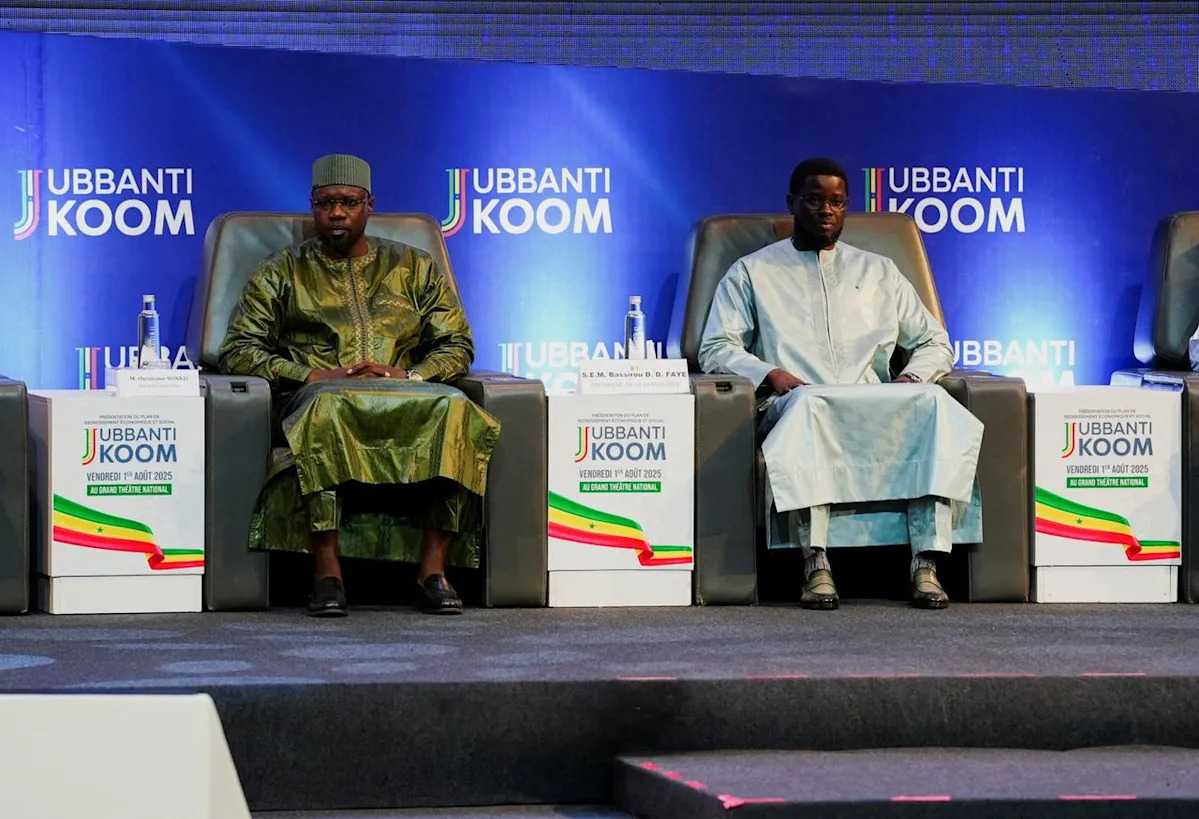
Senegal’s economic divide: sonko vs faye policies clash
When Bassirou Diomaye Faye dismissed Ousmane Sonko on May 23, 2026, the move signaled more than a personal rift—it exposed a fundamental clash over Senegal’s economic direction. Two years after Faye’s April 2024 election victory, which initially united them under the same banner, their partnership collapsed over three critical issues: debt management, hydrocarbon policies, and the role of foreign capital in national development.
debt mismanagement sparks political rupture
In September 2024, Ousmane Sonko publicly exposed billions in undisclosed debt accumulated under former President Macky Sall’s administration. By March 2025, an IMF assessment estimated unrecorded obligations at €7 billion, pushing Senegal’s debt-to-GDP ratio beyond 100%. Annual debt servicing costs reached 5,500 billion West African francs (€8.4 billion), with refinancing needs approaching 6,000 billion francs (€9.1 billion). Credit rating agencies downgraded the country three times within a year, reflecting escalating fiscal risks.
These numbers set the stage for two diametrically opposed approaches. Sonko’s strategy relied on public denunciation of past financial mismanagement, leveraging anti-corruption rhetoric to galvanize support among youth and diaspora communities. His refusal to engage in restructuring negotiations stemmed from a desire to preserve his moral authority, positioning himself as a challenger of the status quo rather than its steward.
Faye, in contrast, pursued pragmatic engagement with international creditors. His administration reopened dialogue with the IMF in November 2025 and convened a national economic forum in May 2026 to seek consensus on fiscal reforms. While Sonko’s stance resonated with grassroots activists, Faye’s approach prioritized economic stability—even if it meant incremental compromises.
hydrocarbon ambitions vs fiscal realism
The second fault line emerged over Senegal’s energy sector. Sonko championed rapid exploitation of newly discovered offshore oil and gas reserves, framing hydrocarbon revenues as a path to rapid industrialization and energy independence. His vision included aggressive licensing rounds and state-backed infrastructure projects to maximize short-term gains.
Faye’s team, however, advocated for cautious development, emphasizing long-term sustainability over immediate extraction. They argued that unchecked hydrocarbon expansion could deepen debt exposure and trigger environmental liabilities. This divergence mirrored broader debates across West Africa, where resource-rich nations struggle to balance growth with fiscal prudence.
foreign capital: partnership or dependency?
The final contention centered on Senegal’s reliance on external financing. Sonko’s rhetoric often framed foreign investment as neo-colonial exploitation, calling for greater state control over strategic sectors. His proposals included renegotiating mining contracts and restricting multinational corporations’ influence in critical industries.
Faye’s government took a more conciliatory approach, seeking foreign partnerships to fund large-scale infrastructure—particularly in renewable energy and port expansion. While Sonko’s stance appealed to nationalist sentiments, Faye’s pragmatism aimed to unlock capital flows despite the associated strings. The tension between these visions ultimately proved irreconcilable, culminating in Sonko’s dismissal and the unraveling of their alliance.
