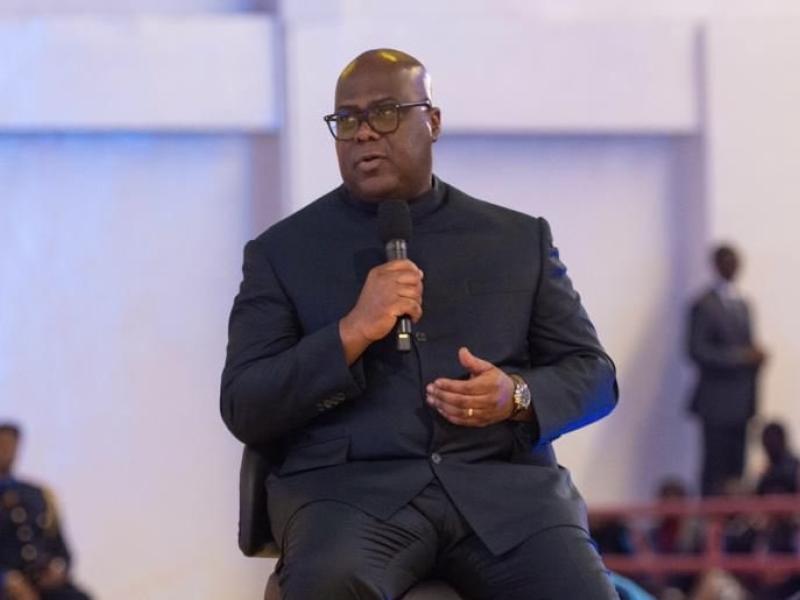
Félix Tshisekedi warns against misuse of dialogue as a political tool
The President of the Democratic Republic of the Congo, Félix Tshisekedi, has issued a strong warning against the instrumentalization of dialogue as a means to undermine institutions or challenge the will of the Congolese people. Speaking ahead of the 66th anniversary of national independence, the head of state reaffirmed his commitment to peaceful engagement while drawing clear red lines for its application.
Dialogue must respect constitutional and institutional frameworks
In a solemn address to the nation, President Tshisekedi emphasized that while the Republic remains open to dialogue with all citizens committed to peace and loyalty to the Nation, such exchanges cannot be manipulated to pressure institutions or circumvent the Constitution. He warned that no individual or group can claim to speak on behalf of the Nation against its own foundational principles.
« The Republic does not close its doors to any citizen who chooses the path of peace, dialogue, and respect for the institutions. However, dialogue cannot be misused. It must never become an instrument of pressure, a means to bypass institutions, or a tool to negate the will of the people, as enshrined in the Constitution and the laws of the Republic. »
The President underscored that sovereignty belongs exclusively to the Congolese people, rejecting any attempts to distort democratic principles, including the separation of powers, free debate, and accountability to the electorate.
Condemnation of violence and threats to national stability
Addressing ongoing tensions and protests against potential constitutional amendments, President Tshisekedi forcefully condemned the use of arms and violence as political tools. He declared that such actions could not be legitimized through negotiation and would not grant any group special concessions over those who uphold the law.
« I must emphasize with the utmost firmness: the use of violence, hatred, disinformation, or any act threatening our sovereignty and territorial integrity cannot constitute a form of political expression. It cannot, under any circumstances, grant a right to negotiation nor elevate those who threaten the Republic above those who respect its laws. »
Call for national unity in the face of existential threats
The head of state urged all Congolese to prioritize national cohesion amid the country’s pressing challenges. He stressed that while political debate and disagreement are legitimate within a republican framework, weakening the Nation during existential threats is not an option but a historical imperative.
« We may debate, diverge, and oppose within the bounds of the Republic’s laws. But we have no right to weaken the Nation when it faces existential threats. In the face of the challenges confronting our country, national unity is not a choice—it is a historical necessity and an absolute imperative! »
President Tshisekedi called on all stakeholders—political leaders, religious figures, civil society, media, and economic actors—to demonstrate restraint, responsibility, and a commitment to preserving stability.
« I urge all political actors, both from the majority and opposition, as well as social, religious, economic, media, and civil society leaders, to act with dignity, restraint, and responsibility. »
Contrasting visions of national dialogue
The President’s remarks come at a time of deep divisions among political actors regarding the framework for national dialogue. While the government advocates for a dialogue anchored in the Republic’s institutions, excluding any challenge to the constitutional order or impunity, opposition groups and civil society leaders argue for an inclusive process under the mediation of religious bodies such as the National Episcopal Conference of Congo (CENCO) and the Church of Christ in Congo (ECC).
These religious institutions have proposed a shared roadmap for dialogue, emphasizing inclusivity while warning against equating it with impunity. Their proposals include transitional justice mechanisms and urgent consultations to prevent the entrenchment of armed groups in occupied territories. Civil society actors have also echoed these calls, stressing that dialogue cannot serve as a means to absolve responsibility.
As of now, no formal national dialogue has been convened. Meanwhile, diplomatic initiatives under the Washington and Doha processes continue, though they have yet to yield significant improvements in security conditions in the North-Kivu and South-Kivu provinces. The Angolan mediation effort, though discreet in recent months, has yet to publicly outline its next steps.
Félix Tshisekedi delivering his address to the nation.
- Politique
