Burkina Faso: the crackdown on beauty pageants signals growing authoritarianism
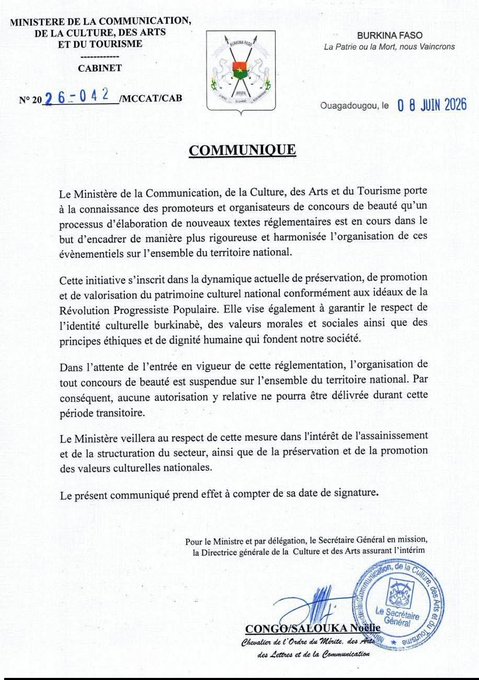
An official announcement has sent shockwaves through Burkina Faso. The government has indefinitely suspended all beauty pageants across the country, citing a commitment to preserving ‘cultural values’ and addressing the ongoing security crisis. However, this move is far from a mere administrative decision—it marks a troubling shift toward creeping authoritarianism.
Distraction as a political tool
In a nation grappling with profound security challenges and a deepening humanitarian crisis, the timing and target of this ban raise serious questions. Why target beauty contests when the immediate priority is reclaiming territory and restoring stability?
Observers across the region recognize this tactic: diverting public attention from unfulfilled promises. By imposing moral and social constraints, the authorities are attempting to shift the national discourse away from their failure to restore constitutional order and ensure security.
State puritanism as a mechanism of control
The prohibition of beauty pageants is not an isolated incident; it reflects a broader pattern of state overreach into private lives and individual freedoms. Cloaked in the language of ‘moral recalibration,’ the government is laying the groundwork for an intrusive moral order.
‘Today, they ban a beauty pageant in the name of values. What comes next? Will they outlaw a fashion style? A work of art? A school of thought?’, warns a human rights activist, speaking on condition of anonymity. Such restrictions on personal expression, leisure, and cultural activities are hallmarks of autocratic regimes. The method is insidious: no overt violence is used, yet decrees and regulations suffocate dissent under the guise of protection.
The slow suffocation of democracy
This development extends beyond the cancellation of a single event. It signals a systematic erosion of civic and democratic space in Burkina Faso. From the suppression of opposition parties to the silencing of independent media and the detention of dissenting voices, the assault now extends to cultural industries.
A disguised dictatorship reveals itself through its relentless intrusion into every aspect of life. By stripping young people and cultural actors of their platforms for expression and entertainment, the transitional government sends a clear message: ideological conformity is mandatory, and even aesthetic dissent will no longer be tolerated.
Beneath the rhetoric of sovereignty and moral guardianship, Burkina Faso is drifting toward a monolithic social structure where the state dictates every facet of life. This is not protection—it is authoritarianism in disguise.
