
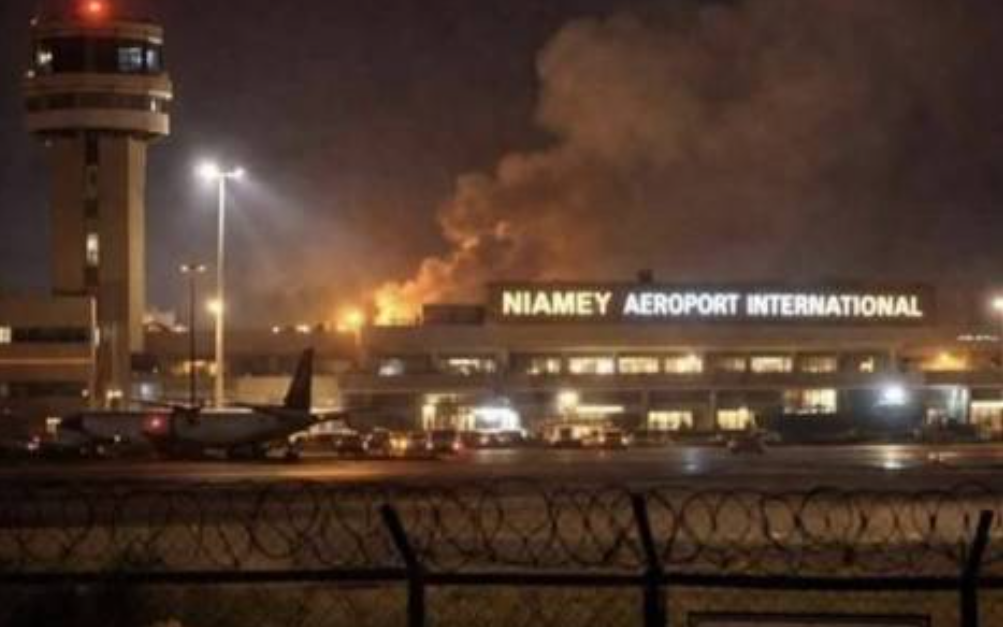
Gunfire erupted for nearly two hours this morning near Niamey’s international airport, leaving the capital tense and on edge. While clashes have subsided, the situation remains highly unstable, with security forces locking down key government sites and conducting sweeping raids. The incident has reignited fears over Niger’s deepening security crisis and the fragility of its transition.
Two hours of terror at the heart of the capital
Residents of Niamey awoke to a wave of automatic gunfire and explosions near the Diori Hamani International Airport. For nearly two hours, relentless exchanges of fire sent shockwaves through nearby neighborhoods, plunging the area into chaos. Eyewitnesses reported panicked motorists abandoning their vehicles in a desperate rush to find shelter.
Nigerien defense and security forces swiftly responded, engaging the attackers in a fierce firefight. The identities and motives of the assailants remain unclear, and no official casualty figures have been released by the ruling military authorities.
Capital locked down as security forces sweep the area
By mid-morning, the intensity of the clashes had waned, though the threat of further violence lingered. Special forces units have since secured the airport perimeter, conducting thorough sweeps to eliminate any remaining threats. The objective: fully securing the runway, terminal, and surrounding infrastructure while hunting down possible insurgents who may have fled or taken cover.
Meanwhile, Niamey has been placed under a strict security lockdown. Major roads leading to the presidential palace and prime minister’s offices have been sealed off by armored vehicles and heavily armed personnel. Access to the city center is now heavily restricted, with authorities urging residents to limit movement to essential activities. This drastic measure underscores the government’s growing unease over potential attempts to destabilize the transitional administration.
Niger’s long shadow of instability
This violent flare-up is not an isolated incident but part of a broader pattern of insecurity gripping Niger. Since the July 2023 coup, the country has faced a surge in complex attacks, not only along its borders but also within major urban centers.
The memory of the failed 2021 coup attempt—just days before the inauguration of former President Mohamed Bazoum—still looms large. Heavy weapons fire had once again rattled the presidential district. More recently, Niger has endured devastating ambushes by non-state armed groups in the Tillabéri and Diffa regions, particularly in the volatile ‘three borders’ zone. The Diori Hamani Airport, a critical logistical hub for both military and civilian operations, has long been viewed as a prime target by terrorist factions and dissident military elements.
A regional security dilemma
This morning’s assault highlights the formidable challenges facing Niger’s military-led government. Despite forming the Alliance of Sahel States (AES) with Mali and Burkina Faso, the promise of eradicating insecurity has yet to materialize. The porous borders and proliferation of rebel and jihadist factions continue to pose a grave threat to the country’s stability.
International observers and regional analysts are closely monitoring the situation. A prolonged destabilization of Niamey could have far-reaching consequences for the already fragile Sahel, where repeated humanitarian crises have left populations vulnerable.
While calm has partially returned to Diori Hamani Airport by late morning, critical questions remain unanswered. Who orchestrated the attack? What was their intended goal? As security forces continue their operations under an oppressive atmosphere, Niger holds its breath. This incident serves as a stark reminder that, despite official assurances, peace and security in the capital remain precariously balanced.