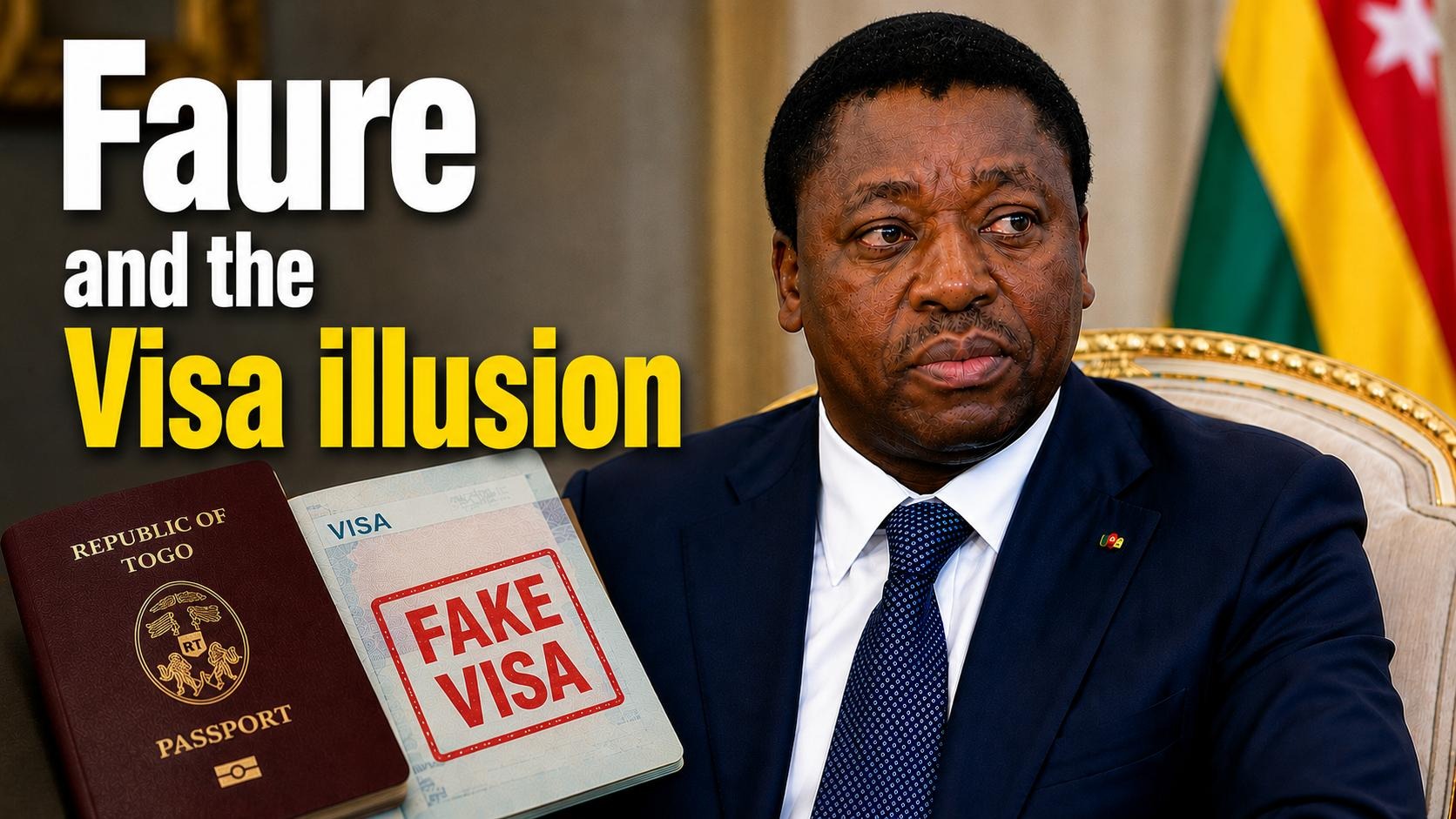
Togo’s visa exemption: a strategic manoeuvre with digital controls
Beneath the grand facade of an ‘Africa without borders’ meticulously presented by Lomé, the abolition of entry visas for Togo conceals a far less straightforward reality. This measure, a blend of political communication and stringent digital oversight, appears less as genuine openness and more as a calculated geopolitical strategy.
President Faure Gnassingbé is once again attempting to embody the role of a champion for pan-Africanism and regional integration. By declaring a visa exemption for all citizens of African nations, the Togolese government garnered significant global media attention. Initially, media professionals, entrepreneurs, and travelers perceived this as a revolutionary step towards unrestricted movement. However, upon closer scrutiny, the complexities, as is often the case, reside within the administrative minutiae.
An ostensible opening: the reality behind the declaration
On the surface, the policy is designed to be universal and to stimulate business and tourism:
- Beneficiaries: All citizens from African countries, provided they possess a valid national passport.
- Duration: Stays are capped at a maximum of 30 days.
- Entry Points: Theoretically applicable across all land, air, and sea borders of the nation.
At first glance, this initiative is appealing, positioning Togo alongside a select few African nations (such as Rwanda and Bénin) that have embraced comprehensive openness. Nevertheless, the practical implementation and the prevailing political climate raise questions regarding Lomé’s underlying objectives.
The illusion of ‘visa-free’: a bureaucratic rebranding
This is the critical element that transforms what appears to be an advancement into a subtle bureaucratic mechanism: ‘visa-free’ does not equate to ‘unrestricted access.’ The authorities have merely shifted the entry barrier from physical borders to a virtual realm.
To gain entry to Togolese territory, every traveler must undergo a rigorous prior digital screening:
- Mandatory registration on the official platform voyage.gouv.tg at least 24 hours before departure.
- Compulsory completion of an online travel declaration.
For many regional observers, this mandatory procedure closely resembles an ‘electronic travel authorization’ (akin to the American ESTA or the British ETA). Essentially, the government retains complete discretionary control over inbound flows. What assurance is there that this platform will not function as a political filter, denying access to critical journalists, human rights activists, or regional opposition figures under the guise of ‘incomplete applications’ or ‘security concerns’? The passport alone is no longer sufficient; the state’s algorithm now holds the ultimate decision-making power.
Faure Gnassingbé’s true agenda: diplomacy and oversight
What motivates such an elaborate presentation? This decision serves a dual agenda, both domestic and international, meticulously orchestrated by the head of state:
- A pan-African charm offensive: Following contested constitutional reforms that solidify his hold on power, isolating him democratically, Faure Gnassingbé seeks to bolster his international legitimacy. Projecting himself as a leader in African integration serves to divert attention from internal criticisms.
- Sustained migratory surveillance: By centralizing all traveler data on a single governmental platform 24 hours prior to arrival, the regime modernizes its surveillance apparatus. Lomé acquires an invaluable database profiling entrepreneurs, journalists, and influential figures entering the country.
Economic pragmatism infused with caution
While entrepreneurs and media professionals had hoped for a completely free circulation zone to invigorate exchanges, they now encounter a digitized bureaucracy. Although traditional visa fees are eliminated, the administrative burden persists in its entirety.
In conclusion, Togo’s visa exemption is not the proclaimed pan-African act of faith. Instead, it represents a geopolitical soft power instrument combined with a sophisticated digital filtering mechanism. Faure Gnassingbé offers with one hand what he controls with the other, demonstrating once more that under his administration, openness is only tolerated when it remains under strict supervision.
