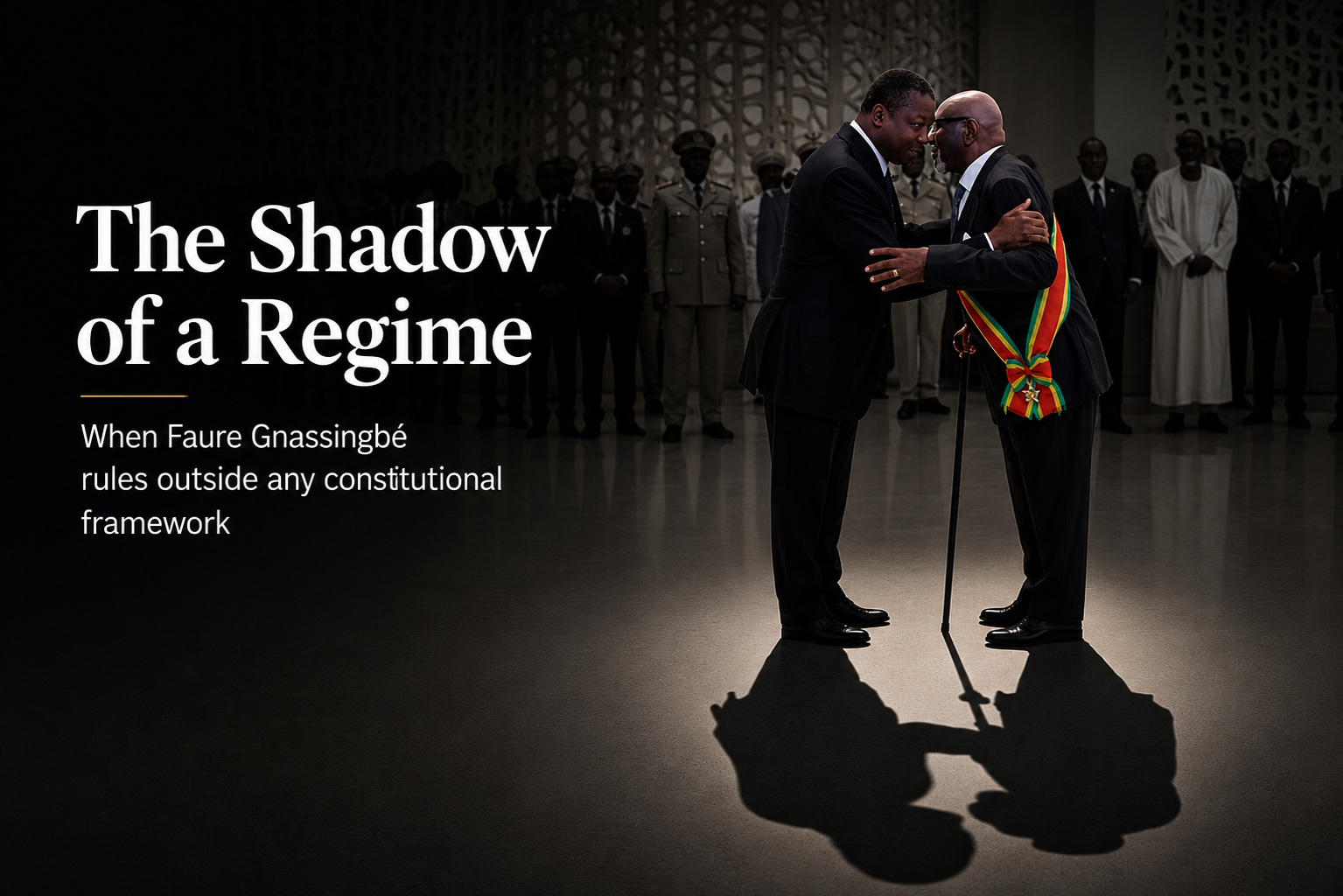
Togo’s constitutional upheaval: faure gnassingbé’s grip on power
The recent detention of two French nationals in northern Togo cast a stark light on the concerning trajectory of Togolese governance. Charged earlier this week following several days in the custody of intelligence services, their fate appears to have been sealed by direct instruction from Faure Gnassingbé himself. He reportedly personally directed his Minister of Justice, Pacôme Adjourouvi, to “yield to no pressure.”
Beyond its immediate diplomatic implications, this incident underscores a far more profound erosion: a complete loss of control over the nation’s governance. A fundamental question now looms over Togo: who truly holds power, and by what legitimate authority?
Upon closer examination, Faure Gnassingbé is no longer, strictly speaking, the President of the Togolese Republic. By orchestrating the adoption of a new Constitution and appointing a symbolic “President of the Republic” while reserving for himself the role of President of the Council, the authorities have engineered an unprecedented institutional arrangement. This represents a true institutional contrivance where titles become secondary to the raw exercise of power.
This maneuver signals a troubling deviation. Refusing to relinquish control of the state, the Togolese leader treats the nation’s fundamental law as if it were a deck of cards in a casino: rules shift according to convenience, and the hand is reshuffled whenever it no longer suits. By issuing direct directives to magistrates while sheltering behind tailor-made institutions, he confirms that the separation of powers has become nothing more than an artificial memory.
Togo is no longer merely contending with a contested constitutional transition; it is confronting a personalized exercise of power liberated from any republican logic. This is an explosive situation where arbitrary rule has definitively supplanted the rule of law.
An unprecedented institutional reconfiguration
The 2024 reform, enacted by a National Assembly dominated by the ruling party (UNIR), transformed the presidential system into a so-called “parliamentary” one. The President of the Republic (Jean-Lucien Savi de Tové) now performs a purely honorific role. All genuine executive authority—determining national policy, commanding the armed forces, making civil and military appointments, international representation, and regulatory power—has been transferred to the “President of the Council,” a position held since May 3, 2025, by Faure Gnassingbé himself.
This new position is not subject to any term limits. While the 1992 Constitution (as revised) restricted the president to two mandates, the new architecture permits unlimited tenure. The leader of the majority party automatically assumes the role of President of the Council. With UNIR securing 108 out of 113 parliamentary seats after the 2024 legislative elections (largely boycotted by the opposition), the outcome was predetermined. This is no longer democratic alternation; it is dynastic perpetuation under a new title.
The instrumentalisation of justice
The case involving the two French journalists (Sébastien Perez Pezzani and Gaël Mocaër), apprehended while filming for a France Télévisions program, is not an isolated incident. It fits into a pattern of actions where intelligence services and the Ministry of Justice operate under direct instructions. The alleged order to “yield to no pressure” exposes a chain of command that entirely bypasses judicial independence. When the head of the executive dictates the conduct of magistrates, the separation of powers ceases to exist.
This practice is not novel. It has been observed in the management of demonstrations in June 2025, in prosecutions against critical voices, and in the handling of other sensitive cases. The law has become a tool for political management, mobilized or neutralized according to the needs of the moment.
Eroding legitimacy
Who genuinely governs? The answer is clear: a man who inherited power in 2005, consolidated it for two decades, and then reshaped institutions to retain it beyond any previous constitutional limits. The Togolese populace was not consulted via referendum on this fundamental change. The legislative elections transpired in a climate of widespread protest and boycott. The Senate, with a third of its members appointed by the President of the Council, further reinforces this centralized control.
This is not a transition. It is a re-establishment of personal power under an institutional veneer. Titles may change, formalities may accumulate, but the ultimate decision-making authority remains the same: Faure Gnassingbé, now President of the Council, head of the majority, commander of the armed forces, and the final arbiter.
An explosive political landscape
When arbitrary rule displaces law, when institutions become hollow shells, and when justice submits to political directives, the social contract inevitably frays. Togo is no longer confronting a mere constitutional controversy. It faces a regime that has opted to govern outside any stable and predictable republican framework.
The question is no longer merely “who governs?” It has evolved into: how long can this system endure before its internal contradictions and popular pressure inevitably lead to its collapse?
