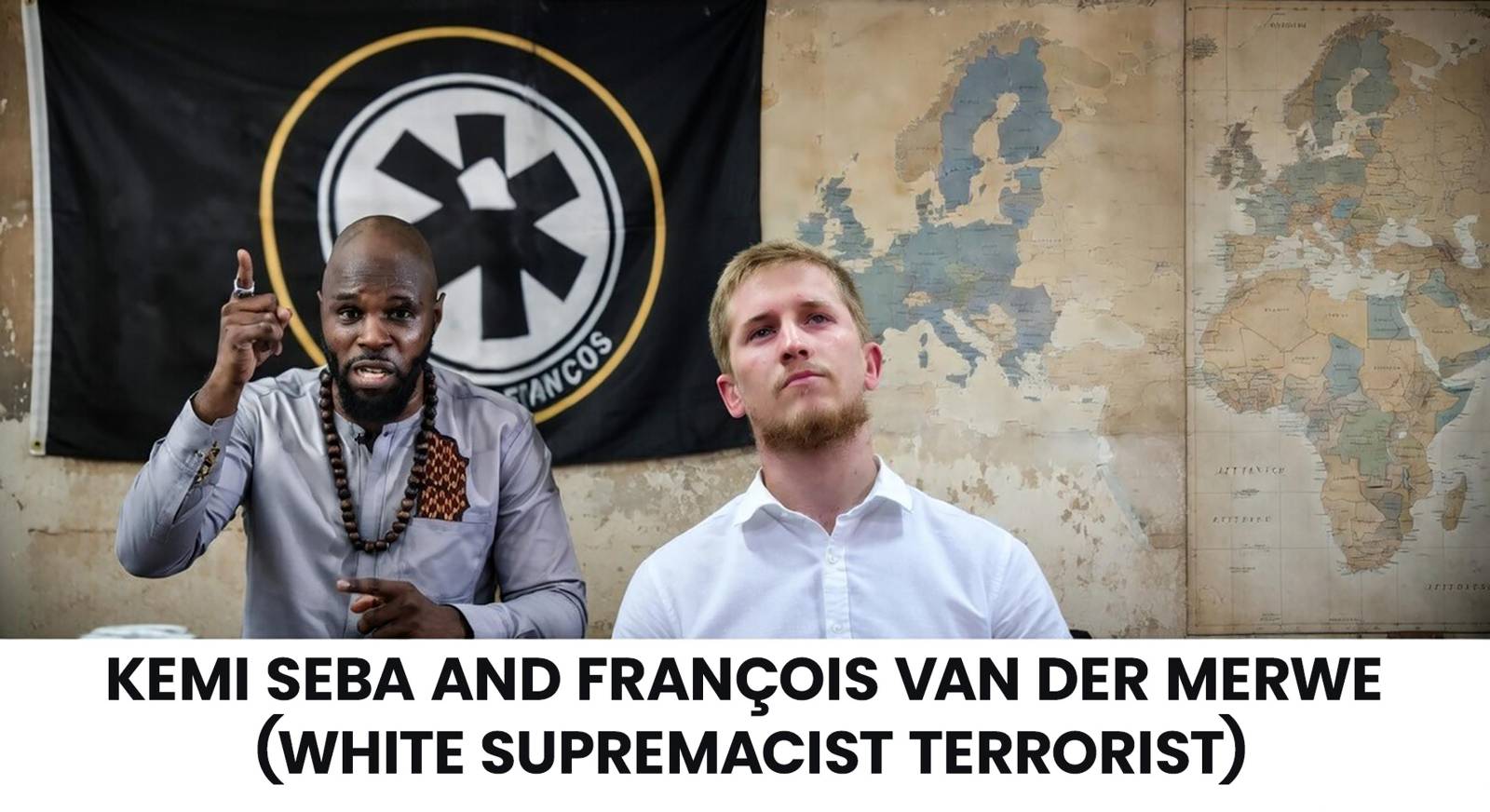
The unsettling alliance between kemi seba and a south african terrorist leader
Certain arrests do more than just stop a person; they reveal hidden truths. When Kemi Seba was detained in South Africa on Wednesday, April 15, the event fell into the latter category. The significance lies not just in his capture, but in the identity of his companion and the financial transactions that allegedly took place between them.
Seized alongside Seba was 26-year-old François van der Merwe. Born in Pretoria in 1998, Van der Merwe serves as the head of the Bittereinders, a group officially classified as a terrorist organization by South African authorities. To grasp the gravity of this partnership, one must examine the origins and radical objectives of the Bittereinders movement.
The radical roots of the Bittereinders
The group’s name is a callback to the final, extremist phase of the Second Boer War (1899–1902). During that conflict, the original Bittereinders were Boer guerrillas who refused to accept defeat against the British, viewing any peace treaty as a betrayal of their race and culture. Van der Merwe has intentionally revived this name to signal a continuation of that uncompromising struggle.
The modern iteration of the Bittereinders emerged following the murder of farmer Brendan Horner and the subsequent unrest in Senekal. Van der Merwe identified what he saw as a void in the activism of young Afrikaners. He filled that space with a movement rooted in a singular, dangerous belief: that Black political leadership in South Africa constitutes an existential danger to Afrikaner civilization.
A vision of racial exclusion
The organization’s goals are remarkably blunt. Van der Merwe campaigns for a Volkstaat—a sovereign, racially exclusive territory carved out of South Africa where Black citizens would be denied any rights or residency. This is a direct echo of the extremist Afrikaner nationalist demands from the early 1990s, when groups like the AWB used domestic terrorism and bombings to try and stop the transition to democracy. Van der Merwe is effectively the modern face of this violent legacy.
Since establishing the group in 2021, Van der Merwe has orchestrated numerous protests against the ANC and EFF. He rejects the post-Apartheid constitutional order, labeling it an “occupation” rather than a democracy. Furthermore, he views policies aimed at Black economic empowerment as a form of anti-white discrimination. Because of these views and the group’s activities, the State Security Agency maintains close watch over them. The Bittereinders are known to conduct paramilitary training, practicing tactical maneuvers and self-defense, often sharing footage of these sessions publicly.
A history of violence and legal trouble
Van der Merwe’s personal history is as volatile as his politics. In late 2023, he was arrested for a pub assault. While out on bail, he led a group of Bittereinders to a courthouse in Groblersdal, where he was arrested again after clashing with police and breaching security barriers. Despite facing charges of inciting violence, he remains defiant, frequently quoting the Afrikaner phrase “Soet is die Stryd” (Sweet is the Struggle), signaling his deepening commitment to the cause after each legal encounter.
This is the man Kemi Seba chose as an ally. More shockingly, it is the man to whom Seba allegedly provided a massive payout.
The clandestine payment and the Limpopo crossing
According to the Hawks, South Africa’s elite organized crime unit, Van der Merwe allegedly acted as a high-priced smuggler. Seba is accused of paying him approximately 250,000 rands (over 13,000 euros) to facilitate an illegal crossing of the Limpopo River into Zimbabwe. From there, Seba reportedly planned to make his way back to Europe.
This payment was not made to a lawyer or a legitimate travel agency, but to the leader of a designated terrorist group. Under South African law, providing funds to a terrorist entity is a major criminal offense, regardless of the intended use of the money. By allegedly placing this cash in Van der Merwe’s hands, Seba has entered a legal minefield.
The collapse of a political narrative
For years, Kemi Seba has cultivated an image as a champion of Black liberation and African sovereignty. His rhetoric centered on fighting Western supremacy and restoring dignity to the continent. However, this arrest exposes a massive ideological contradiction. The man he funded leads a movement that views Black South Africans as an obstacle to be removed and sees their democratic rights as an injustice against white civilization.
The Bittereinders’ ultimate solution is a return to a system indistinguishable from Apartheid. For an activist who claims to represent the interests of Black people to bankroll a white supremacist leader is more than a legal crisis—it is the total destruction of his public credibility.
Kemi Seba now faces a daunting array of charges, including conspiracy, illegal immigration, and the potential financing of terrorism. As the judicial process moves forward, the activist must also face a historical reckoning: the reality that his actions have directly supported the very systems of racial exclusion he claimed to oppose.
