The Sahel juntas’ struggle against JNIM’s growing dominance
The illusion of strength crumbles as the Sahel’s military regimes face their limits
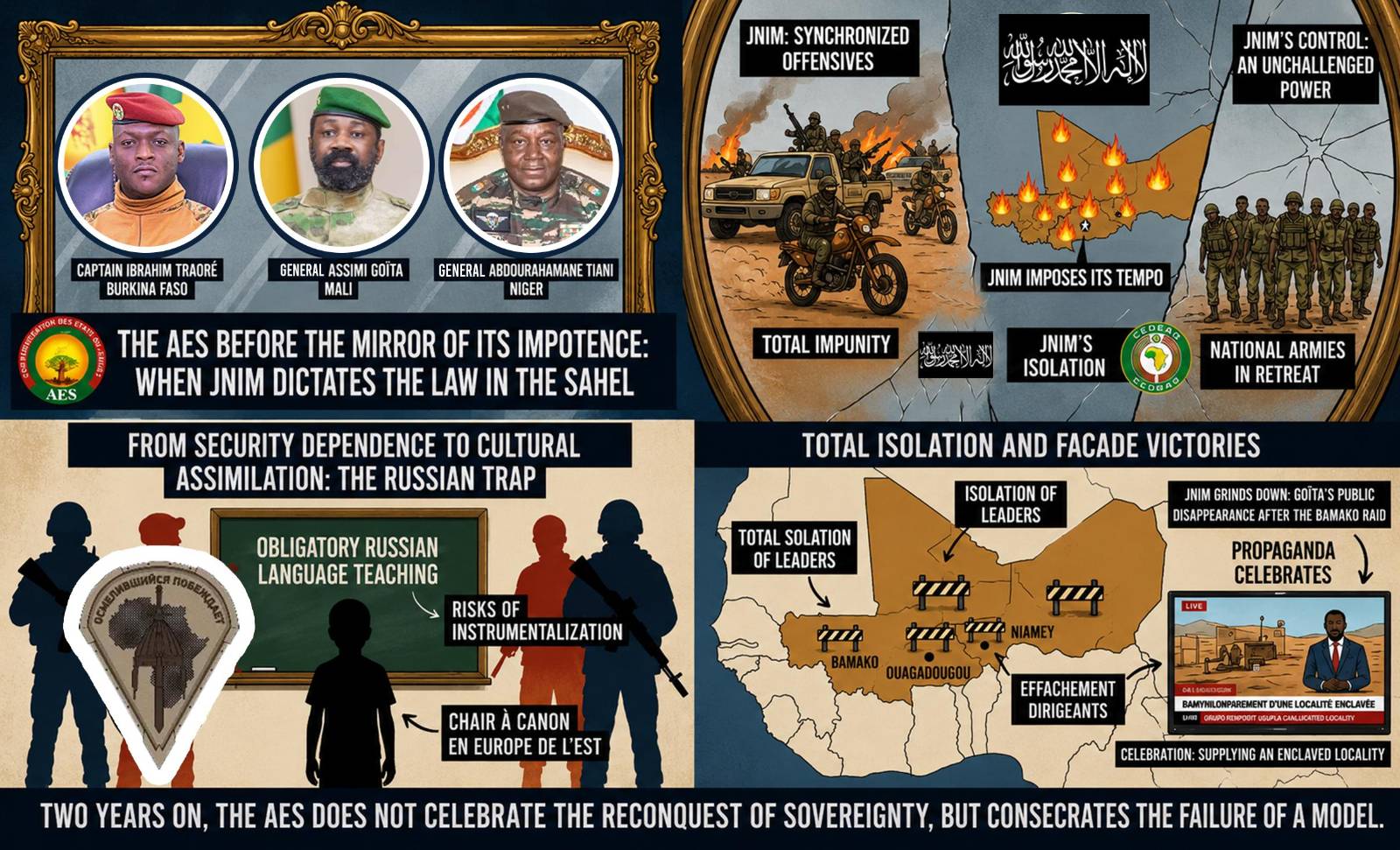
Two years after the Alliance of Sahel States (AES) was formed with great fanfare, the cracks in its facade are impossible to ignore. Beneath the bold declarations of sovereignty and the fiery rhetoric from the juntas in Bamako, Ouagadougou, and Niamey, the harsh reality on the ground remains unchanged: the only truly coordinated and effective force capable of dictating its own pace and striking at will across the region is the Group for the Support of Islam and Muslims (JNIM).
Terrorism’s tactical superiority exposes the AES’s weaknesses
The political amateurism and grandiloquent posturing of the military regimes have collided head-on with the relentless efficiency of the jihadist network. The JNIM orchestrates large-scale, synchronized offensives, targeting multiple critical regions simultaneously and overwhelming national armies that are, on paper, better equipped. Despite the theoretical pooling of intelligence resources within the AES and the wholesale geopolitical alignment with Moscow, the bleeding has not stopped.
From military dependence to cultural assimilation: the hidden costs of Moscow’s embrace
Faced with this security void, Captain Ibrahim Traoré and his counterparts have chosen to tether their nations’ futures to Russia. Yet this partnership has evolved far beyond mere military cooperation or the presence of Wagner Group remnants (now rebranded as the Africa Corps). The announcement that Russian will be introduced into Burkinabè school curricula starting next term signals a profound ideological shift. Marketed as an act of cultural decolonization, this decision instead serves as a subtle but deliberate psychological and structural preparation for the nation’s youth.
The implications of this linguistic shift extend far beyond the classroom. By embedding Russian into education, the regime is laying the groundwork for deeper integration of future generations into Moscow’s sphere of influence. The long-term risk is stark: these young people, once sent to Russia under the guise of education or academic training, could be exploited. Amidst a global climate of confrontation, the concern is justified: the Sahel’s youth may be turned into cannon fodder or human shields in conflicts in Eastern Europe that hold no relevance for them, all to repay Russia’s military support to the juntas.
The JNIM tightens its grip as the AES stumbles into irrelevance
As this cultural transition unfolds, the JNIM continues its relentless campaign. By paralyzing the three regimes, the armed group has succeeded in isolating their leaders almost entirely. In Mali, the extended public disappearance of Assimi Goïta following the deadly Bamako raid that reportedly claimed the life of the Defense Minister stands as the most glaring example of this isolation.
The verdict is clear: while terrorists steadily carve out territory, the military leaderships sink deeper into political absurdity. Today, official propaganda channels trumpet the mere resupply of a remote village or a routine defensive skirmish—an admission of their own impotence.
Two years in, the AES’s legacy is one of failure, not triumph
In its second year, the Alliance does not celebrate the restoration of sovereignty but instead underscores the collapse of a flawed model. By confusing wartime propaganda with military strategy and trading one dependency for another—shifting from the West to a cultural and military subjugation to Moscow—the juntas have allowed the JNIM to set the agenda. The Sahel has not freed itself; it has merely exchanged one master for another, with its youth paying the price.
