Tchad’s street vendors and the hidden cost on children
Tchad’s street vendors and the hidden cost on children
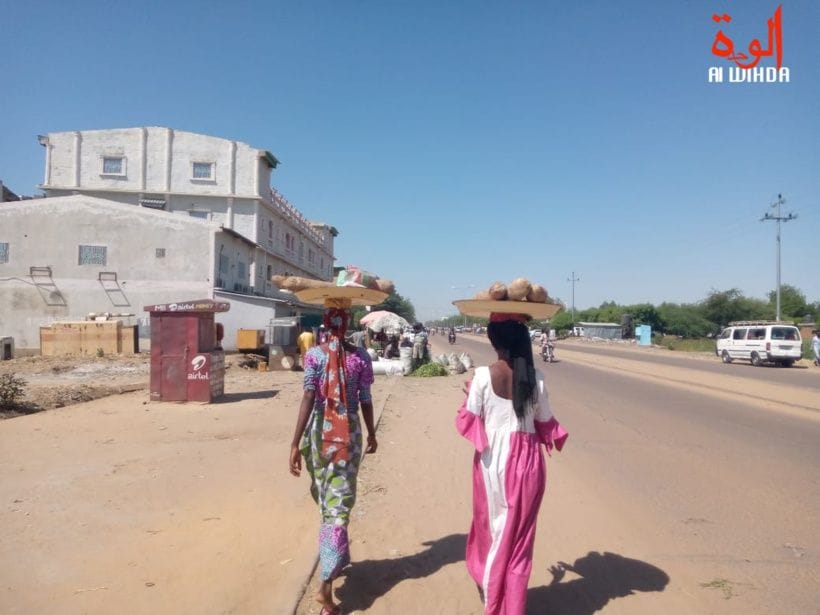
N’Djamena, Moundou, Abéché — The sun rises over the bustling markets of Tchad as waves of women emerge, their heads bowed under the weight of baskets brimming with fresh fruit, sizzling snacks, and vibrant fabrics. They navigate the narrow alleys, dodging motorcycles and pedestrians, their voices rising above the din of commerce. This is not just a scene of survival—it is a testament to resilience, yet one shadowed by a growing concern: the children caught in the currents of this economic tide.
Freedom on the streets, but at what price?
Aïcha, in her early thirties, wipes sweat from her brow as she balances a tray of roasted peanuts on her head. Her youngest child clings to her back, while her older ones dart between the stalls, eyes wide with curiosity. “It’s not easy,” she admits, “but at least we eat. That’s what matters.” Nearby, Fanta kneels by a makeshift stove, flipping dough into golden-brown flatbreads. Her five-year-old son plays unattended in the dust, a discarded plastic bottle his only toy. These women, once confined to household chores, now command the streets—negotiating prices, carrying goods, and carving out a fragile independence. But independence for mothers often comes at a cost for their children.
The silent struggle of Tchad’s youngest
The marketplaces of Tchad are alive with color and noise, yet beneath the surface, a quieter crisis unfolds. Children as young as five or six are pulled into the fray, their small frames burdened with water jugs or bundles of goods. Some cough from the smoke of open fires, others nap in the shade of a passing stranger’s shadow. A local resident in Abéché recalls a recent encounter: “I saw a seven-year-old boy, his arms shaking under the weight of a bucket of water, shouting for spare change while his mother haggled over a sack of millet. School? For many, it’s a distant dream now.”
The streets of Tchad’s major cities—N’Djamena, Moundou, Abéché—are becoming classrooms of a different kind. Here, education is replaced by bartering, and childhood is traded for survival. The women who once depended on husbands or fathers now stand tall, but their children often stumble in their wake, robbed of opportunities that should be their birthright.
An uncertain future
Every dawn, the cycle repeats: mothers rise before the sun to secure their spots in the market, while their children adapt to a world where schoolbooks are swapped for sales pitches and playgrounds are replaced by dusty roads. The economic empowerment of women in Tchad is undeniable, yet the question lingers—will the next generation pay the ultimate price for their mothers’ liberation?
In the heart of Tchad’s markets, a paradox takes shape. Women forge paths to independence, but the road is paved with the unmet needs of their children. The future remains unwritten, but the stakes could not be higher.
