
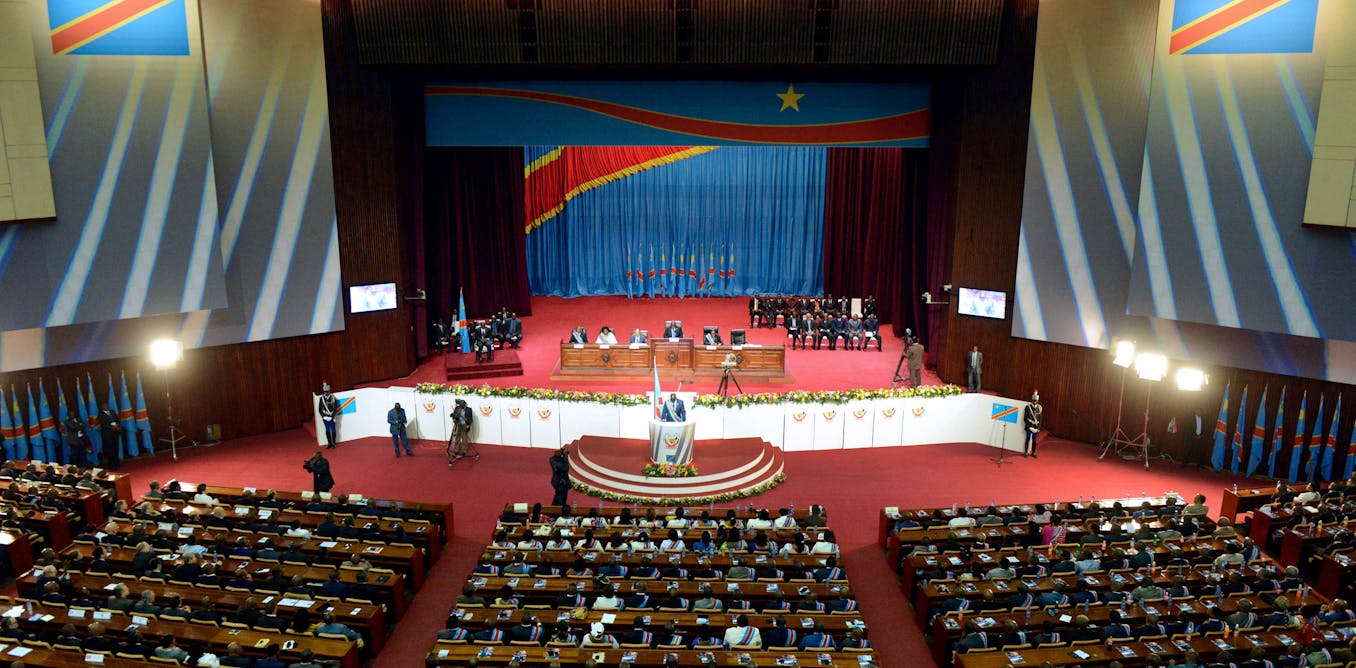
In May 2026, a video circulating across social media platforms laid bare the entrenched sexism plaguing Congo’s legislative chambers. The footage captured Micheline Mpundu, a national deputy, concluding her address before exiting the podium. As she left, Christophe Mboso, then-second vice president overseeing the session, publicly commented on her appearance from the rostrum: “Thank you, colleague, she is very beautiful… isn’t she?”
He continued in Lingala, “Take a good look at her,” laughing heartily while gesturing with his hands to mimic her body shape. Adding, “God made her this way” and “she belongs to someone else,” his remarks were met with roaring laughter and applause from the chamber. The session proceeded as if nothing untoward had occurred. It was only after public outcry from political figures, human rights activists, and internal pressure from his own ranks that Mboso issued a delayed apology—without facing any disciplinary action.
This incident underscores a pressing question: when will African parliaments, particularly Congo’s, cease to be hostile spaces for the women they are meant to represent?
Sexism in parliament: a structural issue, not an isolated incident
My doctoral research in political science examines masculinity within Congo’s legislative bodies, comparing these dynamics across Africa. The Mboso incident is not a one-off lapse in decorum but a symptom of systemic sexism. The disparity between Congo’s legal commitments to gender equality and the reality for women lawmakers is glaring. While the constitution guarantees equal rights, the chamber remains a space where women are reduced to their physical presence rather than their political contributions.
Violence against women in politics is not unique to Congo. In 2016, a global survey by the Inter-Parliamentary Union (IPU) revealed that over 65.5% of female parliamentarians across 39 countries had endured repeated verbal abuse and insults. These figures highlight a disturbing trend: women in legislatures are often judged not on their policies but on their appearance, marital status, or adherence to traditional roles. The IPU’s 2021 regional study on African parliaments confirmed that progress remains painfully slow, despite increased female representation.
When Mboso mocked Mpundu’s body, the applause from the chamber was far from trivial. It exposed a culture that tolerates and even normalizes such behavior—a system that philosopher Kate Manne describes as a mechanism to keep women subordinate. This is not just about one man’s words; it reflects a broader pattern where women are treated as bodies first and legislators second.
Comparing Africa’s parliaments: a pattern of misogyny
Congo’s parliament is not alone in its tolerance for sexism. In Senegal, Deputy Amy Ndiaye was physically assaulted in 2022 while visibly pregnant, an attack captured on camera. In Nigeria, Senator Natasha Akpoti-Uduagha was suspended in 2025 not for professional misconduct but for speaking out against sexual harassment by the Senate president. These cases—spanning three nations—reveal a disturbing truth: while African parliaments may allow women’s voices, they still deny them dignity.
Sexism in Congo’s parliament: a timeline of abuse
Congo’s legislative halls have long been a battleground for gender-based humiliation. In April 2020, former Senate President Thambwe Mwamba publicly shamed Senator Bijoux Ngoya during a session, insinuating she had made inappropriate advances to secure his support for her candidacy as Senate Quaestor. The accusation, aired nationally, sparked chaos and outrage.
In July 2021, Deputy Christelle Vuanga was silenced mid-debate by a colleague’s blunt remark in Lingala: “You are a woman.” The dismissal reduced her political argument to nothing more than her gender. Mboso’s actions in 2026 were not an anomaly but a continuation of a culture that refuses to change.
Despite Congo’s ratification of international conventions and adoption of progressive laws—such as the 2025 Senate bill on gender-based violence—implementation remains absent. The gap between policy and practice is stark. Until accountability is enforced, Congo’s parliament will remain a misogynistic institution, even as women constitute 51% of the population and 13% of its deputies.
Can Congo break the cycle of parliamentary sexism?
Simone de Beauvoir’s 1949 observation—that women are perpetually defined as “the other”—still holds true in Congo’s parliament. Female lawmakers are often reduced to their bodies rather than their legislative contributions. This systemic erasure undermines democracy from within.
Other parliaments have taken steps to address sexism. Campaigns like #NotTheCost (NDI) and #NotInMyParliament (European Parliament) prove that cultural change is possible through concrete sanctions and victim protection. Congo has strong laws, but without enforcement, they are mere words. Failing to hold Mboso accountable sends a clear message to Congolese women considering political careers: their dignity is negotiable.