Senegal’s intensified anti-lgbtqia+ laws raise human rights alarms
As Brussels prepares to mark the 30th anniversary of its Pride Parade this Saturday, May 16, celebrating three decades of advocacy for visibility and equality, a stark contrast emerges in Sénégal. In Dakar, a much bleaker reality challenges global discussions on human rights; a newly enacted law has formalized the persecution of LGBTQIA+ individuals, establishing Sénégal as one of Africa’s most repressive nations.
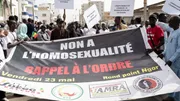
Demonstrators hold a sign reading “no to homosexuality” during a protest demanding the criminalization of homosexuality in Dakar, Sénégal, on May 23, 2025.
President Bassirou Diomaye Faye has signed into law legislation that extends the maximum sentence for “unnatural acts” from 5 to 10 years in prison. Fines have also seen a tenfold increase, now reaching up to 10 million Francs CFA (over 15,000 euros). Prime Minister Ousmane Sonko championed this bill as a matter of “sovereignty.” The Assemblée Nationale sénégalaise unanimously approved the text on March 11, 2026, with 135 votes in favor and none against, sealing the fate of thousands.
Lynchings and a climate of terror
The ramifications of this law are immediate and severe. In recent weeks, more than a hundred individuals suspected of homosexuality have been apprehended. Some alleged offenders are reportedly choosing imprisonment over facing the brutal wrath of vigilante mobs seeking to impose their own “justice.” One young man, speaking anonymously, shared his profound fear: “Every moment, you think they could come for you. You are forced to live in hiding. Being constantly afraid is no way to live.“
He further elaborated that this public animosity is fueled by those in power: “They have been led to believe that to be more devout, one must detest a homosexual. That if you kill a homosexual, you will go to paradise. Whether you love women or men? That is a personal matter. It concerns you and only you and God.“
Paranoia and fear are rapidly spreading throughout the nation. The recent arrest of a French engineer sent shockwaves through the expatriate community. A friend of the engineer described the arrest as a “raid,” noting, “When we learned the circumstances of the arrest, it shocked us even more: they knocked on the door, he opened it, and they seized him. The tactic they use is, in fact, a sweep.” This incident underscores that no one is safe from arbitrary detention.
Political and religious maneuvering
This surge of animosity is being instigated by the highest echelons of power. The religious group And Sàmm Jikko Yi, instrumental in lobbying for the law’s passage, labels homosexuals as a “public danger.“
Its president, Imam Babacar Sylla, baselessly asserts that they “deliberately spread diseases” and openly admits to a lack of empathy for the LGBTQIA+ community. This inflammatory rhetoric has been adopted by the government to deflect attention from a worsening economic recession, by portraying homosexuality as a “Western import” that clashes with traditional sénégalaise values.
A regression of human rights
The International Federation for Human Rights (FIDH) has issued a dire warning. “A law like this protects no one; it further exposes already vulnerable individuals to violence, arbitrary arrests, and humiliation,” stated Drissa Traoré, the organization’s Secretary-General, in a press release. This legislation also imperils freedom of expression by criminalizing any form of “promotion” or support for LGBTQIA+ rights.
Furthermore, HIV testing rates are plummeting. An anonymous source from a sénégalaise LGBTQIA+ rights organization told a news agency that “People will be afraid to have condoms and lubricant within their reach, and they will be afraid to protect themselves, and thus afraid to get tested for fear of being tracked or prosecuted. When someone is HIV-positive, it will now be very complicated to get them to seek treatment.” This regression threatens decades of progress in public health.
Sénégal is not an isolated case: 31 of Africa’s 54 countries criminalize homosexuality, as do 21 nations in Asia. This intensified repression marks a dark turning point. On a continent where Uganda and Nigeria are already recognized as among the worst offenders, Sénégal, once a beacon of stability, now joins the exclusive club of states where sexual orientation can lead to a decade behind bars. For those affected, exile or silence are increasingly becoming the only viable options.
