
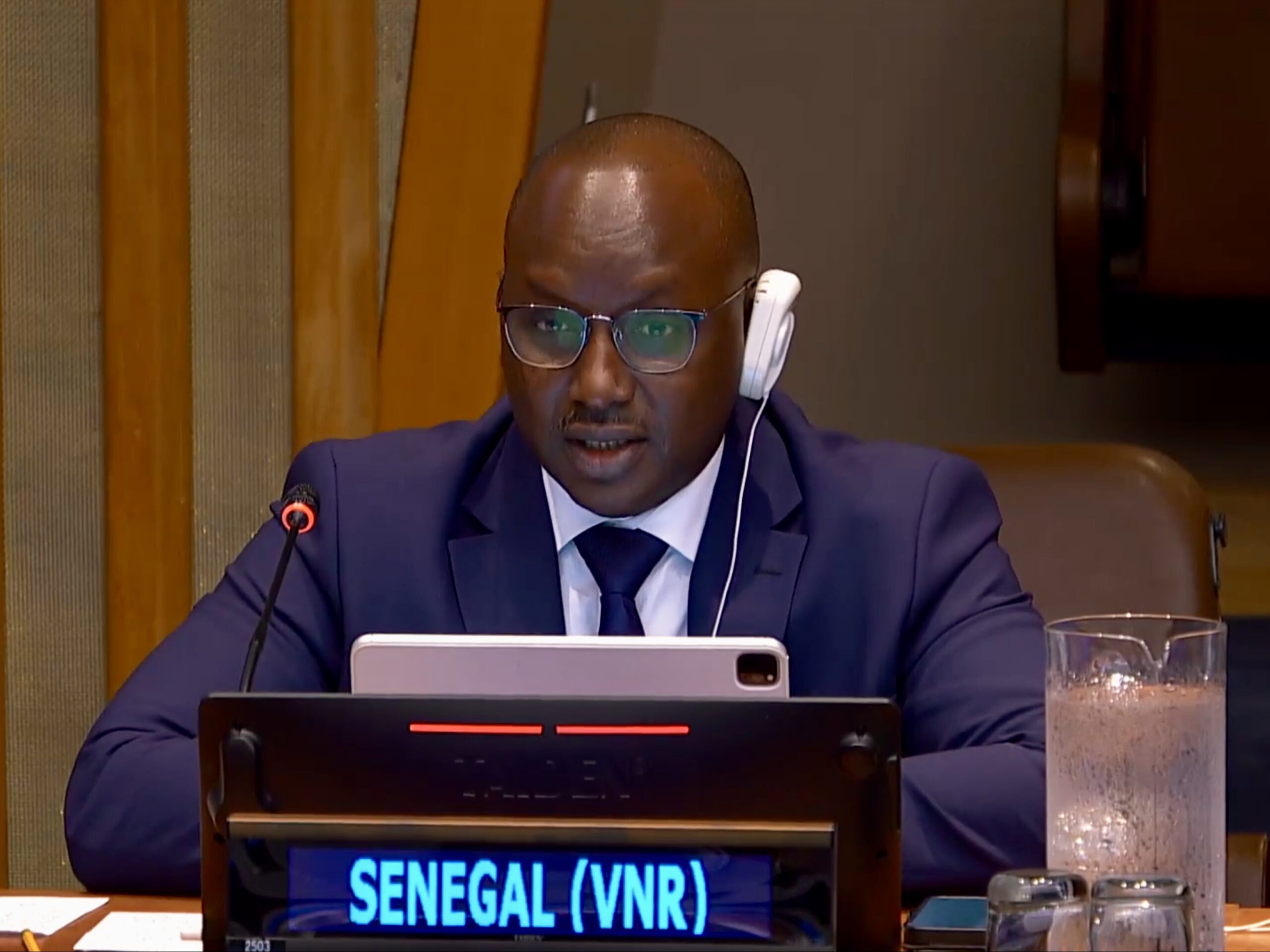
The year 2026 marked a significant milestone for Senegal as it presented its third National Voluntary Review (NVR) at the United Nations High-Level Political Forum on Sustainable Development in New York. On July 13, Cheikh Tidiane Dièye, Minister of Hydraulics and Sanitation, outlined the country’s achievements over the past decade in advancing the 2030 Agenda for Sustainable Development.
Senegal’s journey toward sustainable development goals
From July 7 to 15, 2026, the UN High-Level Political Forum convened under the theme of transformative, equitable, and innovative action for the 2030 Agenda. Five Sustainable Development Goals (SDGs) took center stage: clean water and sanitation, affordable and clean energy, industry innovation and infrastructure, sustainable cities and communities, and global partnerships for development.
Senegal, one of 36 countries presenting its review this year—including ten from West and Central Africa—shared the spotlight with Cabo Verde and Italy. This year’s review underscored the country’s commitment to regularly assessing its progress toward the SDGs through a participatory approach involving government ministries, local authorities, civil society, the private sector, and the UN system.
« Since our first National Voluntary Review in 2018 and our second in 2022, this third review reflects our dedication to tracking the implementation of the 2030 Agenda, » Dièye stated. « The contributions of all stakeholders have shaped a review that captures our national realities. » Innovations included alternative reports by civil society, consultations with disability associations, and the first-ever comprehensive Local Voluntary Review conducted by the city of Pikine.
Tangible progress in key sectors
A National Voluntary Review is a self-assessment conducted by a country to evaluate progress toward the 17 SDGs. Governments highlight achievements, identify gaps, and share lessons learned with the international community. These reviews are presented at the UN High-Level Political Forum, the primary platform for monitoring the implementation of the 2030 Agenda.
The SDGs are embedded in Senegal’s national transformation agenda, « Senegal 2050, » and the National Development Strategy (NDS) 2025-2029. Nearly 93% of SDG indicators are tracked through the national monitoring and evaluation system, including an annual joint review that fosters dialogue and accountability.
Water and sanitation: nearly universal access
Access to clean water has seen remarkable progress. In urban areas, potable water coverage now stands at 97.8%, while rural areas have reached 96%, an increase of nearly nine percentage points over the past decade. Sanitation improvements have been even more pronounced in rural regions, rising from 37.5% to 64.5% since 2015, while urban coverage increased from 62.5% to 73.65%.
Energy transition: electrification and renewable growth
Electricity access has expanded dramatically, from 62% in 2015 to 86% in 2024. Renewable energy now accounts for 29.1% of installed capacity, up from just 3% in 2016, with a national target of 40% by 2030. Urban transport has also transformed, with the Dakar Regional Express Train (TER) transporting 23.1 million passengers in 2025, a tenfold increase over the previous decade. The fully electric Bus Rapid Transit (BRT) system alone prevents over 53,000 tons of CO2 emissions annually.
Urbanization challenges and economic resilience
Despite these gains, Senegal faces pressing challenges. Over half of the population now lives in urban areas, where a housing deficit of nearly 500,000 units persists. Public debt stands at 116.1% of GDP, though domestic revenue mobilization has improved significantly, funding 69.7% of the national budget in 2026 compared to 54.8% in 2015. Air quality in Dakar has also improved, with fine particle levels dropping from 35 to 21.8 micrograms per cubic meter.
Strategic priorities for 2030
Looking ahead, Senegal outlined four key acceleration levers for the SDGs:
- Economic transformation: Focusing on eight strategic sectors, territorial hubs, and special economic zones.
- Water and sanitation security: Through the National Water Security Compact.
- Climate action and renewable energy: Aligning with the updated Nationally Determined Contribution (NDC 3.0).
- Sustainable financing: Strengthening partnerships, including continued cooperation with the International Monetary Fund (IMF), and implementing a National Transition Strategy to graduate from the least developed country category.
Global dialogue: transparency, migration, and governance
The interactive dialogue that followed highlighted both praise and probing questions from fellow delegations. The Gambia commended Senegal’s enduring relationship and asked about efforts to enhance transparency and combat corruption. Dièye emphasized the role of institutions like the National Anti-Fraud and Corruption Office (OFNAC), the National Financial Intelligence Unit (CENTIF), and the new Financial Judicial Pool. He noted Senegal’s removal from the Financial Action Task Force (FATF) gray list in October 2024 and its confirmation in June 2026 as tangible progress.
Spain inquired about the role of the diaspora in development. Dièye highlighted the mutual benefits of migration, citing remittances, skill transfers, and economic linkages. He stressed that well-governed migration fosters sustainable development through balanced cooperation between countries of origin, transit, and destination.
Ireland even extended congratulations to Senegal’s national football team, the Lions of Teranga, for their recent World Cup performance.
In closing, Dièye reaffirmed Senegal’s unwavering commitment to the 2030 Agenda. « We remain fully engaged in implementing this agenda and will continue this path with the international community, » he concluded.