
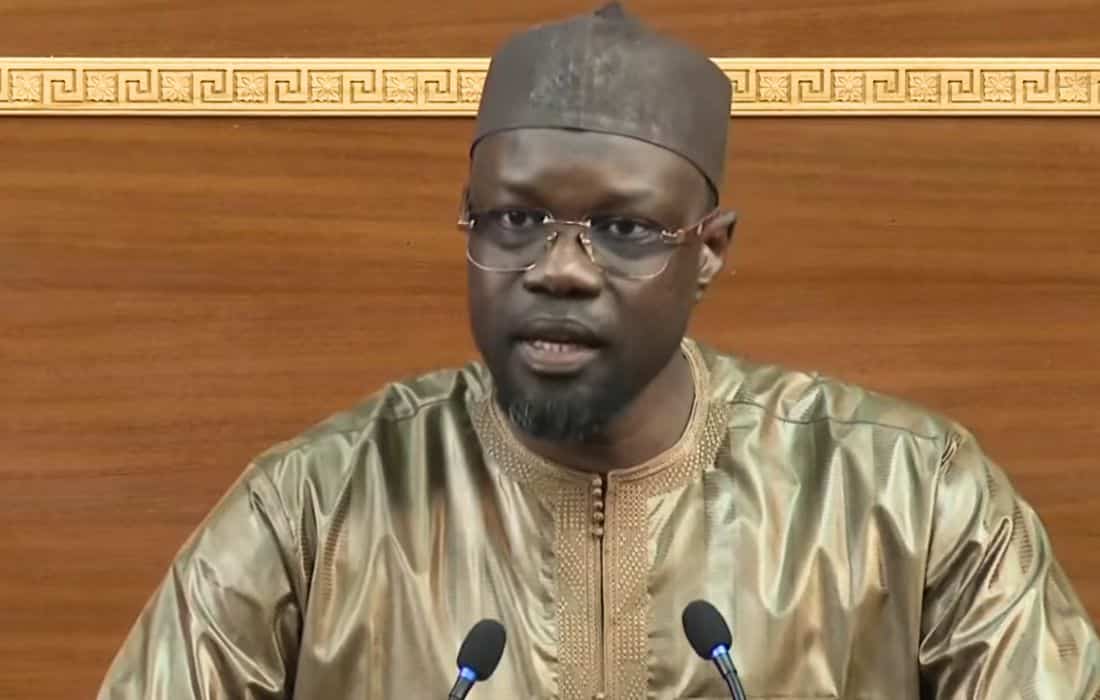
The Prime Minister of Sénégal, Ousmane Sonko, recently addressed Sénégal’s National Assembly, sharply criticizing what he termed the « diktat » of Western nations. In his speech, he went further, accusing the West of attempting to « impose homosexuality » on sovereign nations. His remarks come at a time of escalating political tensions between national autonomy and human rights, particularly as Sénégal tightens its legal stance on same-sex relationships.
This rhetoric reflects a growing trend in Sénégal, where opposition to Western pressure has become a central theme in political discourse. The country’s stance on LGBT rights is increasingly framed as a matter of national sovereignty versus external interference, with the rights of sexual minorities caught in the crossfire.
In early 2026, Sénégal further hardened its laws against same-sex relations, increasing penalties to between five and ten years in prison. This legislative shift coincides with a climate of heightened social stigma and reports of arrests, as documented by local and international human rights groups.
LGBT rights in Sénégal spark heated public debate
The conversation surrounding LGBT rights in Sénégal remains deeply polarizing, especially on social media platforms. Public reactions often echo slogans such as « we will not be dictated to », « these are our values », and « mind your own business ». These responses underscore a recurring tension: the clash between national identity and universal human rights.
In this debate, LGBT rights are frequently framed as a foreign imposition, while legal restrictions are justified in the name of cultural tradition or national pride. This narrative shift obscures the lived realities of LGBT individuals in Sénégal, reducing their struggles to a political talking point rather than a human rights issue.
Harsh penalties and social consequences for LGBT individuals
Sénégal’s legal system criminalizes same-sex relationships under its Penal Code. The 2026 amendments have intensified these penalties, now carrying sentences of up to ten years imprisonment. However, the impact of this legislation extends beyond courtrooms.
Human rights organizations warn that the criminalization of LGBT identities fuels widespread stigma, arbitrary arrests, and violence against sexual minorities. For many, the debate is no longer just about legal technicalities—it is about survival, dignity, and the ability to live without fear.
Why international concern over LGBT rights in Sénégal matters
Critics often question why international groups focus on LGBT rights in Sénégal. The answer lies in the universal nature of human rights. When individuals face persecution or violence because of their sexual orientation, it transcends national borders. It is a matter of fundamental dignity, security, and, in extreme cases, life itself.
To ignore such violations would mean accepting that human rights protections end at a country’s frontier—despite the fact that these rights were designed to be universal and inalienable.
Human rights: a matter of global commitments, not foreign imposition
Contrary to popular belief, human rights are not an external imposition. They are grounded in international treaties and agreements that states voluntarily ratify. Sénégal itself enshrined these principles in its 2001 Constitution, explicitly referencing the Universal Declaration of Human Rights as a cornerstone of its legal framework.
In this context, advocating for LGBT rights is not an attempt to impose a foreign model. It is a call to uphold commitments already made by the state. The issue is not one of cultural interference but of protecting individuals from real and immediate harm.
LGBT identities are woven into senegalese society
A persistent myth suggests that LGBT identities are alien to African societies or the result of foreign influence. This claim is not only inaccurate—it erases the lived experiences of countless individuals.
LGBT people exist in every society, including Sénégal. They are born, work, and contribute to their communities. Their presence is not a recent import but a longstanding human reality. Historical and anthropological evidence, such as the existence of goor-jigeen figures in Sénégal, further disproves the notion that non-conforming gender and sexual identities are foreign constructs.
Navigating cultural pride and human dignity in the LGBT debate
The discourse on LGBT rights in Sénégal is entangled in broader tensions: colonial legacies, domestic politics, and deep-seated social prejudices. In this environment, human rights advocacy is often dismissed as external pressure, while legal restrictions are justified under the banner of tradition or cultural purity.
Some public narratives go even further, framing LGBT individuals as a « threat » or a « cancer » on society. Such rhetoric does more than spark disagreement—it dehumanizes those at the center of the debate, reducing complex lives to simplistic, hostile labels.
Defending rights without imposing change
Organizations advocating for LGBT rights in Sénégal emphasize that their mission is not to impose foreign values but to protect individuals from violence, exclusion, and legal punishment based on their identity. Behind debates about sovereignty and interference lie real people facing real dangers.
No one should live in fear because of who they are. This principle is universal—and non-negotiable.
Global solidarity in defending human rights
Human rights violations are not confined to Sénégal. They occur worldwide, from Russia to China and beyond. Human rights groups respond based on local context, available resources, and urgent needs on the ground.
Focusing on one crisis does not diminish others; it reflects where immediate action is possible. The fight for human rights is both contextual and universal—its principles remain constant, even as its application adapts to different realities.
Taking action: support for LGBT victims in Sénégal
In response to these challenges, a campaign has been launched to provide direct assistance to LGBT individuals in Sénégal who are victims of violence. This initiative offers legal support, emergency aid, and a lifeline to those targeted by discriminatory laws.
Supporting such efforts turns awareness into action. It provides tangible help to those living under the shadow of criminalization, ensuring their voices are heard and their rights protected.