
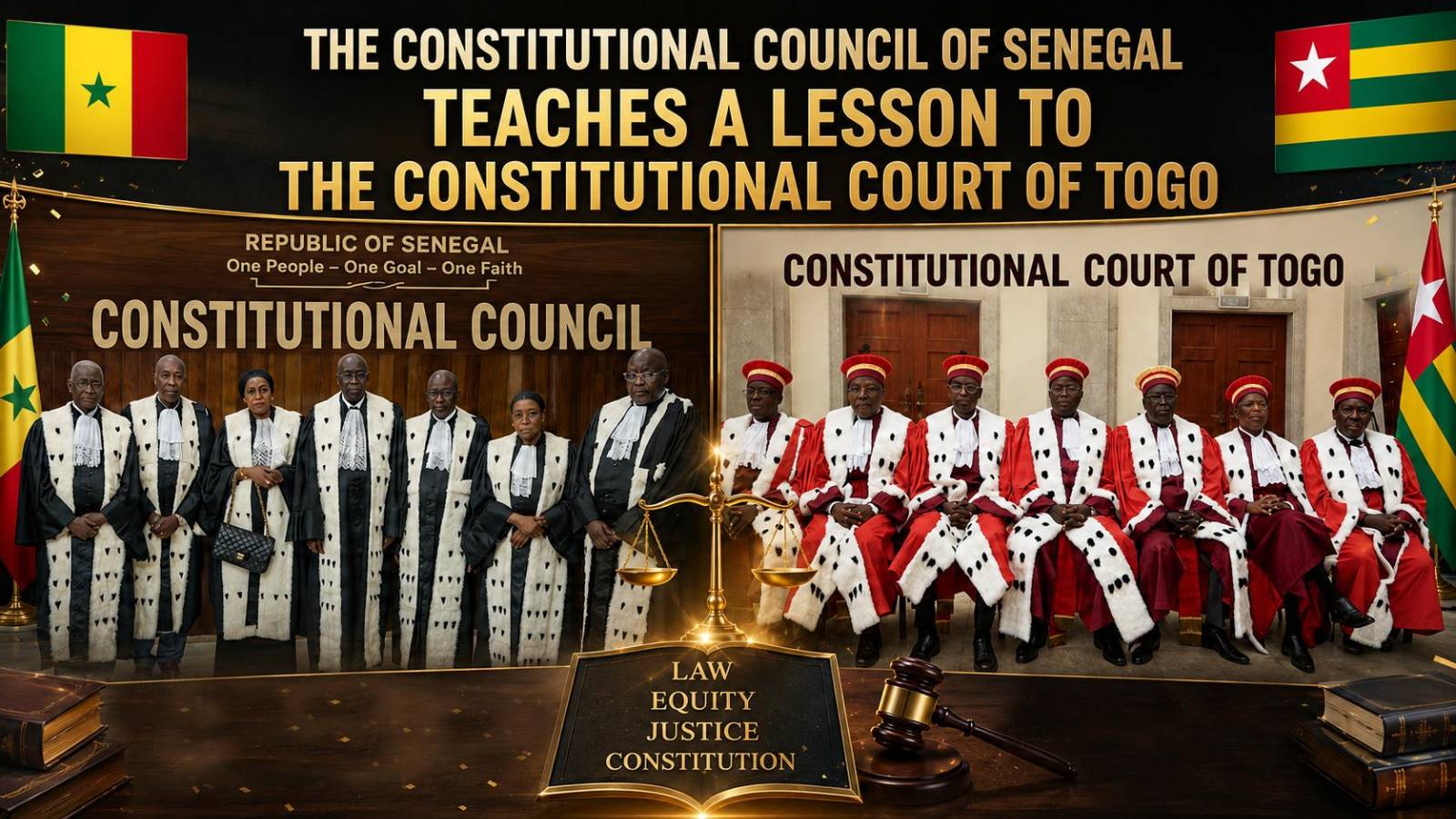
The constitutional courts of Dakar and Lomé have recently highlighted two starkly contrasting approaches to the rule of law in West Africa. While one institution has reaffirmed the supremacy of the Constitution, the other has been criticized for aligning with political decisions. These divergent paths underscore fundamental questions about the role of judicial institutions in safeguarding democracy.
independent judiciary as a safeguard against political crises
In Senegal, the Constitutional Council’s recent decision to block a constitutional amendment proposed by the government serves as a powerful reminder that no political majority is above the law. The ruling, which came despite strong parliamentary support, demonstrates that even electoral victories have constitutional limits. By prioritizing the Constitution over political expediency, the Council has reinforced the notion that the rule of law applies equally to all, regardless of their position in government.
This judicial boldness has broader implications. It not only preserves legal integrity but also strengthens public trust in institutions. Citizens are more likely to respect democratic norms when they see courts acting without fear or favor. Such predictability fosters political stability, economic confidence, and international credibility—factors that are critical for attracting investment and maintaining regional partnerships.
In contrast, Togo’s Constitutional Court has faced scrutiny for validating sweeping constitutional changes amid widespread political opposition. Critics argue that the reforms lacked broad national consensus, transforming the Constitution from a social contract into a tool for political maneuvering. When judicial bodies appear to endorse constitutional revisions driven by short-term political gains, they risk eroding public faith in the very institutions meant to protect citizens.
the dangers of constitution-making as political strategy
A Constitution is not merely a legal document; it is the foundation of a nation’s social and political order. When revisions are perceived as serving narrow political interests rather than the public good, they set a dangerous precedent. Future governments may follow suit, altering institutional rules to consolidate power, thereby perpetuating instability and undermining democratic alternation.
The consequences extend beyond domestic politics. International observers, including investors and multilateral organizations, closely monitor how countries handle constitutional reforms. A stable and credible legal framework enhances a nation’s reputation, while perceived instability can deter foreign engagement. Senegal’s approach, characterized by judicial independence, sends a reassuring signal to external partners. Togo’s experience, however, raises concerns about whether its institutions can truly act as impartial arbiters.
what the contrast reveals about democratic resilience
The contrasting trajectories of Senegal and Togo highlight a critical truth: the strength of a democracy lies not in the frequency of its constitutional amendments, but in the willingness of its institutions to enforce the law impartially. A Constitution’s value is measured by how effectively it constrains power—not by how often it is rewritten to accommodate it.
Senegal’s judicial assertiveness demonstrates that an independent judiciary can prevent crises by acting as a check on executive overreach. Togo’s experience, meanwhile, shows the risks of a judiciary that appears to prioritize political alignment over constitutional fidelity. The two cases serve as a lesson for the region: lasting democratic stability depends on institutions that serve the law, not the powerful.