
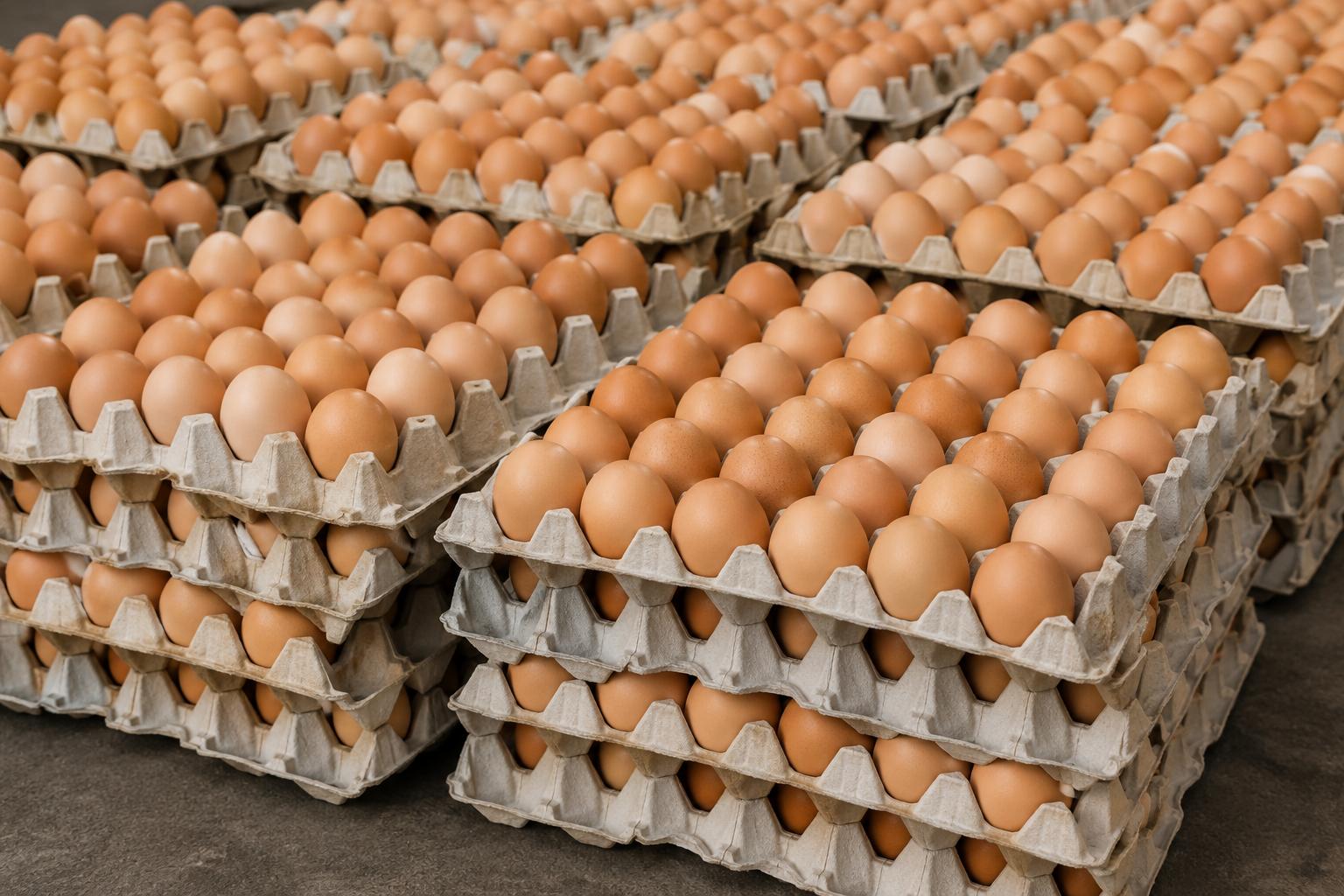
A sweeping government decision has left Burkina Faso’s poultry sector reeling, as officials moved to cap the retail price of eggs at 100 F CFA per unit. The policy, jointly announced by the Ministry of Trade and the Ministry of Animal Resources, sets a wholesale price of 2,600 F CFA per tray for distributors and 2,750 F CFA for retailers. While framed as a safeguard for household purchasing power, the move is widely seen as an assault on private enterprise and the very survival of an already struggling industry.
When price controls ignore production costs
Setting a fixed selling price without addressing the surge in input costs is an unsolvable puzzle for poultry farmers. Egg production relies heavily on feed—corn, soybean meal, cottonseed cake, and mineral supplements—whose prices have spiraled upward in recent months. Inflation, transport bottlenecks, and supply chain disruptions have pushed these essential inputs beyond affordable levels, leaving producers with no margin for profit.
By imposing a price ceiling without subsidizing feed, the government effectively forces farmers into a losing game. Producers now face a stark choice: sell at a loss or shut down operations entirely. Arbitrary price caps do not magically reduce expenses; they simply erase profitability, turning what should be a viable business into a financial liability.
Breaking the backbone of private initiative
The principle of free enterprise rests on the freedom to set prices based on real-world costs and market demand. When the state overrides this freedom by dictating pricing policies from above, it does not regulate—it suffocates. Entrepreneurs who have invested millions in infrastructure, borrowed heavily, and hired local workers now see their ability to recoup costs stripped away by a decree that ignores their financial reality.
Why would any business owner take such risks if the government reserves the right to cap revenues while ignoring soaring operational expenses? The message is clear: initiative is welcome, but only as long as it conforms to rigid, centrally planned limits. Such an approach stifles innovation, discourages investment, and sends a chilling signal to the private sector.
The inevitable consequences: scarcity and black markets
History shows that artificial price controls rarely deliver the intended benefits. Instead, they often trigger unintended crises. The poultry sector in Burkina Faso now faces three immediate threats:
- Collapse of small producers: Unlike large industrial farms, small-scale poultry farmers lack the financial cushion to absorb losses. Many will be forced to close, eliminating thousands of jobs across the country.
- Reduced output: To avoid losses, farmers will likely scale back their flocks, shrinking the national supply of eggs.
- Emergence of underground markets: As official supply dwindles, eggs will vanish from store shelves. Consumers will then turn to black markets where prices far exceed the regulated 100 F CFA—ironically making eggs even less affordable for ordinary households.
A smarter path to affordable eggs
Ensuring that eggs remain within reach of Burkinabè families is a worthwhile goal, but it cannot come at the expense of those who produce them. The solution lies upstream, not in price caps. The government’s role should be to reduce feed costs through subsidies, tax exemptions on poultry inputs, or low-interest loans for farmers. These measures would lower production costs directly, allowing the market to settle at a fair price without distorting competition.
Fixing egg prices while ignoring the soaring cost of feed is economic folly. It sends a dangerous signal to investors: that private enterprise is at the mercy of decrees disconnected from economic reality. To rescue Burkina Faso’s poultry sector and secure its food sovereignty, the only sensible path forward is to lift these price controls and support production instead of stifling it.