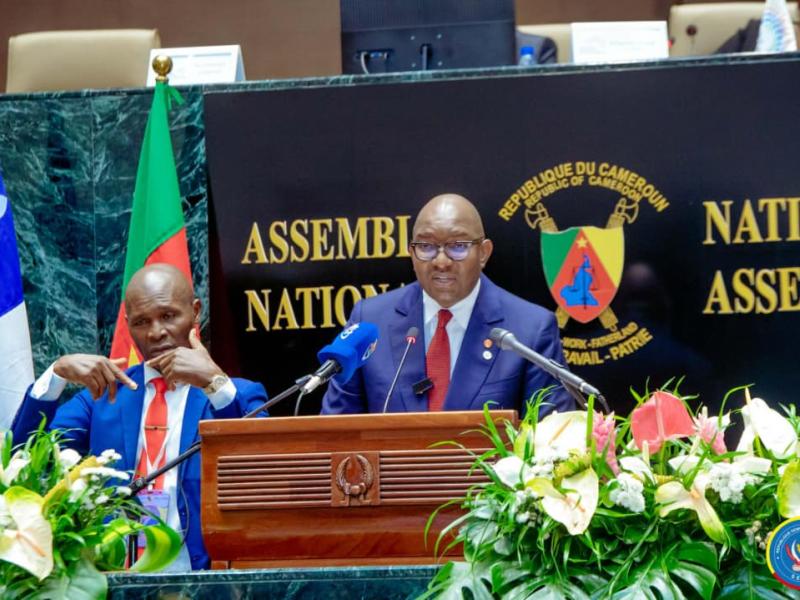
Sama Lukonde highlights DRC as a ‘solution country’ at APF/Yaoundé amid ecological fallout from Rwanda-backed M23
DRC’s ecological leadership and Rwanda-backed M23 crisis dominate APF/Yaoundé talks
- Politics
The 51st session of the Francophonie Parliamentary Assembly (APF) held in Yaoundé from July 6 to 11, 2026, became a platform for Jean-Michel Sama Lukonde, President of the Democratic Republic of the Congo’s Senate, to champion his nation’s ecological contributions while condemning the environmental devastation wrought by the Rwanda-backed M23-AFC insurgency in eastern DRC.
Addressing over 300 parliamentarians from 42 national, subnational, and interparliamentary sections across the Francophonie, Sama Lukonde positioned the DRC as a “solution country”, emphasizing its pivotal role in global climate stability. He underscored the country’s vast natural assets—most notably the Congo Basin, the world’s second-largest tropical rainforest—and highlighted initiatives like the Kivu-Kinshasa Green Corridor, a 500,000 km² project aimed at bolstering global climate resilience.
Yet, the Senator’s optimism was tempered by warnings of ecological catastrophe unfolding in eastern DRC. He accused Rwanda of orchestrating an “unjust aggression” through its proxy forces, the M23-AFC, whose military campaigns have left a trail of environmental destruction. According to Sama Lukonde, the conflict has poisoned water resources, annihilated wildlife, and triggered mass deforestation, exacerbating the climate crisis while displacing millions.
“Climate stability cannot be achieved while war ravages and plunders our natural resources,” he declared, urging the Francophonie community to prioritize peacebuilding and support the Washington Accords.
The Senate President concluded by advocating for a Francophonie climate pact, rooted in solidarity and the empowerment of forest-adjacent communities. He also announced the DRC’s endorsement of Julianna Lumumba’s candidacy for the leadership of the International Organisation of La Francophonie (OIF).
The Yaoundé gathering, co-hosted by the Cameroonian APF section, featured intensive deliberations across permanent commissions and thematic networks, covering pressing issues from democracy and governance to socio-economic and environmental challenges. Parallelly, the 11th edition of the Francophonie Youth Parliament (PFJ) convened, bringing together 61 young delegates from 29 Francophone sections alongside representatives from the OIF and Agence Universitaire de la Francophonie (AUF).
