Rising militant threats expose Mali’s junta security failures in the Sahel
rising militant threats expose Mali’s junta security failures in the Sahel
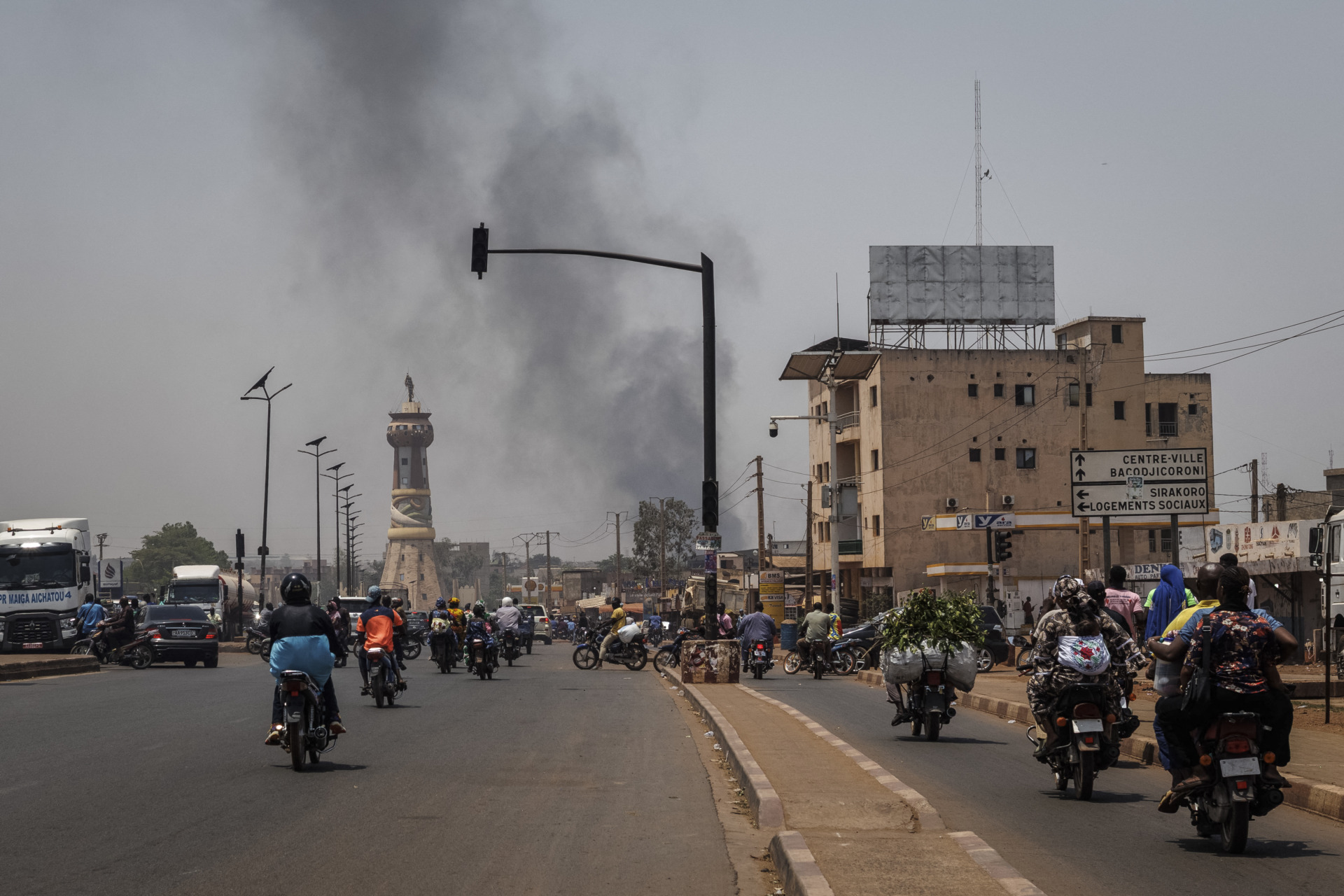
Before dawn on April 25, explosions and sustained gunfire shattered the quiet around Kati, a key military base 15 kilometers northwest of Bamako, Mali’s capital. Within hours, coordinated assaults launched by the jihadist coalition JNIM and the Tuareg separatist FLA spread across the country. By the following day, the ruling junta announced that Defense Minister Sadio Camara had died from injuries sustained during an attack on his residence. Reports later emerged suggesting that the junta’s intelligence chief, Modibo Koné, may also have been killed or gravely wounded in the same wave of violence. Despite these setbacks, the junta insisted the situation was under control, a claim sharply contradicted by the ongoing nationwide fighting.
These coordinated attacks represent the most direct challenge to junta leader Assimi Goïta’s authority since he seized power in the 2020 coup. The offensive comes at a time when the military regime’s credibility is already severely weakened. JNIM’s months-long blockade, which began last September, has choked off essential food and fuel imports from Senegal and Côte d’Ivoire by targeting over 130 fuel tankers. The blockade has forced school closures across Mali and left the country grappling with severe shortages. In March, the junta denied releasing more than 100 JNIM prisoners to secure a temporary truce allowing fuel convoys to resume ahead of Eid al-Adha. Together, the blockade and recent attacks underscore how JNIM’s influence extends beyond traditional battlefield tactics.
a tactical alliance with deep roots
In 2012, a similar coalition of jihadist and separatist forces routed Malian troops across the country’s north. The alliance initially united the Tuareg separatist MNLA with jihadist factions like AQIM and Ansar Dine. Many Tuareg fighters had returned from Libya after the fall of Muammar Gaddafi’s regime, bringing weapons and combat experience. Though the alliance briefly succeeded in capturing vast territories, it fractured violently as jihadist factions turned on their Tuareg partners once Malian forces were expelled from the north.
The recent offensive marks the first major coordinated assault by JNIM and the FLA in over a decade. While their objectives align with those of their predecessors, their alliance appears tactical rather than strategic. Long-term tensions between the groups make a permanent merger unlikely, but for now, they share a common goal: exposing the Malian state’s inability to protect its institutions. For JNIM, the offensive is part of a broader strategy to erode the junta’s will and resources until the regime collapses from within.
the russian security partnership under scrutiny
General Camara, who led Mali’s defense ministry, was the primary architect of the country’s partnership with Moscow and the key figure behind the initial deployment of the Wagner Group at the end of 2021. This move contributed to the expulsion of French forces in 2022 and the withdrawal of the UN peacekeeping mission in 2023, both deployed in 2013 to prevent jihadist advances toward Bamako. Following the death of Wagner leader Yevgeny Prigozhin in August 2023, the group was reorganized under the Russian Ministry of Defense and rebranded as Africa Corps.
However, Africa Corps has shifted its focus from combat operations to training and advisory roles, prioritizing the preservation of Russian influence over direct military engagement. According to the Armed Conflict Location and Event Data (ACLED) project, battles involving Russian fighters in Mali decreased from 537 in 2024 to 402 in 2025, averaging just 24 incidents per month by early 2026. The ongoing conflict in Ukraine has further strained Russia’s capacity to sustain even this reduced level of involvement in Mali.
the fall of Kidal and its regional implications
The distinction between Wagner’s combat-focused approach and Africa Corps’ advisory role is critical to understanding the events in Kidal. In November 2023, Malian forces and Wagner fighters captured the city after a decade under jihadist control, a victory that bolstered the junta’s partnership with Moscow. However, following the April 25 attacks by JNIM and the FLA, Africa Corps withdrew from Kidal without resistance, surrendering the city’s strategic gains.
The retreat from Kidal highlights the broader challenges facing the Alliance of Sahel States (AES), formed by Mali, Burkina Faso, and Niger. The juntas in these countries expelled Western partners, arguing that such alliances had failed to deliver security. They withdrew from ECOWAS and established their own defense pact, the AES. Yet, the security environment in the region has deteriorated measurably under their leadership, and the scale of the recent attacks has exposed the growing risks of this approach.
regional instability and the future of Sahel security
Since 2012, military coups in the Sahel have been justified under the pretext of insecurity, with at least five unconstitutional seizures of power. Three removed democratically elected presidents, including Mali’s Amadou Toumani Touré in 2012 and Ibrahim Boubacar Keïta in 2020, while another removed Burkina Faso’s Roch Marc Christian Kaboré in 2022. In 2022, Burkina Faso’s Lieutenant Colonel Paul-Henri Sandaogo Damiba was overthrown after failing to improve security, a fate that now looms over Mali’s junta leader, Assimi Goïta.
Goïta’s grip on power has weakened significantly. The death of Defense Minister Camara removes a key rival within the junta but also creates a vacuum in Mali’s security architecture at a time when the regime’s legitimacy is already eroding. In May 2025, the junta dissolved all political parties, and the military-appointed transitional council granted Goïta a renewable five-year presidential term, extending his rule until at least 2030. A failed coup attempt in August exposed divisions within the military, with dozens of soldiers, including two generals, arrested for plotting against the regime. The recent offensive may deepen these fractures, as officers blame the junta for its failure to anticipate the coordinated attacks.
The chances of a palace coup or junior officer mutiny have risen, particularly after the fuel blockade exacerbated public discontent. The Russian partnership was supposed to serve as a safeguard for the junta, but the events of April 25 have forced Mali’s leaders to reconsider whether Moscow can still deliver on its promises.
Mali’s shifting alliances and u.s. leverage
For nearly a decade, Mali was the centerpiece of U.S. efforts to counter terrorism and violent extremism in the Sahel. Coups in 2012 and 2020 led to the suspension of most foreign assistance under Section 7008 of the U.S. congressional appropriations bill, which prohibits funding for governments that seize power through military coups. However, recent signals suggest the Trump administration may reconsider this stance. In February, the Treasury Department lifted sanctions on three senior Malian officials, including the late defense minister, originally imposed in 2023 for facilitating Wagner’s activities in Mali. This move followed a visit by the State Department’s Africa lead to Bamako to explore reviving bilateral relations and discussing intelligence-sharing, drone surveillance permissions, and access to critical minerals like lithium and gold.
The recent offensive paradoxically increases U.S. leverage in Mali. The junta’s Russian partner has been publicly humiliated by the militant assaults, and the central premise of the junta’s security strategy is now visibly faltering. Reports indicate that Washington was already exploring a minerals-for-security deal with Bamako before the weekend attacks, possibly inspired by the agreement signed with the Democratic Republic of the Congo in December. This deal offered economic and security cooperation in exchange for access to the country’s critical mineral reserves and involved private security actors like Erik Prince’s Vectus Global. Such an arrangement could serve as a template for re-engaging Sahelian juntas.
The April 25 offensive confirmed what JNIM’s trajectory has long suggested: the junta’s approach is failing. The group’s capabilities have expanded to include drone warfare, economic sabotage, and a regional network that transcends national borders. Meanwhile, the Malian state has fewer resources and less legitimacy to draw upon, and no credible regional security architecture exists, especially after the AES states withdrew from ECOWAS last year.
regional reactions to Mali’s crisis
Mali served as Russia’s gateway into the Sahel, and the reputational damage from the April 25 offensive will resonate with other African governments that have looked to Moscow for security guarantees. The Alliance of Sahel States marketed its approach as a more effective alternative to Western-led security partnerships. Other members of the alliance are closely watching as the credibility of the junta model is put to the test.
Beyond the Sahel, Africa Corps has sought to expand its influence in the Central African Republic, where President Faustin-Archange Touadéra has resisted transitioning away from Wagner, whose units have been integral to his personal security. Russian military instructors from Africa Corps also arrived in Madagascar following the Gen Z uprising and subsequent coup in late 2025. Both governments sought Russian engagement for regime protection, but the events in Mali may prompt these and other Russia-curious governments to reassess their calculus.
Even before the weekend’s events, Russia’s credibility was already waning. Its inability to prevent the collapse of the Bashar al-Assad regime in Syria and the U.S. rendition of Venezuelan leader Nicolás Maduro in January underscored the limits of Moscow’s ability to deliver for its partners. With Africa Corps’ humiliating withdrawal from Kidal, regimes that have courted Russian security cooperation can now draw their own conclusions about the true value of such partnerships under sustained pressure.
