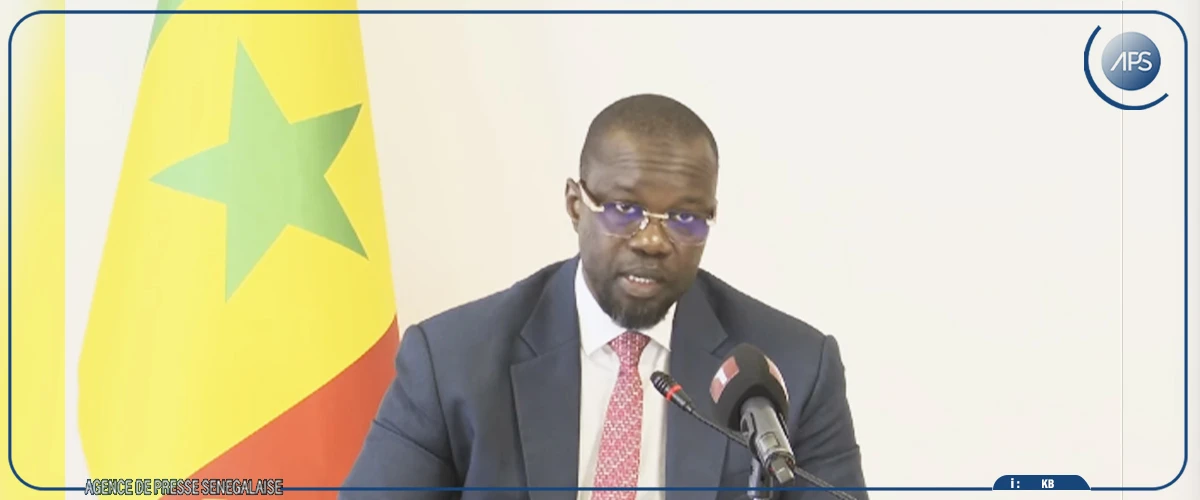
Prime minister ousmane sonko urges acceleration of Senegal’s infrastructure projects
SENEGAL-GOVERNMENT
Dakar, May 21 – Senegal’s Prime Minister, Ousmane Sonko, issued a strong directive to his cabinet members on Thursday in Dakar, emphasizing the critical need to finalize and activate ongoing infrastructure developments within their respective ministries.
“Regarding maritime and port facilities, I urge the Minister of Fisheries and Maritime Economy to implement the necessary measures for their swift and appropriate operationalization, particularly through public-private partnerships,” stated Sonko in an official document released by the Prime Minister’s Office following an inter-ministerial council focused on infrastructure.
This initiative specifically targets significant maritime projects including the Foundiougne-Ndakhonga port, the Ndangane Sambou fishing wharf in the central region, the upgraded landing point at Soumbédioune, and the processing sites located in Rufisque, to the west.
Also included in this directive are the dredging vessels operated by the National Agency for Maritime Affairs in the central regions of Kaolack and Fatick.
The government has identified a substantial portfolio of 62 “stalled” infrastructure projects. Among these are the Sine-Saloum El Hâdj Ibrahima Niass University, various open digital spaces, regional airports in Saint-Louis, Matam (north), and Kolda (south), the container terminal at Nadayane port (west), cold storage facilities, and the memorial dedicated to the “Le Joola” ferry disaster.
The comprehensive reconstruction of Dakar’s Aristide-Le-Dantec Hospital also stands out as one of these critical “blocked” endeavors, as highlighted by the Prime Minister.
“Adherence to all required quality standards”
A forthcoming committee, tasked with inventorying current infrastructure projects and monitoring the inter-ministerial council’s resolutions, will “take appropriate financial, administrative, and legal steps to restart and complete” the stalled projects, according to the Prime Minister. He reassured the public that the completion of these 62 projects would strictly adhere to “all necessary quality and cost requirements.”
Prime Minister Sonko also addressed technical concerns related to water, electricity, and telecommunications networks for the projects underway. “I demand that all ministers henceforth ensure, in the planning and execution of infrastructure projects, the proper integration of technical aspects related to water, electricity, and telecommunication networks, their adequate equipment, and the definition of appropriate operational models for sustainable management and maintenance,” he asserted.
Furthermore, Sonko expressed concern over the progress of youth and citizenship centers under construction in Tivaouane, Mbour (west), Linguère, Ranérou (north), Bambey, Diourbel, Kaolack (center), and Tambacounda (east). He instructed the relevant ministries—Youth, Finance and Budget, and Local Authorities—to “finalize their equipment and take the necessary steps for their commissioning by November 30, 2026, at the latest.”
The inter-ministerial council also reviewed the 11 “Naatangué” village farms being developed in the Fatick, Kaolack (center), Louga (north-west), Thiès (west), and Tambacounda (east) regions.
Discussions during the governmental meeting also touched upon the agro-industrial hubs planned for Mpal (north), Adéane, Dioulacolon (south), and Mbellacadiao (south).
Mobilizing new investment resources
“I instruct the ministers responsible for Agriculture, Industry, Finance and Budget, along with the local authorities where these agro-industrial infrastructures are located, to define sustainable operational models with private partners for their prompt commissioning, taking into account the needs of the affected communities,” the Prime Minister declared.
Regarding the youth and citizenship centers, open digital spaces, women’s centers, and agropoles, he affirmed, “I ask the ministries concerned to examine the best options for enhancing the value of each infrastructure.”
Sonko suggested that these options could include the transfer of usage rights, long-term leases, rentals, long-term concessions, rehabilitation, administrative assignment, or “any other legally sound public-private partnership model capable of mobilizing new investment resources.”
For national stadiums and other sports facilities, he recommended that the government “take appropriate measures for their suitable operation, within the framework of public-private partnerships, where beneficial.”
“Proposing a valuation or recycling mechanism”
Ousmane Sonko extended the same recommendation to ministries overseeing national parks (Niokolo-Koba, Hann, Saloum Delta, and Djoudj), urban reserves like Technopole and Lac Rose (west), and various natural sites.
Concerning the real estate and land assets of Senegalese diplomatic and consular missions abroad, he tasked the Minister of African Integration, Foreign Affairs, and Senegalese Abroad with “proposing a valuation or recycling mechanism that considers national interest and respects the legislation of the accredited states.”
“An inter-ministerial meeting must be convened as soon as possible to define an appropriate doctrine for enhancing the value of this heritage,” Sonko underscored.
The government also deliberated on the real estate and land assets of La Poste, the railway and airport sectors, highways, public universities, hospitals, and more. The Prime Minister advised the relevant ministries and other public entities to “take the necessary steps for the recycling and/or valorization of these assets.”
Finally, regarding the military’s real estate assets, he directed the government to “take appropriate measures to find the most suitable management model, including private sector involvement, for their optimal exploitation.”
ESF/MFD/MTN
