
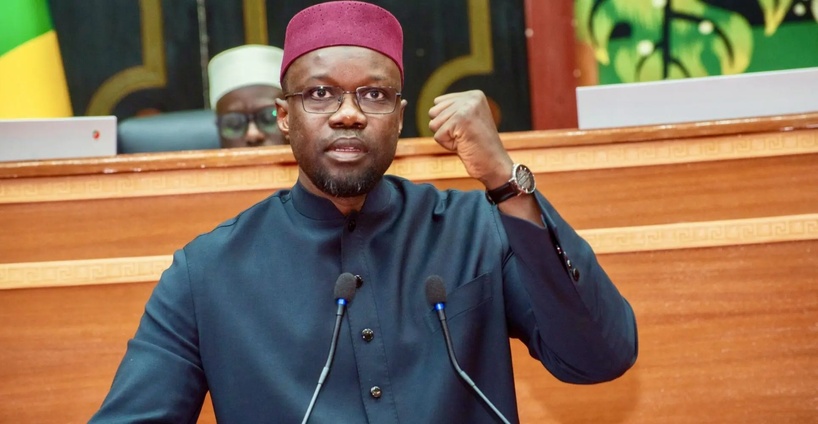
Senegal’s Prime Minister, Ousmane Sonko, appeared before the National Assembly this Friday morning at 10:00 GMT for a crucial session of current affairs questions directed at the government. This significant institutional gathering served as a vital platform to scrutinize the government’s performance, delve into major macroeconomic challenges, and provide clarity on the prevailing political atmosphere.
This parliamentary exchange unfolded amidst a particularly sensitive political environment, notably shaped by ongoing debates surrounding the recent amendments to articles L.29 and L.30 of the Electoral Code. These reforms, which directly impact eligibility criteria and the review of civic rights, have ignited public discourse and remain central to current national concerns. Following the adoption and promulgation of this legislation by President Diomaye Faye, opposition political factions have consistently accused the parliamentary majority of enacting a “tailor-made law” designed to facilitate Sonko’s eligibility for the 2029 elections, despite his repeated assurances of already being eligible for all electoral contests in Senegal.
This fifth accountability exercise for the Prime Minister within the parliamentary setting also placed a strong emphasis on the daily realities faced by Senegalese citizens. Accompanied by all members of his government, Sonko was expected to address concrete issues, particularly the rising cost of living. Discussions focused on the measures the state is implementing to alleviate prices of essential commodities and energy.
The national economy and public finances were also prominent on the agenda, with anticipated discussions centered on the progress of talks with the International Monetary Fund (IMF), the current status of the economic recovery plan, and the preparations for the upcoming national budget.
Regarding specific sectoral priorities, the session also covered family security scholarships, the progress of the current agricultural campaign, and the state’s preparatory support for the upcoming Tabaski celebration.
The dynamic between Prime Minister Sonko and President Diomaye Faye was another key subject during the exchanges, set against a political backdrop that Sonko himself has characterized as a “gentle cohabitation.”
This parliamentary exchange unfolded amidst a particularly sensitive political environment, notably shaped by ongoing debates surrounding the recent amendments to articles L.29 and L.30 of the Electoral Code. These reforms, which directly impact eligibility criteria and the review of civic rights, have ignited public discourse and remain central to current national concerns. Following the adoption and promulgation of this legislation by President Diomaye Faye, opposition political factions have consistently accused the parliamentary majority of enacting a “tailor-made law” designed to facilitate Sonko’s eligibility for the 2029 elections, despite his repeated assurances of already being eligible for all electoral contests in Senegal.
This fifth accountability exercise for the Prime Minister within the parliamentary setting also placed a strong emphasis on the daily realities faced by Senegalese citizens. Accompanied by all members of his government, Sonko was expected to address concrete issues, particularly the rising cost of living. Discussions focused on the measures the state is implementing to alleviate prices of essential commodities and energy.
The national economy and public finances were also prominent on the agenda, with anticipated discussions centered on the progress of talks with the International Monetary Fund (IMF), the current status of the economic recovery plan, and the preparations for the upcoming national budget.
Regarding specific sectoral priorities, the session also covered family security scholarships, the progress of the current agricultural campaign, and the state’s preparatory support for the upcoming Tabaski celebration.
The dynamic between Prime Minister Sonko and President Diomaye Faye was another key subject during the exchanges, set against a political backdrop that Sonko himself has characterized as a “gentle cohabitation.”
Prime minister ousmane sonko addresses Senegal’s national assembly on critical national issues