Niger’s strategic barter with Turkey exposes hidden costs of military cooperation
During an official visit to Ankara, General Abdourahamane Tchiani delivered a statement that sent shockwaves through diplomatic circles: Turkish President Recep Tayyip Erdogan had authorized the delivery of military equipment to Niger without prior financial settlement. While Niamey’s leadership portrays this as a gesture of solidarity, the deviation from international arms trade protocols reveals the underlying mechanisms of a partnership that encroaches upon Niger’s sovereignty.
In the realm of defense procurement, the notion of a ‘total credit’ arrangement without upfront guarantees is fundamentally flawed. Defense industries universally require substantial down payments before any equipment changes hands. The announcement made on June 4, 2026, by Niger’s transitional president thus masks a complex economic and geopolitical reality where gratuity has no place.
The unspoken financial arrangements: deferred payment structures
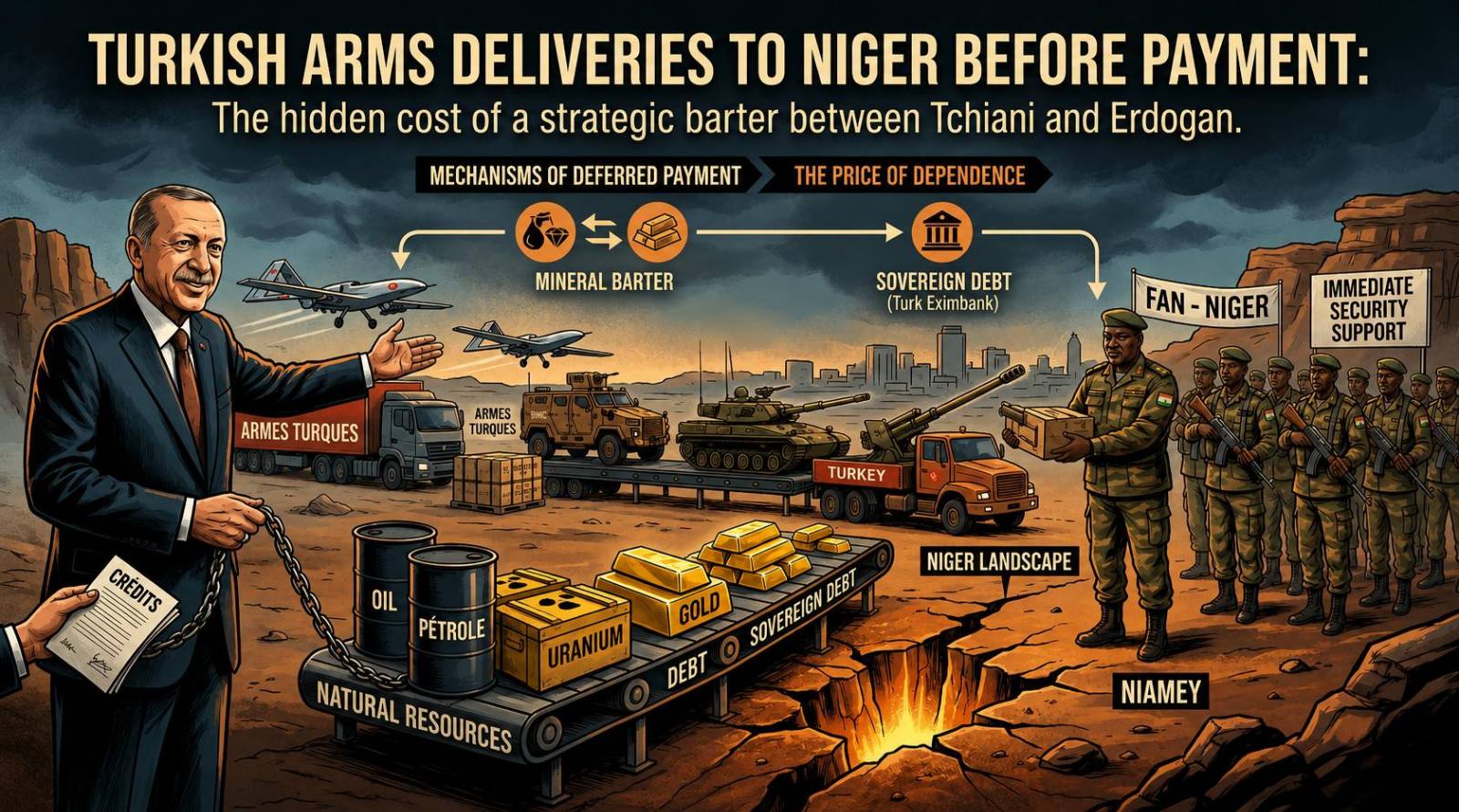
The global arms trade operates on an immutable principle: all delivered matériel must ultimately be paid for, one way or another. To address Niamey’s immediate financial constraints, several compensatory mechanisms are being employed behind the scenes:
- Resource-for-arms barter: Niger’s subsoil ranks among the richest in West Africa, boasting vast deposits of uranium, oil, and gold. By accepting upfront military deliveries, Ankara secures exclusive mining rights or exploration concessions for its national enterprises in return.
- Sovereign debt financing: These transactions are structured as loans facilitated by institutions such as Turk Eximbank. Niger’s urgent security needs are thus converted into long-term financial obligations to Turkey.
The currency of sovereignty: long-term implications
For General Tchiani, this alliance is indispensable for re-equipping the Nigerien Armed Forces (FAN) following the withdrawal of Western troops. However, this short-term pragmatism comes at a steep price for the nation’s future autonomy.
The specter of over-indebtedness looms large: by accepting Turkish-made Bayraktar TB2 drones, armored vehicles, and communication systems on credit, Niamey effectively surrenders a measure of control over its economic and mining policies to Ankara.
Turkey’s strategic counterbalances
The flexibility extended to Sahelian military regimes by Erdogan serves as a high-yield geopolitical investment, fulfilling three core objectives:
- Consolidating Turkey’s influence in the region by displacing Western actors.
- Countering Russian military presence through the provision of advanced defense technologies.
- Securing new markets for Turkey’s defense industry, a cornerstone of its modern global stature.
Political triumph, economic uncertainty
General Tchiani’s domestic political gain—securing weapons without immediate financial strain—is undeniable. Yet this perceived independence collides with the harsh reality of material dependence. Between outsourced security arrangements with Moscow and accrued technological debt to Ankara, Niger has not broken free from foreign influence; it has merely exchanged creditors, with costs yet to be borne by its citizens.
