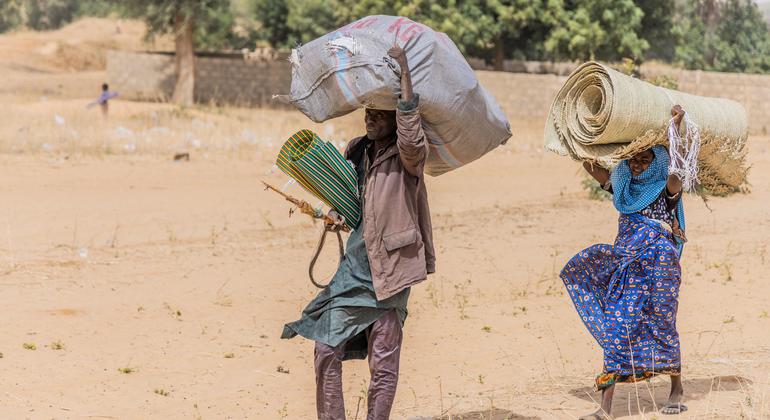
Nigeria’s escalating violence and overlooked humanitarian crisis
Nigeria’s escalating violence and overlooked humanitarian crisis
Recent months have seen a surge in abductions of schoolchildren, coordinated assaults on entire villages, and violent attacks targeting worshippers in churches and mosques. These incidents have thrust Nigeria back into the global spotlight, particularly after the United States launched airstrikes on Christmas Day against jihadist positions in the country’s northern regions. Washington framed the intervention as a protective measure for Christian communities under threat.
Beyond religious borders: Nigeria’s widening security crisis
While international attention often focuses on religious dimensions of the violence, the reality in Nigeria is far more complex. The United Nations warns that the country faces one of Africa’s most severe and neglected humanitarian emergencies, with security challenges spanning multiple regions rather than being confined to a single area.
Mohamed Malik Fall, UN Coordinator for Nigeria, emphasizes: “Security remains one of the nation’s greatest challenges. It’s no longer confined to any particular region—it’s everywhere.”
Decades of insurrection and displacement
The crisis originated in Nigeria’s northeast in 2009 with the emergence of Boko Haram, followed by splinter groups including the Islamic State’s West Africa Province. Nearly 20 years later, this protracted conflict has shattered communities across the nation.
More than two million people remain displaced, with entire generations growing up in camps without any alternative. The UN reports over 40,000 deaths since the insurgency began, alongside the destruction of thousands of schools, health facilities, and farmlands. “We’re seeing populations cut off from economic opportunities, stripped of their livelihoods and dignity,” Fall explains.
Rising banditry and localized conflicts
Compounding the long-standing insurgency is a growing tide of violence in the northwest. States like Zamfara, Katsina, and Sokoto now face what authorities classify as “banditry”—armed criminal gangs that engage in looting, kidnappings, and extortion. “Entire villages have been abandoned,” Fall notes. “Today, we’re looking at nearly one million displaced persons in this region alone.”
The central belt of Nigeria has become another flashpoint, where clashes between farmers and herders over land—fueled by population pressure and climate change—have triggered additional waves of displacement. Further south, separatist movements and oil-related sabotage add to the instability.
With approximately 3.5 million internally displaced persons, Nigeria accounts for nearly 10% of Africa’s total displaced population.
Targeted religious violence or widespread insecurity?
Recent attacks on Christian churches and schools have reignited heated debates about religious persecution. In January alone, over 160 worshippers were abducted during Sunday services in Kaduna State. Earlier, coordinated assaults on villages in the northwest left dozens dead, while students were targeted outside a Catholic school in Papiri.
The trauma of Chibok—where Boko Haram kidnapped 276 schoolgirls, mostly Christian, in 2014—still looms large. In response, the U.S. carried out airstrikes on jihadist positions on Christmas Day, with some officials labeling the situation a “Christian genocide.” The UN, however, has avoided this terminology, citing insufficient evidence to confirm deliberate targeting based on religion.
Fall clarifies: “I wouldn’t go so far as to call this a targeted persecution of one religious group. The vast majority of the 40,000-plus deaths in the insurgency have been Muslims killed in mosques.” He points to the Christmas Eve attack in Maiduguri, where a strike occurred “between a mosque and a market,” killing Muslim worshippers. “Insecurity affects everyone, regardless of religion or ethnicity,” he warns. “Such narratives risk deepening divisions rather than fostering social cohesion.”
Massive but underfunded humanitarian emergency
The security crisis masks an equally daunting humanitarian situation. In Nigeria’s northeast alone, 7.2 million people require assistance, with nearly 6 million in severe or critical need, according to the UN.
Food insecurity is reaching alarming levels, with projections suggesting up to 36 million people could face food insecurity in the coming months. Among children under five, over 3.5 million are at risk of acute malnutrition. “The consequences extend far beyond immediate needs,” Fall stresses. “Malnutrition impacts cognitive development, education, and has lifelong effects.”
Additional vulnerabilities stem from climate shocks—droughts and floods—recurrent cholera and meningitis outbreaks, and a weakened healthcare system.
Funding for humanitarian efforts has plummeted. “A few years ago, the humanitarian response plan reached nearly $1 billion annually,” Fall recalls. “In 2024, it was $585 million. Last year, just $262 million. This year, we’re unsure we’ll even reach $200 million.”
Nigeria’s economic giant and its humanitarian burden
The paradox of Nigeria is striking: a nation boasting one of Africa’s largest economies faces a humanitarian crisis of massive proportions. “Nigeria isn’t Sudan, Somalia, or South Sudan,” Fall asserts. “It’s a country with resources. The primary responsibility for humanitarian response lies with the government.”
The UN is urging a gradual transfer of leadership in aid efforts to federal and state authorities while calling on donors not to turn away. “No population wants to live on assistance,” Fall concludes. “People need access to economic opportunities more than aid. Giving a fish feeds for a day; teaching to fish sustains a lifetime.”
