New Benin president romuald wadagni sworn in after high turnout
Benin swears in Romuald Wadagni as president following landmark election
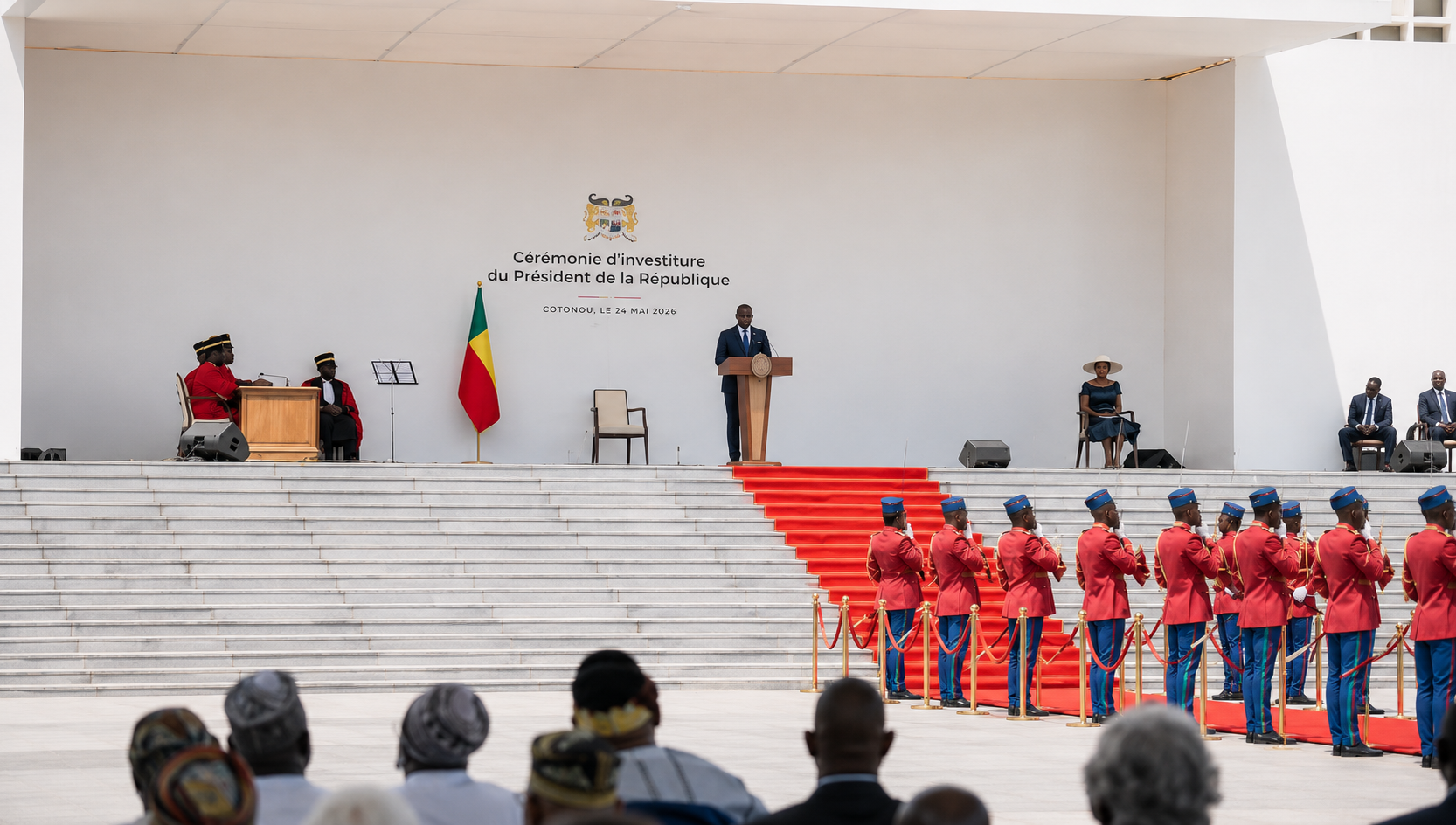
Romuald Wadagni took office on Sunday, May 24, in Cotonou, securing 94% of the vote in an election marked by the absence of the main opposition party. The former Finance Minister inherits a nation at a political crossroads while signaling continuity in economic policy.

On a historic Sunday in Cotonou, Romuald Wadagni was inaugurated as Benin’s fifth president since the nation’s democratic revival in 1990. The former Finance and Economy Minister, who previously served under outgoing President Patrice Talon, secured a sweeping 94% of the vote in an election held on April 12, 2026. His victory came against a single opponent, Paul Hounkpè of the Forces cauris pour un Bénin émergent (FCBE), in a vote that excluded the country’s leading opposition party.
From technocrat to head of state: a seamless transition
Wadagni’s path to the presidency is defined by two decades of public service, including 17 years at Deloitte before joining the government in 2016. As Finance Minister, he played a central role in securing international financing and maintaining Benin’s sovereign credit rating. His presidency now begins with a constitutional shift: thanks to a 2025 amendment, his term extends to seven years instead of five. The change also decouples presidential elections from legislative ones, reshaping the national electoral calendar.
A tightly controlled political landscape
The opposition party Les Démocrates, led by former President Thomas Boni Yayi, was barred from the race in October 2025 after its candidate list failed to secure the required parliamentary endorsements. The Constitutional Court upheld the decision, leaving Benin’s political field notably restricted. Reckya Madougou and Joël Aïvo, prominent opposition figures sentenced to long prison terms on charges widely criticized by human rights groups, remain in custody. The 2016 creation of the Court of Repression for Economic and Terrorism Offenses (CRIET) continues to draw scrutiny over its use against political dissent.
Additional barriers have further marginalized opposition voices. High registration fees, government-controlled certification processes, and a 2025 threshold requiring parties to win at least 20% of the vote in each district to retain seats have slashed opposition representation. In the January 2026 legislative elections, Les Démocrates won no seats.
Diplomatic signals and regional realignments
The inauguration ceremony, held at the Palais des Congrès in Cotonou, saw an unprecedented diplomatic turnout. Sixteen foreign delegations attended, breaking with Benin’s tradition of excluding heads of state from such events. Among them were representatives from the Alliance of Sahel States—Mali’s Foreign Minister Abdoulaye Diop, Burkina Faso’s Karamoko Jean-Marie Traoré, and Niger’s Prime Minister Ali Mahaman Lamine Zeine—as well as Nigeria’s vice president, sent by Bola Tinubu. When Zeine’s name was announced, the crowd erupted in prolonged applause, a gesture that underscored a subtle but significant shift in Benin’s stance toward military-led governments in the Sahel.
This overture contrasts with Benin’s previous firm position toward Niamey following the July 2023 coup. The two nations have clashed repeatedly over the closure of their shared border, which has at times disrupted the flow of Nigerian oil to Benin’s port via pipeline. Wadagni’s remarks signal a willingness to re-engage, even as Benin maintains its commitment to combating armed groups active in the north since 2022.
Policy priorities and early challenges
In his address, Wadagni framed two core priorities: translating economic growth into tangible benefits for families across Benin—particularly youth, women, rural communities, and the middle class—and adopting a firm stance against armed threats. His speech also emphasized national unity, addressing segments of the population directly with repeated phrases, from the diaspora to descendants of the African diaspora, whom he described as returning to a “home that still stands.”
The new president’s first test will come with the formation of his government, expected in the coming days. Will he expand the cabinet beyond Talon’s inner circle, or consolidate continuity? Another critical test lies in the fate of imprisoned opposition leaders. A potential amnesty, long demanded by Les Démocrates, could send a powerful signal. Diplomatically, the next move may belong to Niamey, Bamako, or Ouagadougou—with Wadagni’s next official visit likely to set the tone for Benin’s relations with the Alliance of Sahel States.
The inauguration marks the beginning of a seven-year mandate under a constitutional framework reshaped by the outgoing administration. The question now is whether Benin’s celebrated economic stability can coexist with a political system that offers limited space for dissent. One thing is clear: the new president begins his term in a nation transformed—by choice and by circumstance.
