Maroc and Mauritania deepen security ties amid Sahel instability
Morocco and Mauritania strengthen security cooperation amid rising Sahel instability
Introduction to security cooperation
The strengthening of defense collaboration between Morocco and Mauritania emerges as a strategic response to escalating regional instability across the Sahel, compounded by the proliferation of illicit trafficking networks. This partnership prioritizes safeguarding the vast desert border regions shared by both nations.
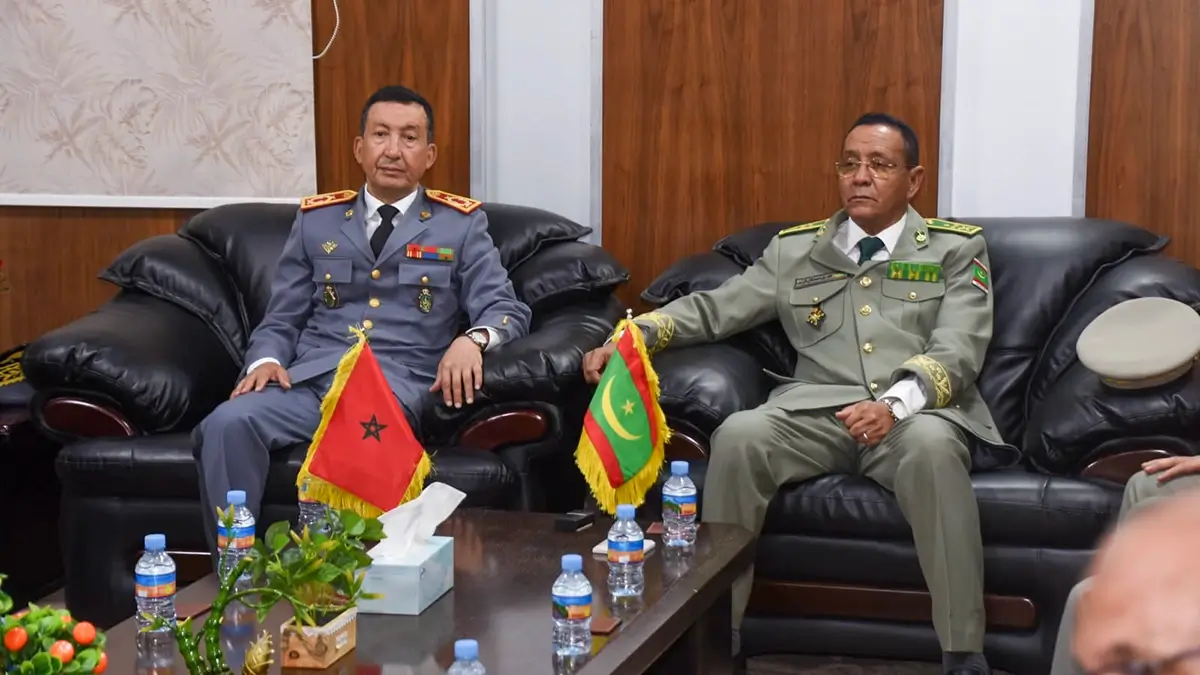
The visit of Lieutenant General Mohammed Berrid to Nouakchott underscores the evolution of bilateral military relations, transitioning from technical coordination to a more structured operational framework specifically designed to address shared security challenges.
Lieutenant General Mohammed Berrid’s visit to Nouakchott
The meeting, held during the sixth session of the Morocco-Mauritania Joint Military Commission, was co-chaired by General Berrid and Mauritanian General Mohamed Vall Ould Rayess. Both delegations highlighted concrete advances that consolidate this strategic partnership, particularly in operational coordination against cross-border threats.
Institutional recognition was evident during the official reception hosted by Mauritanian President Mohamed Ould Cheikh El Ghazouani in Nouakchott, attended by the Moroccan Ambassador to Mauritania, Hamid Chabar. Additionally, Mauritanian Defense Minister Hanana Ould Sidi awarded General Berrid the National Order of Merit at the rank of Commander, symbolizing the political significance of this cooperation in the bilateral agenda.
Morocco-Mauritania Joint Military Commission
Although bilateral military collaboration dates back to 1971, its formal institutionalization began in 2006 through a memorandum establishing the Joint Commission. Since then, escalating insecurity in the Sahara and Sahel regions has progressively enhanced its role, evolving into a more robust partnership tailored to an increasingly unstable regional environment.
The discussions covered critical security domains such as border surveillance, irregular migration control, counterterrorism, organized crime, and monitoring of illicit trafficking routes across desert zones. These areas form the operational core of the alliance, aimed at strengthening security and reducing the operational capacity of transnational criminal networks.
Institutional ceremony and political recognition
The Mauritanian president presided over the official ceremony welcoming Lieutenant General Berrid, highlighting the high priority placed on bilateral cooperation. The awarding of the National Order of Merit at the rank of Commander to Berrid reaffirms not only political recognition but also institutional commitment between Morocco and Mauritania.
This gesture aligns with a broader agenda where defense and security are prioritized as key pillars to address instability across the Saharo-Sahelian region, thereby enhancing the political and diplomatic dimensions of this strategic alliance.
From its origins in 1971 to its institutionalization in 2006, military cooperation between Morocco and Mauritania has evolved from technical coordination into a comprehensive operational partnership. This transformation responds to growing threats in an increasingly complex regional context, especially along the shared desert border areas.
Heightened insecurity and the expansion of criminal networks in the Sahel have been decisive factors in establishing this intensified cooperation, designed to jointly address emerging security and defense challenges.
Key topics discussed in the bilateral meeting
During the sixth session of the Joint Military Commission, central security issues for the region were addressed, including border surveillance, control of irregular migration, counterterrorism, organized crime, and monitoring of illicit trafficking routes. These points constitute the operational heart of the alliance and the primary axis for mitigating cross-border threats.
Both delegations emphasized progress in coordination aimed at enhancing joint capacity to address these issues through strategies adapted to the specific dynamics of the Sahelian environment.
Specialized sources indicate that border zones remain particularly vulnerable to armed group infiltration and the activities of criminal networks operating in drug trafficking, arms smuggling, and irregular migration flows. Mauritania, having long been exposed to these threats, has prompted a collaborative response with Morocco to create a practical stability mechanism aimed at preventing conflict escalation.
Bilateral cooperation seeks to reduce insecurity factors and neutralize rising tensions with regional and international actors, thereby consolidating stability across the Sahelian region.
Training and joint military exercises
A key aspect of cooperation includes military academy exchanges and implementation of joint training programs and field exercises. These activities cover operational planning, demining, marksmanship training, and field operation management.
Participation in regional centers associated with the G5 Sahel also plays a role, where training is refined through simulation systems and specific drills to counter complex, multidimensional threats.
Current coordination is part of a defined work plan established in previous sessions, including the 2024 Rabat meeting, where objectives were set to expand and deepen cooperation in 2025. The Nouakchott session confirmed the continuity and consolidation of this dynamic with clear defense and security objectives.
This operational framework ensures a structured and systematic response to regional challenges, enabling effective and anticipatory management of transnational risks affecting both nations.
Regional context and strategic priorities
Persistent instability in the Sahel, the expansion of extremist groups, and increasing migratory pressure shape the environment in which this cooperation is situated. Additionally, the political issue of the Western Sahara adds a component influencing regional balance and joint security strategies.
These factors constitute the priority framework for Morocco and Mauritania, which, through comprehensive coordination, aim to mitigate transnational risks and foster a more stable environment in one of Africa’s most volatile regions.
Beyond the bilateral framework, the relationship between Morocco and Mauritania stands as a fundamental pillar of regional stability, particularly through the strengthening of border control and protection of strategic corridors. This cooperation contributes to containing insecurity dynamics affecting the Sahel and Western Sahara regions.
Thus, this alliance emerges as a practical risk management instrument in one of the continent’s most sensitive zones, providing effective mechanisms to address the security and defense challenges presented by the region.
