Mali rebels use libyan corridor to launch offensive on Kidal
Rebel Tactics: A Cross-Border Logistics Network
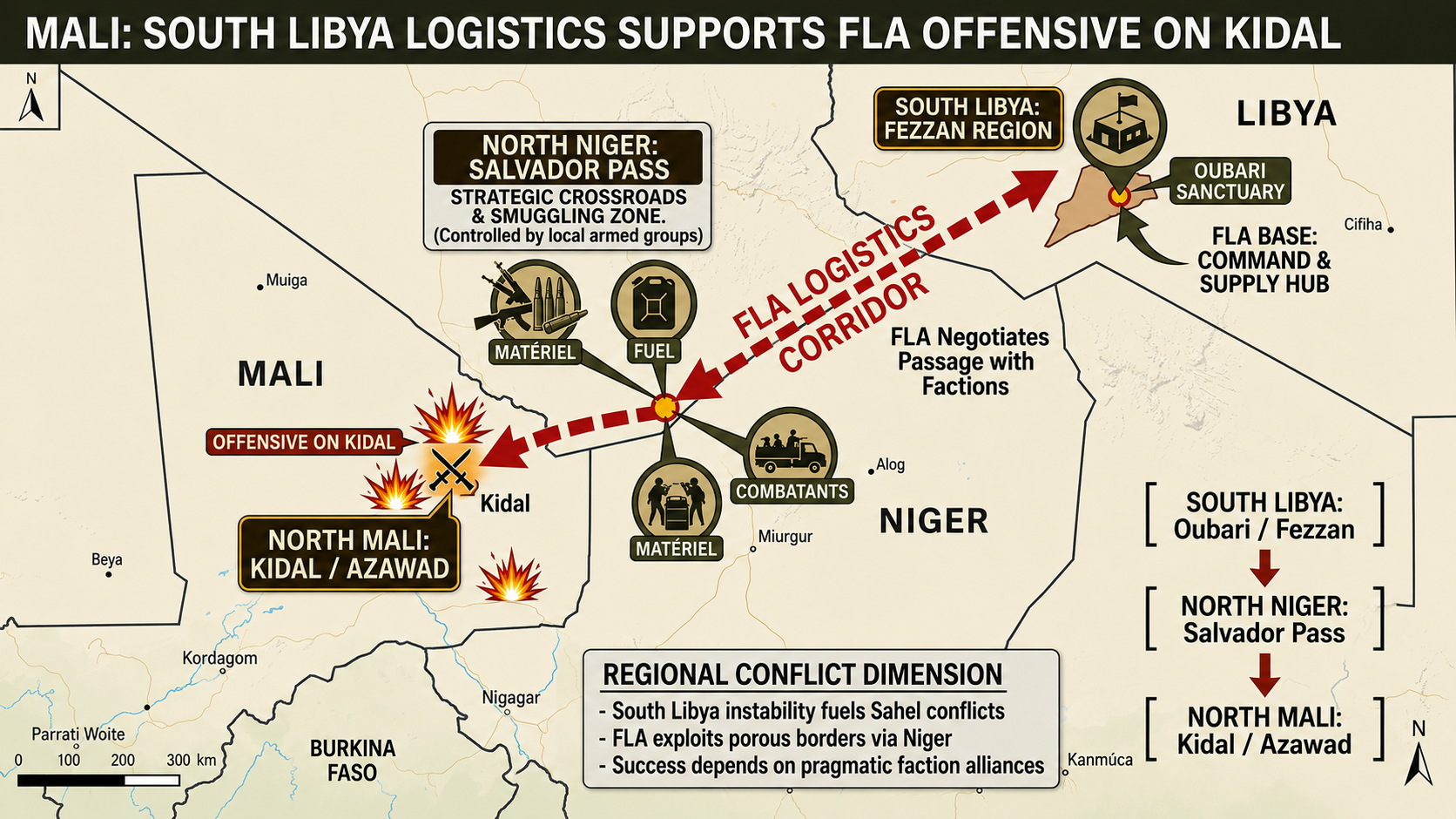
The Front de Libération de l’Azawad (FLA), a Tuareg rebel faction operating in Mali, has established a critical logistical corridor linking southern Libya to northern Mali via Niger. This network enabled the FLA to launch a significant military campaign on April 25 aimed at recapturing Kidal.
Southern Libya: A Strategic Rear Base
Southern Libya, particularly the Fezzan region, has once again emerged as a focal point in the Sahel’s shifting security landscape. The FLA reportedly utilized this area as a logistical rear base, with key operations centered near the city of Oubari. Rather than serving as a passive refuge, Fezzan functioned as a command center, supply hub, and staging ground for rebel forces preparing their offensive.
Oubari and Fezzan: The Logistical Backbone
Within southern Libya, the Fezzan region and its proximity to Oubari provided the structural framework for rebel operations. The area’s historical permeability and limited state oversight made it an ideal location for organizing military movements, storing equipment, and coordinating attacks against Malian forces in the North.
The ‘Salvador Pass’: A Critical Transit Route
To deploy fighters and supplies into Mali, the FLA relied on a transnational axis stretching from southern Libya through Niger to northern Mali. At the heart of this route lies the ‘Salvador Pass,’ a desert crossing in northern Niger notorious for its role in illicit trafficking networks.
The pass facilitates the movement of three essential elements:
- Military hardware: Weapons, ammunition, and logistical support are channeled through this corridor.
- Fuel: A vital resource for sustaining the mobility of armed convoys traversing the Sahara.
- Fighters: Combatants use this route to advance into Malian territory before retreating to Libyan sanctuaries post-operation.
The following map illustrates the strategic flow of this logistical network:
[Southern Libya: Oubari / Fezzan]
           │
           ▼
[Northern Niger: Salvador Pass] *(Controlled by local armed groups)*
           │
           ▼
[Northern Mali: Kidal / Azawad]
Niger: A Crossroads of Regional Alliances
The FLA’s ability to operate along this axis highlights the intricate web of regional alliances. Since the northern Niger segment of the corridor is controlled by multiple armed factions, the rebels could not act unilaterally. Securing passage required negotiating with these local actors, underscoring the necessity of pragmatic agreements in Sahelian conflicts.
As the battle for Kidal intensifies, these developments underscore the transnational nature of the conflict. The instability in Libya continues to reverberate across Sahelian hotspots, shaping the dynamics of insurgency and counterinsurgency in the region.
