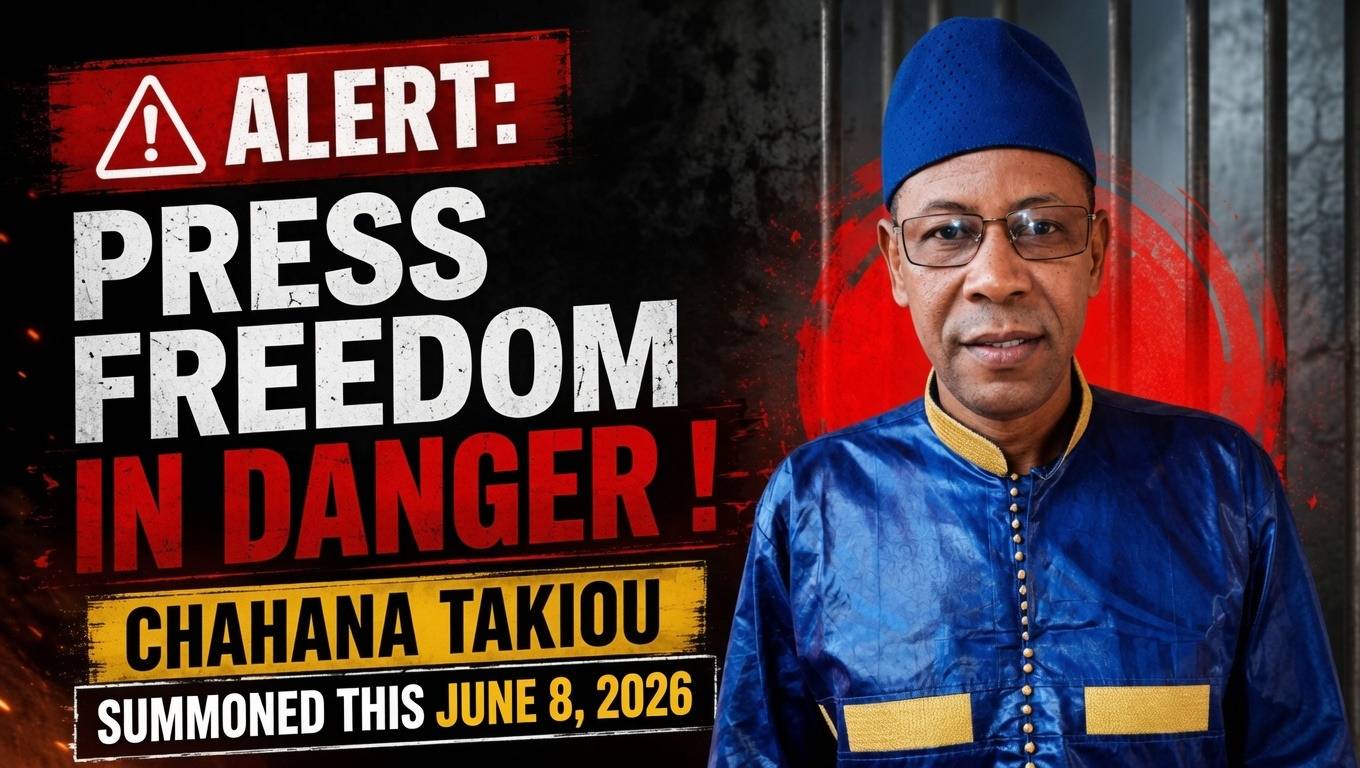
Mali faces growing press freedom crisis as journalist Chahana Takiou summoned
In a fresh escalation of judicial pressure against dissenting voices, Chahana Takiou, editor-in-chief of the Malian weekly Le 22 Septembre, has been summoned to appear before the cybercrime unit in Bamako on June 8, 2026, at 1 p.m. The move follows his recent public critiques of the military-led transitional government’s policies on governance, security, and economic management.
Cybercrime unit becomes tool of state intimidation
The announcement sent shockwaves through Mali’s media landscape. The cybercrime division, originally intended to combat digital crime, has increasingly been weaponized against journalists and critics. For Chahana Takiou, who has long championed independent reporting, this summons represents more than a legal obligation—it is a high-stakes confrontation with a judicial system increasingly aligned with political repression.
The timing and context leave little room for interpretation: his analyses, delivered without compromise, have directly challenged the official narrative promoted by the transitional authorities. In today’s Mali, practicing journalism is no longer just a profession—it has become an act of defiance in a climate where truth itself is under siege.
Press freedom eroded under military rule
The once-vibrant Malian press, long celebrated as a pillar of democratic life, now operates under suffocating constraints. What was once a dynamic space for public debate has shrunk into a narrow corridor of permitted speech. Journalists who strive to report objectively or raise legitimate questions face immediate consequences: suspensions, formal warnings from the Haute Autorité de la Communication (HAC), and relentless administrative harassment that drains resources and morale.
The current regime demands absolute loyalty to its version of events. Any deviation—whether in print, broadcast, or online—is swiftly met with punitive measures. Independent media outlets, both national and international, are systematically targeted, their operations choked by financial and legal pressure. The message is clear: conformity is the only path to survival.
Silencing critics through fear and disappearance
The summons against Chahana Takiou is not an isolated incident. It is part of a broader campaign to crush dissent across Malian society. Politicians, human rights defenders, civil society leaders, and ordinary citizens expressing dissent online have all found themselves in the crosshairs. The tactics have grown increasingly brutal, extending beyond legal proceedings into the realm of abduction and enforced disappearances.
Reports from across the country describe nighttime arrests by unidentified armed men, often linked to state intelligence services. Detainees vanish for weeks, held incommunicado in undisclosed locations. This climate of terror is designed to paralyze public discourse and enforce silence across Mali. The goal is not just to suppress opposition—it is to erase the very possibility of contestation.
Media solidarity under threat
In response to the summons, press freedom organizations and journalist unions have mobilized, issuing urgent calls for solidarity and protection. Yet this collective resistance faces overwhelming odds. The military-led state has systematically dismantled constitutional safeguards, rendering legal protections meaningless. The judiciary, once a bastion of justice, now functions as an extension of executive power.
Professional bodies emphasize that constructive criticism is vital to national resilience, especially during crises. But under the current leadership, any form of dissent is branded as treason or an attempt to destabilize the nation. The door to pluralistic debate has been slammed shut, leaving no space for alternative perspectives.
The June 8 summons for Chahana Takiou marks another ominous milestone in Mali’s authoritarian drift. By targeting a respected journalist of his standing, the transitional authorities have sent an unequivocal message: no critical voice will be spared. This obsession with enforced unanimity—achieved through force, imprisonment, and intimidation—is pushing Mali further into isolation and deepening internal fractures.
As the country grapples with severe security and humanitarian challenges, silencing those who seek the truth will not resolve its crises. The future of independent journalism and civic freedoms in Mali is now being decided in the courtrooms and detention centers of Bamako. The stakes could not be higher.
