Libreville’s 2025 administrative accounts show surplus amid governance shift
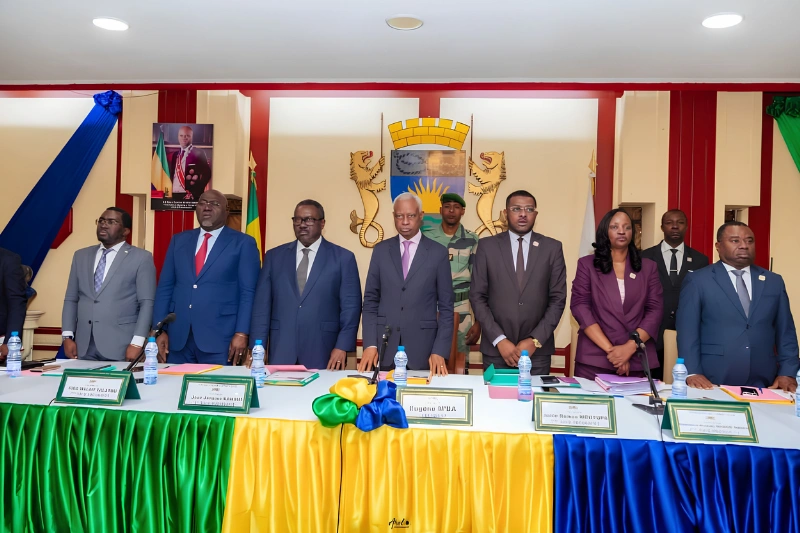
Libreville’s municipal council reconvened under new leadership this week to review the city’s administrative and management accounts for the 2025 fiscal year. The session, held in the Jean-Félix Lassy hall, brought together councillors alongside Marie-Françoise Dikoumba, the Governor of the Estuary Province, signaling a return to institutional stability following recent political turbulence.
Last April’s rejection of the 2026 draft budget by a majority of councillors triggered a significant political shift, culminating in the departure of former Mayor Pierre Matthieu Obame Etoughe’s executive team. The appointment of a new council led by Mayor Eugène Mba marked a turning point, restoring confidence in the municipality’s operations. The meeting adhered to the legal framework governing decentralization, which mandates the review of the previous year’s accounts during the first ordinary session of the calendar year.
Mayor Mba opened the proceedings by underscoring the critical role of the administrative account—a financial document that meticulously tracks all budgetary transactions executed over the fiscal year. It serves as a vital tool for comparing projected revenues and expenditures with actual collections and disbursements, ensuring transparency and accountability in public finance management.
Under the interim administration, the 2025 budget was initially set at 25.623 billion CFA francs before being adjusted upward by 500 million CFA francs through a supplementary budget. The final administrative account for the year revealed a positive operating result of 1.311 billion CFA francs. Acknowledging that he was not in office during the fiscal year in question, Mayor Mba emphasized the principle of continuity of public service, validating the presentation of these financial outcomes to the council. He urged councillors to approach the review with diligence and impartiality.
In addition to approving the administrative and management accounts, the councillors deliberated on a proposal concerning the Mindoubé commercial complex. Municipal authorities framed the project as a strategic initiative to bolster local economic activity and enhance the city’s revenue streams.
