Laurent gbagbo reconfirmed as ppa-ci president in Côte d’Ivoire
Despite previous indications of a potential political retreat, Laurent Gbagbo has been re-elected to lead the Parti des Peuples Africains-Côte d’Ivoire (PPA-CI). The former Ivorian head of state, now in his eighties, had previously contemplated stepping back from active politics, particularly after being barred from the most recent Ivorian presidential election due to a legal distinction between a ‘grace’ and an ‘amnesty’.
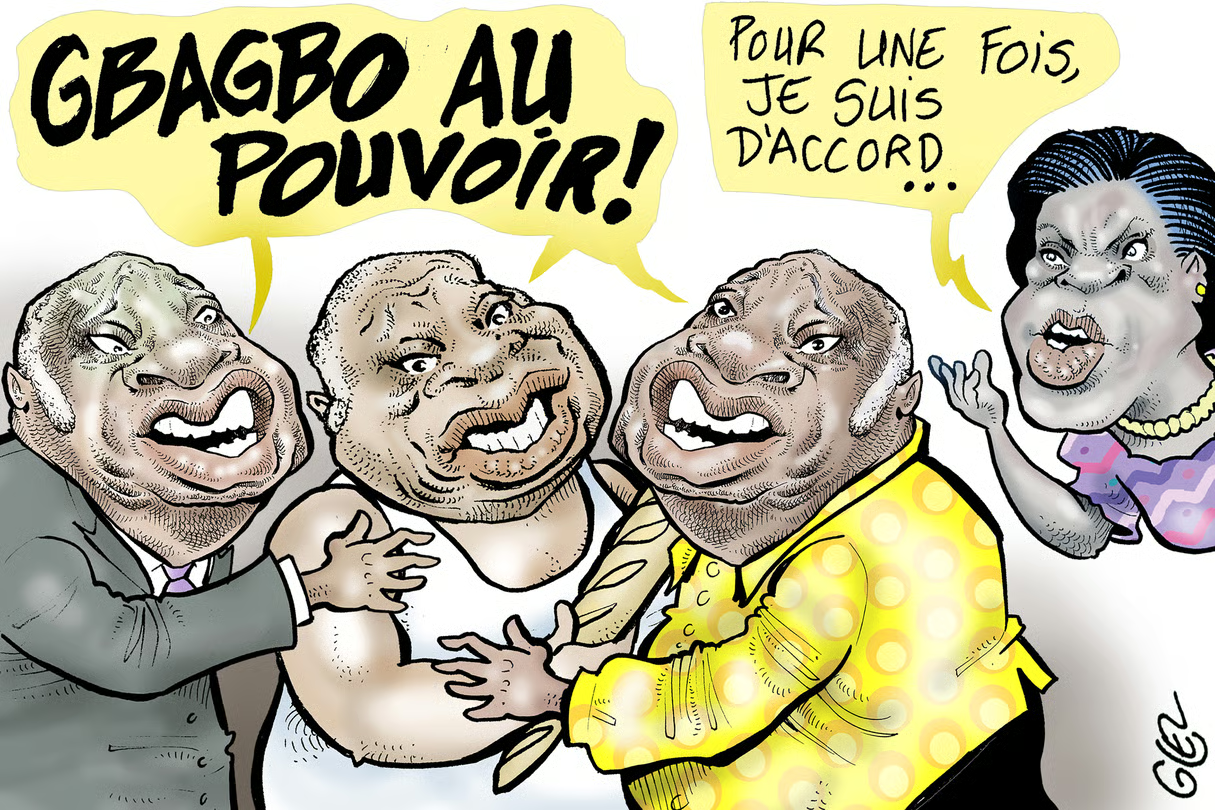
Several factors appear to have influenced this decision to remain at the helm. One significant element is arguably the continued political presence of his long-standing rival, Alassane Ouattara, who remains in the highest office. Additionally, the nascent PPA-CI has experienced a somewhat challenging start since its formation, especially following the deep divisions that plagued its predecessor, the Front Populaire Ivoirien (FPI). It seems Gbagbo, affectionately known as the “Woody of Mama,” felt compelled to continue, reportedly swayed by widespread popular demand for him to guide the Ivorian people through perceived difficulties.
The reconfirmation of Gbagbo’s leadership occurred on the inaugural day of the party’s first ordinary congress, held on May 14 and 15 at the Palais de la culture in Treichville. Though absent from the proceedings, the former head of state was reinstated by acclamation as the party’s figurehead. This move aims to simultaneously ensure continuity and invigorate the PPA-CI’s activities. Notably, the party opted out of both the last presidential election and the recent 2025 legislative elections.
Forging unity after internal dissent
While the overwhelming show of support – Gbagbo’s re-election by acclamation and the palpable enthusiasm of the 3,000 congress attendees – projected an image of enviable unity, the congress was also a critical moment for consolidating party ranks. This came after a period marked by independent actions from some PPA-CI members, including former executive vice-president Ahoua Don Mello, who unsuccessfully ran as an independent candidate in the October presidential election.
In a move to enforce party discipline, three dissenting members were expelled by the central committee, and 62 others faced suspensions ranging from three to eighteen months. Among those disciplined were prominent figures such as Prince Arthur Dalli, the mayor of Lakota; Stéphane Kipré, now an independent deputy; and Professor Georges Armand Ouégnin.
Addressing dissident disobedience
These disciplined individuals had been advocating for a rejuvenation of the party’s internal structures and a re-evaluation of leadership roles. Their exclusion from the Palais de la culture conclave was a direct consequence of their “disobedience” to the party’s call for an election boycott.
While leading a political party may not be an arduous daily task – especially for someone nicknamed the “baker” – Laurent Gbagbo is not expected to engage in the day-to-day management of the PPA-CI. This was implied by various proposals prior to his public address to the congress members on Friday, May 15, and the subsequent “Renaissance Festival” held on Saturday in the Ivorian village of Songon. However, old habits, particularly in politics, tend to persist.
