
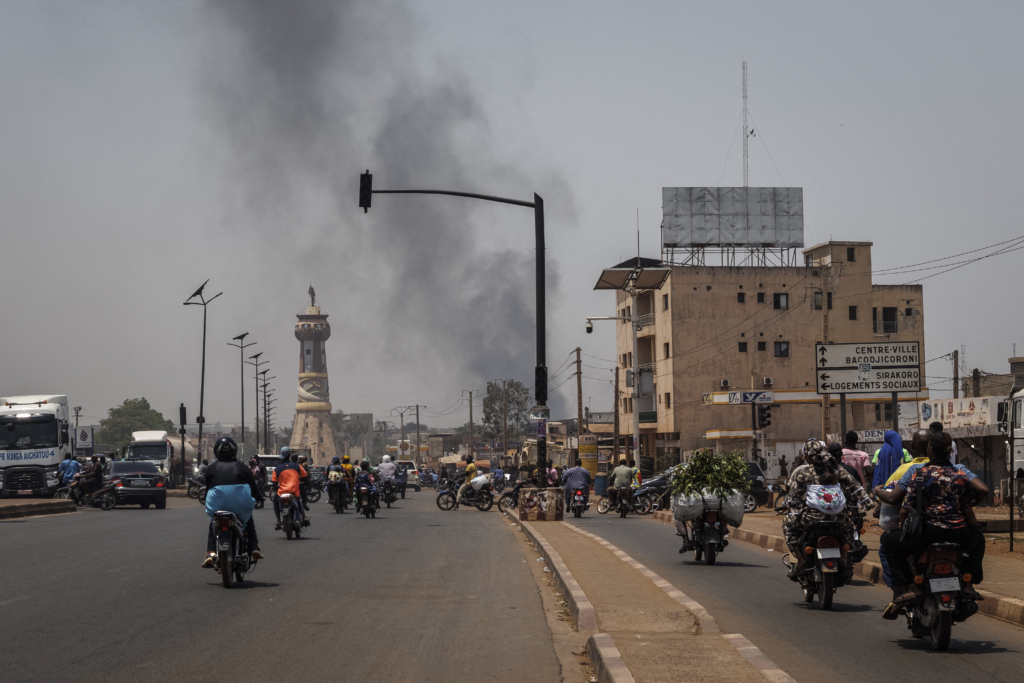
The ongoing blockade of Bamako is inflicting unacceptable hardships on civilians, threatening their fundamental rights to food, health, and safety, Amnesty International warned today. The international human rights organization urged the Groupe de soutien à l’islam et aux musulmans (GSIM)—an armed group affiliated with Al-Qaïda—to comply with international humanitarian law and ensure the protection of civilians.
Since April 28, three major routes leading to Bamako have been blocked after the GSIM declared a siege on the Malian capital. On May 6, the group targeted a civilian convoy transporting goods—including produce—from Bamako to Bougouni. According to verified reports, the trucks carried no military personnel or equipment and were not under military escort at the time of the attack.
« Attacks on civilian vehicles used for non-military purposes are unlawful under international humanitarian law, » stated Marceau Sivieude, Regional Director for West and Central Africa at Amnesty International. « All parties in an armed conflict must distinguish between civilians and combatants at all times. Deliberate attacks against civilians or civilian infrastructure—including essential goods and services—are strictly prohibited. »
Sieges must not violate the economic and social rights of the civilian population.
Marceau Sivieude, Regional Director for West and Central Africa, Amnesty International
Illegal siege tactics violate war laws
On April 28, a GSIM spokesperson announced via an online video the blockade of Bamako, marking a stark shift from the group’s previous measures in September 2025, which had only targeted fuel tankers supplying the capital. The current blockade appears to indiscriminately halt all incoming trucks, severely disrupting the flow of essential goods.
By May 15, at least three of the six primary routes connecting Bamako to regional ports were compromised, cutting off critical supply lines. Local residents and media sources report soaring prices for staple goods, exacerbating food insecurity in the city.
« Sieges must not undermine the economic and social rights of civilians, » emphasized Sivieude. « The GSIM must adhere to international humanitarian law by guaranteeing Bamako’s population uninterrupted access to clean water, food, and other life-sustaining resources. »
A day prior, the UN Human Rights Office urged an immediate end to hostilities, calling on all conflict parties to uphold international humanitarian and human rights laws, with particular emphasis on protecting civilians and civilian infrastructure.
On May 6, the GSIM announced a partial easing of the blockade, permitting medical emergencies to enter Bamako. However, the group’s claims remain unverified by independent observers.
Survivor recounts deadly GSIM ambush on fuel convoy
Amnesty International interviewed a survivor of a GSIM attack on a fuel tanker convoy during the group’s 2025 blockade of Bamako. At the time, the GSIM had vowed to disrupt fuel shipments from regional ports and specifically targeted tankers traveling from Dakar along the Kayes-Bamako route. By November of that year, the group had declared drivers of fuel tankers as legitimate military targets.
Amnesty International demands an immediate halt to all attacks targeting civilians, including indiscriminate assaults.
Marceau Sivieude, Regional Director for West and Central Africa, Amnesty International
On January 29, 2026, the driver was part of a military-escorted convoy of fuel tankers traveling between Diboli and Kayes when it came under attack. Survivors described how over 200 armed assailants on motorcycles ambushed the convoy. « We were attacked 20 kilometers from Diboli, » the driver recounted under anonymity. « The jihadists opened fire without warning. »
« After the initial assault, three military trucks arrived to reinforce the convoy. However, the soldiers aboard were killed, and the jihadists set the vehicles ablaze, » the survivor continued. « At least 12 drivers and apprentices were captured, forced to dig graves for fallen militants, and subsequently executed. Their throats were slit. »
Amnesty International reiterated its call for strict adherence to international humanitarian law by all conflict parties. « The GSIM must cease all attacks on civilians immediately, including indiscriminate violence. The Malian authorities must investigate these atrocities, which may constitute war crimes. Victims and survivors of international crimes deserve truth, justice, and reparations, » Sivieude asserted.
Escalating violence and civilian toll
On April 25, coordinated attacks by the GSIM and the Front de libération de l’Azawad (FLA) struck multiple locations, including Bamako, Kati, Mopti, Sévaré, Gao, and Kidal. Targets included military installations and the homes of political and military figures. In Kati, the Minister of Defense Sadio Camara and several family members were killed when an improvised explosive device detonated in a vehicle outside their residence.
On May 6, GSIM militants launched an assault on the villages of Kori Kori and Gomassagou in central Mali, resulting in significant civilian casualties and property damage. Regional authorities reported « numerous human and material losses, » while local sources confirmed at least 40 deaths and multiple disappearances.