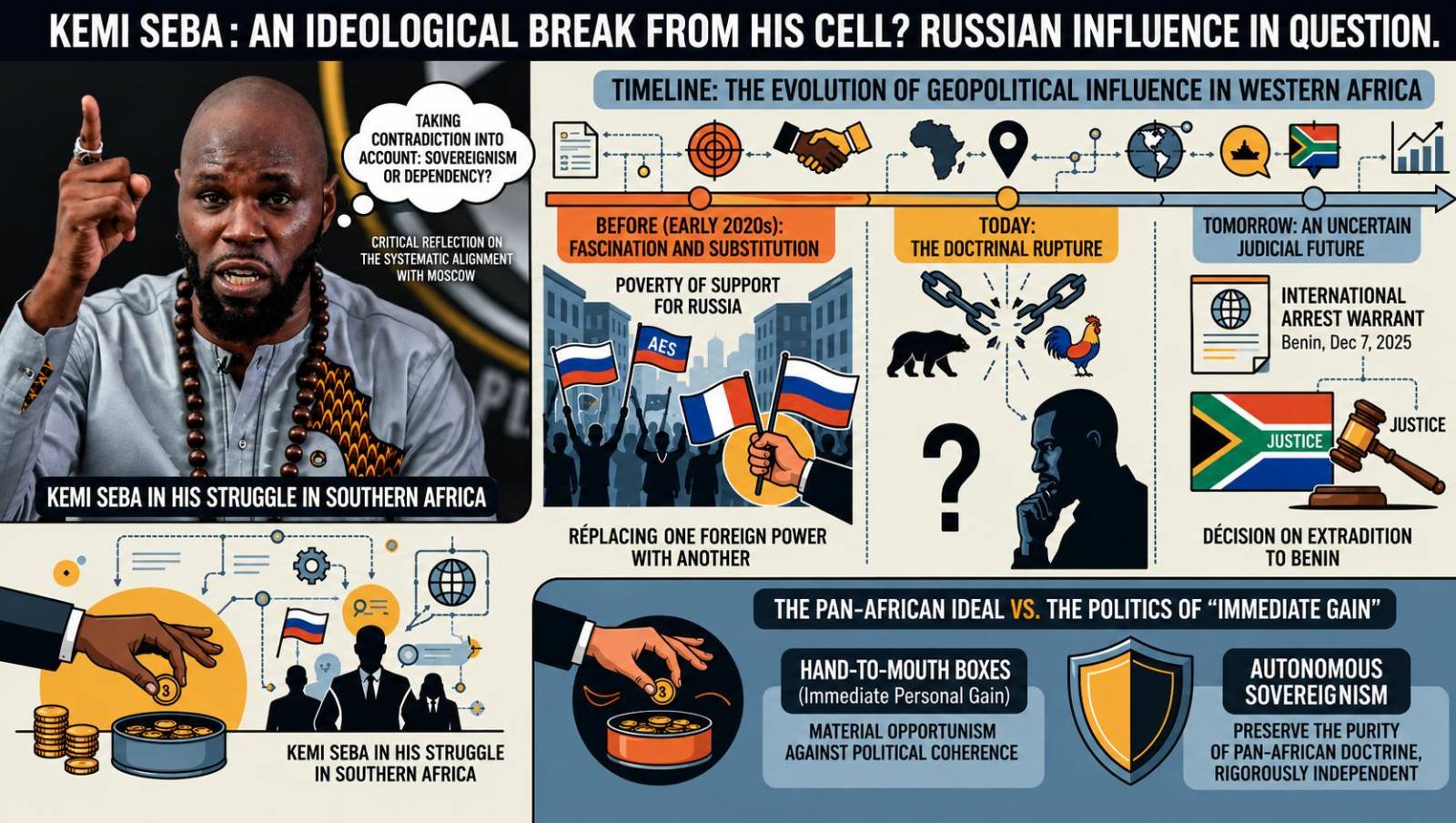
Kemi Seba challenges Russian influence amid ideological shift from prison cell
In recent years, the political landscape across several African nations—particularly within the member states of the Alliance of Sahel States (AES)—has been dominated by highly symbolic displays. During numerous demonstrations advocating for sovereignty, Russian flags have become ubiquitous in public spaces, accompanied by chants unmistakably aligned with Moscow’s agenda. For a vocal segment of activists, Russia is now portrayed as the indispensable savior, offering a definitive alternative to traditional Western powers.
Yet this growing infatuation raises fundamental questions, especially when it stems from movements that claim to champion total independence. Today, it appears that one of the leading voices of contemporary Pan-Africanism, Kemi Seba, is undergoing a significant doctrinal shift—one that challenges this very dynamic—while confined to a prison cell in South Africa.
From sovereignty to new dependencies: the paradox of ideological substitution
The pursuit of fresh international alliances is a legitimate diplomatic endeavor for any state or political movement. However, the temptation to merely replace one foreign influence with another is widely seen as a profound ideological inconsistency. Swapping France’s historical dominance for that of Russia does not, in essence, signify liberation; it merely shifts the axis of dependence from one external power to another.
Observers suggest that Kemi Seba has begun to recognize this contradiction. The Pan-African ideologue has publicly scrutinized what he describes as the limitations of an uncritical alignment with Moscow, firmly rejecting the notion of embracing a new—albeit anti-Western—protectorate.
Pan-African ideals versus the politics of instant gratification
This recalibration of stance has exposed a rift within sovereignist movements. While some enthusiasm for Russia stems from a sincere desire for geopolitical rupture, other dynamics appear driven by material interests rather than ideological conviction.
Kemi Seba has forcefully opposed this opportunism, which he metaphorically critiques as the pursuit of filling so-called “boîtes à ragoût”—a reference to the prioritization of immediate personal gain over long-term political coherence. By rejecting this mercenary approach to ideology, the activist seeks to uphold the doctrinal integrity of a Pan-Africanism that demands absolute autonomy.
A suspended political and judicial future in Pretoria
This period of doctrinal reflection coincides with a critical juncture in Seba’s personal life. The activist, who faces an international arrest warrant issued by the government of Benin following the December 7, 2025, coup attempt, remains incarcerated in South Africa. His fate now rests not only in the realm of ideas but also in the hands of the courts.
The South African judiciary is set to rule on the extradition request submitted by Cotonou. Will this enforced pause behind bars mark a definitive break in his ideological trajectory, or merely a reconfiguration of the Pan-African discourse he champions? The coming weeks will prove decisive—not only for Kemi Seba’s political future but also for the direction of the movements he continues to inspire.
