
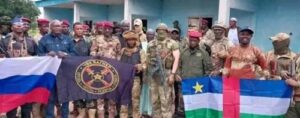
Internal strife in MPC as Russian mercenaries officially intervene in Bossangoa
The Movement of Central African Patriots (MPC) is facing unprecedented internal turmoil as Russian-backed mercenaries have taken an official role in operations, reshaping leadership dynamics in the strategically vital town of Bossangoa. The sudden involvement of these external forces has triggered a chain reaction within the group, pushing key figures into a precarious position.
Didot Ali’s leadership under pressure as new successor emerges
Didot Ali, a longstanding figure within the MPC, now finds himself navigating a fragile balance of power. His position has become increasingly tenuous following the arrival of Russian mercenaries, who have reportedly taken control of key logistics and decision-making processes in Bossangoa. The group’s traditional internal hierarchy is being systematically overridden by this external influence, raising questions about the future autonomy of the MPC.
Recent developments suggest that the mercenaries are not merely advisors but are actively steering operational directives. This shift has led to the emergence of a new successor within the MPC, further complicating the already volatile situation. The transition of power, now influenced by foreign actors, has left many members of the group divided over loyalty and strategy.
A new era of instability in Central African Republic’s security landscape
The intervention of Russian mercenaries in Bossangoa marks a significant escalation in the Central African Republic’s (CAR) security challenges. The MPC, once a dominant armed faction in the region, is now grappling with an identity crisis as its operations are increasingly dictated by external entities. This development underscores the growing influence of foreign actors in the country’s internal conflicts, reshaping the power dynamics in the region.
Local observers warn that this shift could exacerbate existing tensions, particularly in areas where the MPC has historically held sway. The mercenaries’ involvement may provide short-term stability in certain pockets but risks deepening divisions within the group and fueling broader instability across the Central African Republic.
What’s next for the MPC?
With Russian mercenaries now firmly embedded in its operations, the MPC faces a critical juncture. The group must decide whether to fully align with these external forces or risk further fragmentation. The coming weeks will be pivotal in determining whether the MPC can regain control of its own narrative or if it will be permanently reshaped by this foreign influence.
The situation in Bossangoa serves as a stark reminder of the complex interplay between local armed groups and international actors in the Central African Republic. As the MPC navigates this new reality, the broader implications for regional security remain uncertain.