
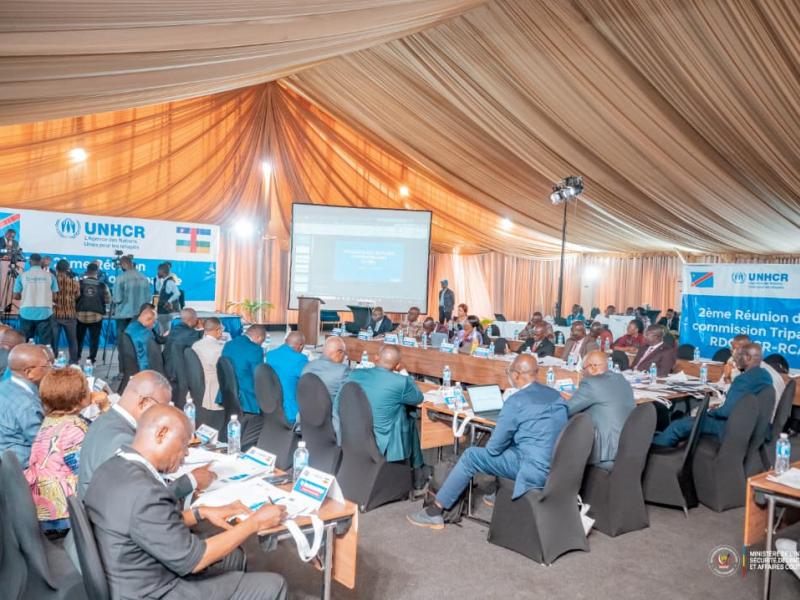
historic tripartite meeting to facilitate return of 20,000 refugees from DRC to Central African Republic
- society
The capital of the Democratic Republic of the Congo, Kinshasa, is hosting a historic tripartite meeting from Tuesday 9 to Thursday 12 June. The gathering brings together Congolese officials, Central African authorities, and representatives from the United Nations High Commissioner for Refugees (UNHCR) to address the voluntary return of over 20,000 Central African refugees currently living in the DRC.
Pierre Atchom, UNHCR Representative in the DRC, disclosed during his opening remarks that 22,604 biometrically registered Central African refugees remain in the country. These individuals are primarily located in Nord-Ubangi, Sud-Ubangi, and Bas-Uélé provinces. Additionally, 65,000 new asylum seekers from the Central African Republic arrived in May 2025 in the Zapaï locality, within the Ango territory of Bas-Uélé.
Éric Mukandila, Permanent Secretary of the National Commission for Refugees (CNR) and head of the DRC delegation, emphasized that the voluntary repatriation process resumed following the stabilization of previously conflict-affected zones. This followed a 2019 agreement between the DRC, Central African Republic, and UNHCR. He noted that 40,000 Central Africans have already returned home safely and with dignity since 2019, facilitated by the UNHCR in collaboration with both governments.
Mukandila stressed the need for an in-depth review of the current challenges to ensure the remaining refugees can return under safe and dignified conditions. He highlighted the frustration and disappointment among those awaiting repatriation, calling for pragmatic solutions.
Mesmin Guenguebe Mbari, Advisor for Territorial Development in the Central African Republic and head of his country’s delegation, praised the success of the return initiative, noting that 43% of the refugees registered in the DRC have already returned home. He outlined ambitious plans for 2026, targeting the potential return of nearly 60,000 refugees from various host countries. Mbari introduced a strategic development plan focused on creating poles of development in areas receiving returnees, aiming to ensure their successful reintegration.
He called for frank and pragmatic discussions to evaluate the real-life experiences of those who have already returned. This includes assessing their integration into communities and measuring the tangible impact of the support provided to them.
The tripartite meeting represents a critical step in addressing the humanitarian crisis affecting the Central African Republic, with far-reaching implications for regional stability and cooperation.