
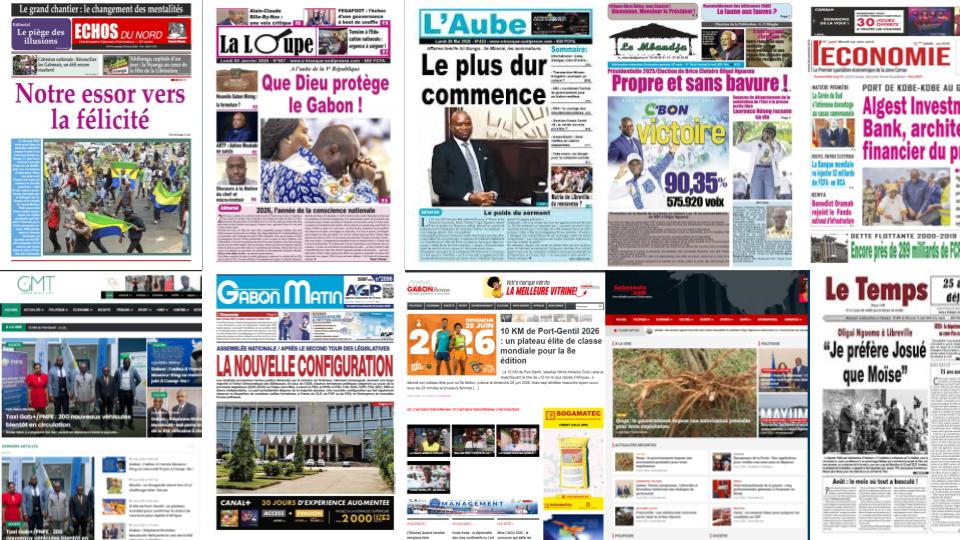
As Gabon strives to establish a modern Fifth Republic, its media landscape faces an unprecedented crisis. Print publications are fading, online outlets struggle to survive, advertising revenue dwindles, and access to public information grows increasingly difficult. Beyond the economic survival of news organizations, the very foundation of Gabonese democracy is now at stake.
The most troubling silence today isn’t in political debates or infrastructure announcements—it’s the near-total absence of discussion about the media sector’s collapse. While the nation focuses on grand projects and political milestones, an essential pillar of democracy is quietly eroding beneath the surface.
A democracy without viable media ultimately becomes a monologue. When a government only hears its own voice, its connection to reality weakens dangerously.
Print media: the silent erosion of public discourse
Few institutions better reflect this decline than Gabon’s print media. Once bustling newsstands now sit half-empty, with titles like La Loupe, L’Aube, and Échos du Nord—once robust voices in national debates—reduced to rare collector’s items. These publications endured tougher times in the past, facing criticism and even accusations of systematic opposition. Yet they persisted, maintaining their presence in the public sphere.
Today, their disappearance isn’t just an economic loss—it represents the silencing of critical perspectives. When a newspaper vanishes, so does a community’s ability to engage in informed discussion.
The fading legacy of Gabon Matin
The decline of Gabon Matin serves as a stark example. For decades, this government-aligned daily stood as an institution in Gabonese media. It evolved from daily publication to biweekly, then attempted a weekly format during the transition period. Now, physical copies have vanished from newsstands entirely, surviving only in digital form under the banner of technological adaptation.
Few believe this shift reflects mere editorial strategy. The reality is simpler: economic hardship affects every sector, even those historically backed by the state.
Where is the promised media restructuring?
Years have passed since officials announced support mechanisms to restructure the media sector. Funds were pledged, timelines discussed, and expectations raised. Yet on the ground, publishers continue to fight for survival with little tangible change. The most telling measure of any policy isn’t in its announcement—it’s in its results. And today, those results are alarming.
Digital outlets: a mirage of progress
While new online platforms proliferate, very few meet basic professional standards. How many can claim structured newsrooms? Transparent ownership? Clearly identified editorial leadership? The answer remains distressingly low.
Those few outlets still upholding rigorous journalism face impossible economic equations. Advertising revenue dries up, digital income remains minimal, operational costs climb, and institutional advertising contracts concentrate among the same few players. The result? A media landscape where only the most adaptable—or the most compromised—can persist.
Why weakened media weakens democracy
The consequences extend far beyond balance sheets. How can pluralism exist when media organizations disappear daily? How can diverse viewpoints thrive when independent outlets collapse one by one? And how can editorial quality survive when newsrooms operate in constant financial precarity?
A financially vulnerable press becomes susceptible to undue influence, pressure, and compromise. A robust democracy demands exactly the opposite: independent, resilient, and credible media that can operate without fearing each month’s survival.
The collective risk of media extinction
The irony is striking. The regulatory body tasked with overseeing Gabon’s media could soon find itself regulating an empty field. What purpose does regulation serve when the regulated entities vanish? What value does legal pluralism hold when independent voices fade into silence? These questions must be confronted with urgency, for what’s truly at stake isn’t just the future of media—it’s Gabon’s capacity to sustain a vibrant, contradictory, and democratic public sphere.
Saving media to save democracy
The time for denial has passed. The media crisis isn’t a corporate issue confined to journalists and publishers. It’s a societal challenge. A nation that allows its media to collapse inevitably impoverishes its public debate. And a weakened public debate ultimately undermines democracy itself.
Gabon now faces a choice: continue watching its media landscape decay or implement meaningful reforms grounded in transparency, fairness, pluralism, and economic viability. Because in the end, a democracy doesn’t just die when newspapers close—it begins to wither when they’re allowed to die.