DRC government strengthens case against Rwanda, AFC/M23 with new human rights reports
The Democratic Republic of Congo’s government (DRC) is intensifying its legal and economic response to allegations presented in recent Human Rights Watch and Global Witness reports. These reports detail the security, humanitarian, and natural resource exploitation situation within territories controlled by the AFC/M23 rebellion in eastern DRC.
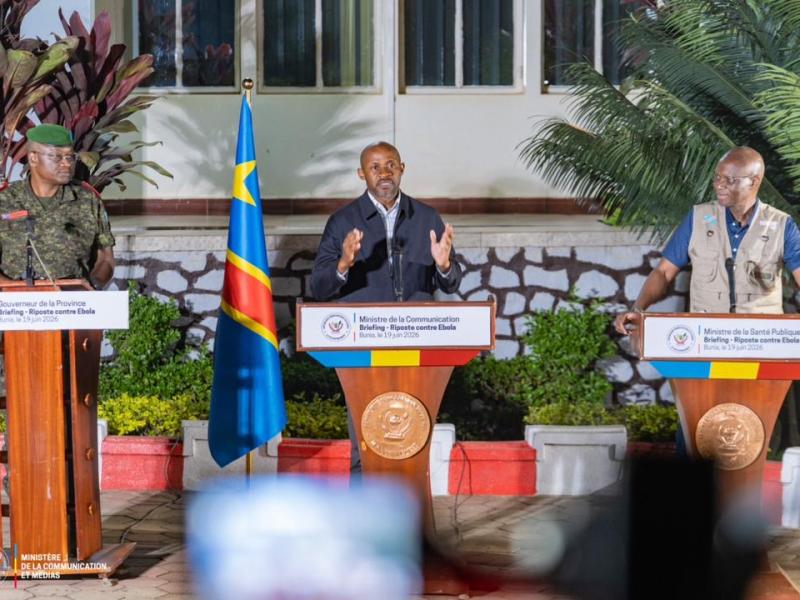
During a press briefing, government spokesperson Patrick Muyaya, alongside Public Health, Hygiene, and Social Welfare Minister Samuel Roger Kamba, stated that these publications did not surprise Congolese authorities. Muyaya emphasized Kinshasa’s multi-faceted approach, which includes both “a judicial front and an economic front.” He further announced upcoming legal actions to be initiated by the Ministry of Justice.
“The recent reports from Human Rights Watch and Global Witness are not unexpected,” Patrick Muyaya told the press. “We possess intelligence, and our strategy to counter this aggression involves multiple fronts: judicial and economic. In fact, the Ministry of Justice will launch new legal proceedings in the coming days. Regarding minerals, it’s insufficient to only identify those at the source; the entire supply chain must be scrutinized.”
Addressing the exploitation and trade of minerals in eastern DRC, Muyaya stressed the necessity of examining the entire supply chain, not just local actors, to assign responsibility accurately. He recalled a significant meeting held in Geneva with the Prime Minister and various traders involved in these commercial networks.
“Months ago, we convened a crucial meeting in Geneva with the Prime Minister and several traders involved in these commercial networks,” government spokesperson Patrick Muyaya stated. “These reports corroborate information we already possessed and provide additional details that will strengthen our existing legal and economic cases. Our focus includes the war economy sustained by Rwanda, which profits from the instability in the Democratic Republic of Congo’s East.”
Muyaya also addressed allegations of forced child recruitment, particularly highlighted by Human Rights Watch. He noted that Congolese authorities have been receiving alerts about this practice for several months. According to Muyaya, the AFC/M23 rebellion resorts to such coercive tactics due to its unpopularity in occupied territories, where it attempts to enforce its presence through violence.
“We understand that both the ‘father’ (Rwanda) and ‘son’ (AFC/M23) are unpopular in the areas they control,” he explained. “They govern through fear and violence, employing coercive methods, especially against children, mirroring tactics seen in Rwanda. We have repeatedly received alerts from parents, some of whom were hesitant to send their children to school due to fears of forced recruitment. Sometimes, staged events are even organized to publicly present supposed volunteers recruited from various camps.”
He further asserted, “Human Rights Watch’s findings confirm what we have long denounced. These reports will also bolster ongoing legal proceedings. The documented facts constitute serious crimes, including war crimes, for which national and international justice mechanisms have already been, or will soon be, engaged.”
Continuing his address, Patrick Muyaya reiterated the government’s resolve to pursue actions against Kigali and the AFC/M23 on multiple fronts, aiming to restore the Democratic Republic of Congo’s sovereign rights.
“We understand the nature and methods of the aggressor, and we will pursue them everywhere,” government spokesperson Patrick Muyaya affirmed. “While Human Rights Watch and Global Witness reports don’t always capture the full scope of events on the ground, they complement our ongoing investigations and significantly strengthen our response when published.”
Muyaya emphasized that the government’s response extends beyond public statements. He cited recent US sanctions against certain Rwandan army officials, viewing them as part of a broader effort to combat illicit circuits linked to mineral exploitation.
“The government’s actions are not confined to declarations or press releases; they manifest as concrete measures,” Muyaya asserted. “The recent US sanctions against certain Rwandan army officials, for instance, stem from that army’s perceived involvement, complicity, or responsibility in illicit mineral exploitation and trade networks. All these matters are already subject to legal proceedings and will continue to be pursued in the coming weeks.”
These report findings bolster prior investigations into human rights violations and the plundering of natural resources in eastern Democratic Republic of Congo. They emerge amidst an ongoing offensive by the AFC/M23, a movement that, according to Congolese authorities and numerous international reports, receives Rwandan backing and controls significant areas in North Kivu and South Kivu provinces. Global Witness’s revelations reignite concerns about the effectiveness of international mechanisms designed to prevent strategic minerals from conflict zones from entering global supply chains.
For several years, the Democratic Republic of Congo’s government has maintained that the persistent instability in the country’s East is driven by economic interests tied to illegal mining. Kinshasa frequently labels this conflict an “economic war” aimed at plundering Congolese minerals. Kigali consistently refutes these accusations, denying any involvement in the illegal exploitation of DRC’s natural resources or the destabilization of its eastern region.
