
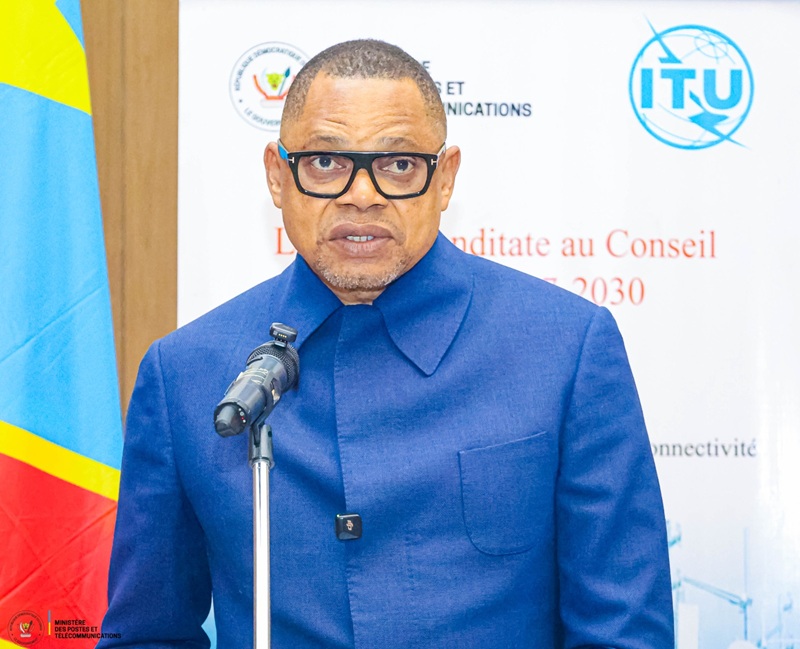
In a bold diplomatic offensive, Democratic Republic of the Congo (DRC) Minister of Posts and Telecommunications, José Mpanda Kabangu, has initiated high-level consultations to secure his country’s election to the International Telecommunication Union (ITU) Council. The move comes ahead of the ITU Plenipotentiary Conference in Doha, Qatar, scheduled for November 2026, where member states will vote on representation for the 2027–2030 term.
The announcement was made during a carefully orchestrated evening reception at Kinshasa’s Hilton Hotel, attended by ambassadors, heads of diplomatic missions accredited in the DRC, and representatives from international telecom organizations. The event underscored the DRC’s strategic importance in Africa’s digital transformation and its ambition to shape global telecom governance.
a strategic bid rooted in regional leadership
Speaking to the assembled diplomats, Minister Mpanda framed the DRC’s candidacy as both a call for international solidarity and a reflection of the country’s central role in Africa’s digital future. With its vast natural resources, young population, and growing digital economy, the DRC is positioning itself as a key player in the continent’s technological evolution.
“Our bid to join the ITU Council is not just about securing a seat—it’s about elevating the voice of Africa and developing nations in shaping global telecom policies. The DRC, as the host of the African Telecommunications Union (ATU), is uniquely positioned to advocate for inclusive connectivity, digital sovereignty, and equitable access to technology.”
He emphasized that with 13 seats allocated to African countries on the ITU Council, the DRC’s leadership in the ATU—along with its vast mineral wealth critical to global tech supply chains—makes it a natural choice to represent the continent’s interests. “It would be inconsistent for the country that houses the ATU headquarters not to have a seat at the table where the rules of the digital world are decided,” he asserted.
vision for an inclusive digital africa
Christian Katende, Chair of the DRC’s Post and Telecommunications Regulatory Authority (ARPTC), outlined four core commitments driving the DRC’s candidacy: strengthening Africa’s voice within the ITU; promoting investment in networks, satellites, and data centers; advocating for a digital governance model that balances innovation, security, and citizen protection; and fostering knowledge-sharing and capacity-building across African regulators.
“We aim to transform the DRC into a digital hub for Central Africa and a leader in the continent’s digital economy. But our vision extends beyond our borders—we want to empower Africa to compete globally, accelerate its digital integration, and speak with one voice in international forums.”
Highlighting the DRC’s role in the global tech supply chain—thanks to its critical minerals essential for semiconductors and AI infrastructure—Katende argued that the country’s inclusion in the ITU Council is not only justified but necessary. “By supporting the DRC, you’re choosing an Africa that doesn’t just adapt to digital change, but helps design it. You’re choosing an Africa that invests, innovates, and builds its own solutions with responsibility.”
diplomatic backing and regional solidarity
Noëlla Ayeganagato, Deputy Minister of Foreign Affairs, reinforced the government’s commitment to the candidacy, urging diplomats to rally support from their respective capitals. She stressed the strategic importance of the ITU in achieving sustainable development goals and called for coordinated diplomatic efforts to ensure the DRC’s success in Doha.
“The ITU is a vital partner in advancing digital development across Africa. We urge potential voting members and traditional allies to champion this candidacy, ensuring our commitments are met and our diplomatic engagements are fully leveraged.”
The formal submission of the DRC’s candidacy is set for November 2026 in Doha, where the country will compete for one of the 13 African seats on the ITU Council. The outcome could redefine the DRC’s role in global digital governance and strengthen Africa’s position in shaping the future of telecommunications.