
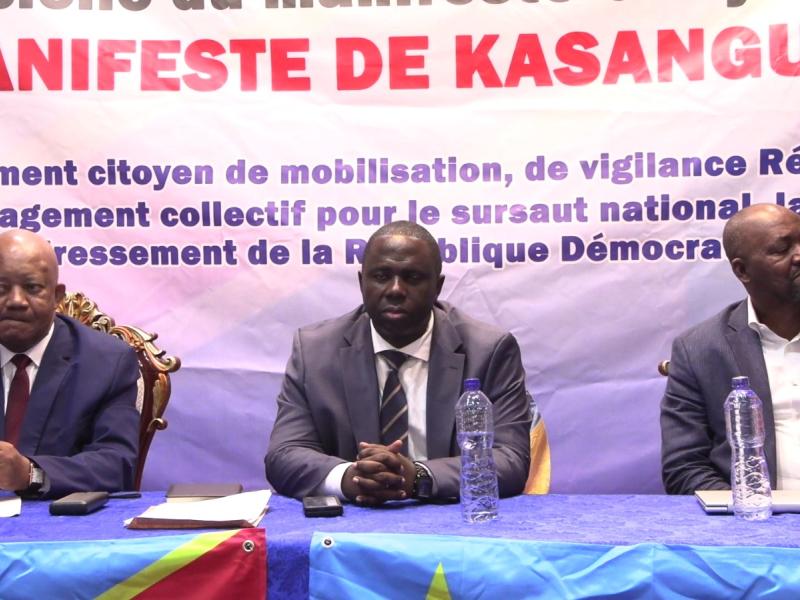
Civil society organizations in DRC launch the ‘Kasangulu Manifesto’ as a citizen roadmap for national renewal
- Politics
Under the leadership of the Crisis Committee of Civil Society for Peace and Security in the Democratic Republic of Congo (CCPS-RDC), national stakeholders officially launched on Friday, June 26, 2026, in Kinshasa, the Citizen Manifesto—presented as a guiding document for the renewal and recovery of the Democratic Republic of Congo. Dubbed the Kasangulu Manifesto, this initiative represents, according to organizers, a collective response to the nation’s pressing political, security, economic, social, and institutional challenges.
The manifesto emerges from an inclusive process involving representatives from multiple provinces. It outlines a shared vision for national transformation centered on responsible governance, peace, security, social justice, citizen participation, education, health, economic development, environmental protection, and the strengthening of the rule of law.
From vision to action: a manifesto built on collaboration
The launch ceremony was inaugurated by Ms. Sylvie Nakweti, Director of Communication, Advocacy, and Documentation at DYCOD-RDC, who commended civil society organizations for spearheading this national renaissance movement.
Professor Iyoka Jean Bedel emphasized that the Citizen Manifesto stems from an inclusive and educational approach designed to provide the Democratic Republic of Congo with a foundation for reflection and action toward reconstruction. “The Citizen Manifesto is the result of a pedagogical and inclusive process aimed at equipping our nation with a framework for reflection and action to achieve its rebirth,” he stated.
Me Patient Bashombe Matabishi, Coordinator of the CCPS-RDC, underscored the historic significance of the initiative, noting that the country faces deep-seated crises requiring a united national response. “We are launching today the Citizen Manifesto—known as the Kasangulu Manifesto—because it was in Kasangulu that the commission drafting this document convened. This manifesto embodies the vision of civil society for the recovery of Congo. We all agree that our country is experiencing an unprecedented crisis. The question is: How do we emerge from it? The Citizen Manifesto offers a path forward for recovery and renewal,” he explained.
He further highlighted the symbolic timing of the launch, just days before the celebration of Independence Day. “The date was chosen deliberately, falling just before June 30—the day we celebrate our independence. We wanted to contribute to the national debate and, above all, to raise awareness among every Congolese about their responsibility to history. This debate must not be confined to politicians alone. Congo belongs to all its people. Above all, the Citizen Manifesto is an expression of the citizens themselves. It is a call to all patriots to defend the Democratic Republic of Congo,” he asserted.
The Democratic Citizen Revolution: a political current takes shape
Daie Mutombe Pierrot, President of the Congolese Onusiens, presented the Democratic Citizen Revolution, championed by the BLOC-RDC movement. This initiative seeks to promote active citizenship, good governance, and national sovereignty. During the event, Me Patient Bashombe Matabishi was elected President of BLOC-RDC, with Professor Iyoka Jean Bedel named Secretary General.
Addressing constitutional reform: seeking consensus over division
When questioned about potential constitutional reforms, the CCPS-RDC Coordinator reaffirmed the civil society’s position, stressing the need for broad consensus on so-called “locked” constitutional provisions. He warned that any reform process failing to include all provinces or strengthen national unity could risk destabilization. “Reform is indeed envisaged by the Constitution itself. However, we believe that any approach that does not incorporate all provinces or contribute to national cohesion risks leading to implosion. The Constitution remains our fundamental tool for cohesion—a text that unites our entire people. Regarding the locked articles, which are at the heart of the debate, we believe a consensus is essential,” he declared. “These provisions were locked not by electoral means but through consensus. In law, the principle of parallel forms means only a new consensus can alter an existing one. In this spirit, we aim to make the Citizen Manifesto a foundational text for the future direction of our country. It carries the vision we, as civil society and as a people, advocate for the renewal of the Democratic Republic of Congo.”
The event brought together nearly 200 civil society organizations, community representatives, academics, trade unionists, lawyers, doctors, entrepreneurs, youth groups, women’s movements, human rights defenders, and local leaders. Participants praised the document’s quality and called for a nationwide campaign to promote its adoption across the country and among the Congolese diaspora.
In closing, the Crisis Committee of Civil Society for Peace and Security in DRC urged all segments of the nation to embrace the Citizen Manifesto as a pivotal contribution to state renewal, peace consolidation, and the construction of a fairer, more prosperous, and democratic future for the Democratic Republic of Congo.
The initiative unfolds amid a critical regional context marked by the Rwandan aggression through the M23 rebellion, compounded by the activities of local and foreign armed groups. This exacerbates the humanitarian crisis, with rising numbers of internally displaced persons and refugees, all while international funding dwindles, diplomatic initiatives remain stalled, and hostilities persist in eastern DRC. Against this backdrop, the debate over constitutional reform has intensified, giving rise to two opposing dynamics: the Coalition Article 64 for the Defense of Constitutional Order (C64) and the Congolese Coalition for Constitutional Change (C4), each claiming widespread popular support for their respective objectives.