
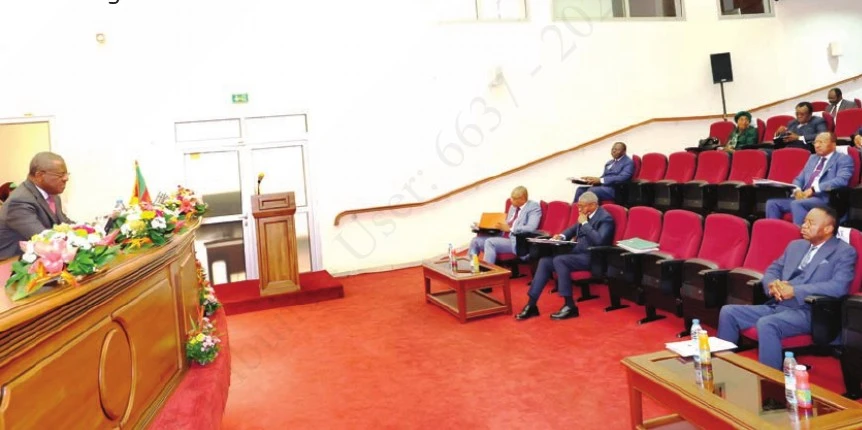
The Cameroonian government has taken decisive steps to shape its economic trajectory for the next three years. During a high-level cabinet meeting held on June 26, 2026, chaired by Prime Minister Joseph Dion Ngute, critical decisions were made regarding the 2027-2029 national budgets. With projected growth at 3.5% for 2026 and a commitment to keeping public debt under 50% of GDP, these strategic choices will define the country’s financial landscape for the coming four-year period.
Macroeconomic framework and fiscal discipline
The Deputy Minister of Finance outlined the broader economic context. The global economy remains under strain from the lingering effects of the 2026 Middle East conflict, which has slowed worldwide growth from 3.4% in 2025 to 3.1% in 2026, with a modest recovery to 3.2% expected in 2027. Cameroon, however, is projected to maintain a steady growth rate of 3.5% in 2026 and 3.7% in 2027, while inflation continues its downward trend.
The push for fiscal discipline appears closely aligned with ongoing negotiations for a new Economic and Financial Program with the International Monetary Fund (IMF). A key objective is to cap public debt at less than 50% of GDP. To achieve this, the government will focus on boosting non-oil domestic revenue and optimizing public expenditure, ensuring that every franc is spent with maximum efficiency.
Investment priorities for 2027-2029
The Minister of Economy, Planning and Territorial Development presented the Priority Investment Program for 2027-2029. This ambitious plan targets multiple sectors: digital infrastructure, road networks, railway expansion, energy, water supply, agriculture and industry. Among the top priorities is the rapid deployment of digital infrastructure and an increase in electricity generation capacity to meet growing demand.
Impact on citizens: social inclusion and economic empowerment
On the social front, the government is prioritizing the extension of the universal health insurance system to vulnerable populations. Additionally, the Special Fund for Women’s Economic Empowerment and Youth Employment will receive accelerated funding. These initiatives aim to reduce inequality and foster inclusive growth.
The cabinet also adopted an Economic and Budgetary Programming Document for 2027-2029, which will be submitted to Parliament as part of the Budget Orientation Debate. While this is a formal step, it provides a binding framework for all ministries moving forward.
Prime Minister Joseph Dion Ngute has directed the Minister of Finance to finalize the document promptly, in close collaboration with the Ministry of Economy. The use of performance contracts for public projects is set to become standard practice across all government agencies.