Burundi urges stronger international commitment amidst eastern DRC violence and unfulfilled peace accords
- Sécurité
As the current chair of the African Union and a key witness to the Washington Peace Accord between Félix Tshisekedi of the Democratic Republic of Congo (RDC) and Paul Kagame of Rwanda, brokered by then-United States President Donald Trump, Burundi expresses profound disappointment. This pivotal initiative, spearheaded by the Trump administration, has regrettably failed to deliver its anticipated outcomes on the ground, with hostilities persisting between Congolese government forces and the AFC/M23 rebellion, which continues to receive support from Rwanda in the Eastern RDC.
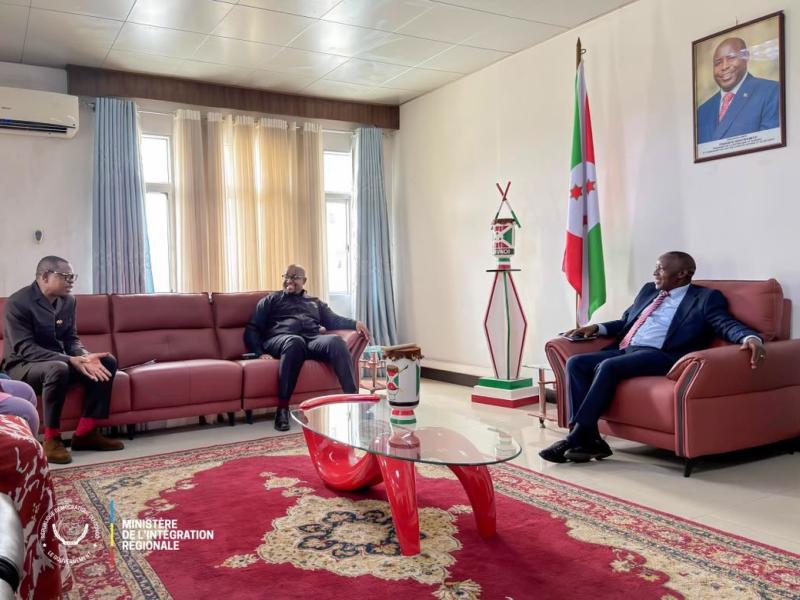
This sentiment was conveyed by Burundian Minister of Foreign Affairs, Regional Integration, and Development Cooperation, Ambassador Édouard Bizimana, during his meeting with his Congolese counterpart, Floribert Anzuluni, Minister of Regional Integration. During their discussions on Monday, June 1, in Bujumbura, the Burundian official lamented that despite some Congolese citizens returning home, widespread insecurity continues to plague numerous areas, triggering fresh displacements towards neighboring countries. He urgently called for robust engagement from the international community.
“Regarding peace and security in the region, Minister Édouard Bizimana voiced regret that the agreements between the RDC and Rwanda, facilitated by Washington, have not been fully honored. He highlighted that while some improvements have allowed refugees to return, other regions face a resurgence of instability, leading to new waves of displacement into neighboring nations. He emphasized the critical need for increased international involvement to bolster existing regional initiatives,” the Burundian Ministry of Foreign Affairs reported.
During the same high-level meeting, both authorities commended the strong bilateral and diplomatic ties between Burundi and the RDC, reaffirming their commitment to further strengthening these relations. Beyond the pressing security situation in the Eastern RDC, various other matters of mutual interest were addressed. These included discussions on the land allocated for the future Burundian embassy in Kinshasa, the administration of the Executive Secretariat of the International Conference on the Great Lakes Region (CIRGL), and preparations for the upcoming ordinary summit of CIRGL Heads of State and Government, an organization currently led by the Democratic Republic of Congo.
For his part, Congolese Minister Floribert Anzuluni expressed sincere appreciation for Burundi’s diplomatic endeavors, particularly its vital role in mobilizing humanitarian assistance for Congolese refugees residing in camps within Burundi. Concerning the CIRGL, he informed his counterpart about an impending Troika meeting, designed to review the regional security landscape and assess the statutory contributions from member states.
Minister Édouard Bizimana reiterated Burundi’s unwavering commitment to silencing the guns across the African continent. This objective stands as one of the primary goals set by Burundian President Évariste Ndayishimiye upon assuming the presidency of the African Union, succeeding his Angolan counterpart, João Lourenço.
Within the Great Lakes region, Burundi and the Democratic Republic of Congo (RDC) stand as strategic allies, bound by a bilateral defense agreement inked in March 2023. In response to the escalating insecurity in the Eastern RDC and what Kinshasa describes as Rwandan aggression through the AFC/M23 rebellion and its associated groups active in South Kivu, Bujumbura has deployed thousands of soldiers to support the Congolese army (FARDC) and secure their shared border. This military alliance encompasses multiple facets of cooperation.
Since the signing of the joint communiqué in Montreux, Switzerland, from April 13 to 17, 2026, between representatives of the RDC government and the Alliance Fleuve Congo/Mouvement du 23 mars (AFC/M23)—with mediation from the United States of America, the State of Qatar, and the Republic of Togo (acting as an African Union mediator)—the situation remains fraught with mutual accusations of ceasefire violations and non-adherence to commitments. The Washington process faces similar challenges; despite numerous meetings, the situation shows no improvement, as each party interprets the accord’s terms differently, hindering its effective implementation.
This diplomatic stalemate, unfolding under the watchful eyes of mediators like the United States and Qatar, continues to severely undermine the security situation, with ongoing combat in the Eastern Democratic Republic of Congo.
