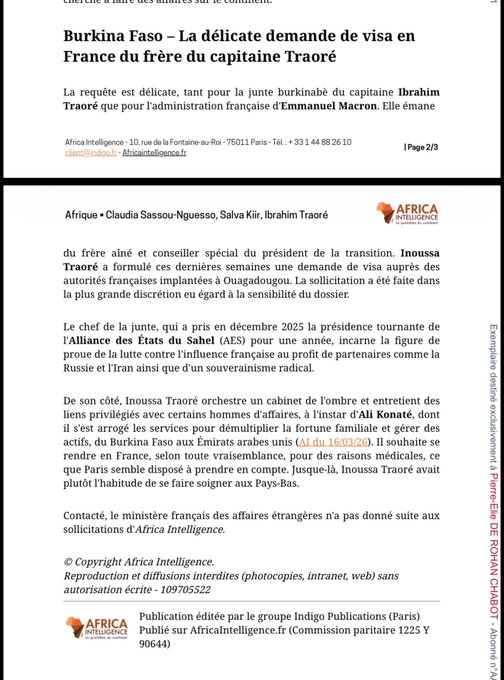
Burkina Faso’s Traoré family confronts France publicly but seeks visas privately
The Burkina Faso government has spent over two years cultivating a sharp break from France, with President Captain Ibrahim Traoré positioning the former colonial power as a symbol of oppression that his nation must escape. From expelling French troops to denouncing Western influence and forging alliances with Russia and Iran, Ouagadougou has made confrontation a cornerstone of its official narrative.
Yet beneath the bold rhetoric, whispers of a more nuanced reality persist. A confidential report indicates that Inoussa Traoré, elder brother of the Head of State and reputedly a key advisor to President Traoré, may have quietly submitted a visa application at the French embassy in Ouagadougou. The request appears to have been handled with extreme discretion, a necessity given the explosive nature of the request.
According to the same report, Inoussa Traoré’s stated purpose for the trip is medical treatment in France—a destination he had previously avoided, opting instead for the Netherlands for healthcare. French foreign ministry officials have neither confirmed nor denied the claim, leaving the claim hanging in the balance.
Public opposition, private necessity
The potential visa request highlights a growing dissonance in Burkina Faso’s strategy. Since taking office, Ibrahim Traoré has built his political identity on a defiant stance toward Paris, with official speeches routinely condemning France as a source of past and present exploitation. Yet the very idea that a close advisor to the president might seek entry into the country his administration publicly vilifies raises pointed questions.
Critics of the regime have long argued that the sovereignist rhetoric masks a gap between public posturing and private decisions. When high-ranking officials quietly pursue visas, medical care, or financial opportunities in countries they publicly condemn, it fuels accusations of hypocrisy. The Traoré family’s alleged request—if true—could become a rallying cry for opponents who see it as proof of a leadership that preaches one thing and practices another.
Sovereignty in words versus necessity in action
Ouagadougou’s leadership has repeatedly declared an era of complete independence, vowing to sever ties with former colonial patrons. However, practical realities often defy political slogans. Despite fiery speeches against Western influence, African leaders—including those in Burkina Faso—frequently travel to Europe for specialized medical treatment, business, or administrative needs.
The case involving the Traoré family could reinforce perceptions of a double standard: a public posture of defiance toward France, while private circumstances drive individuals to seek its services when required. Such contradictions do not necessarily invalidate the regime’s political stance, but they do invite closer scrutiny of its credibility and consistency.
Politics of perception and the weight of actions
In the realm of governance, words carry weight, but actions often speak louder. When a government publicly brands a nation as an adversary, any private engagement with that nation becomes a subject of intense debate. While such actions do not automatically signal political inconsistency, they do prompt broader reflection on the feasibility—and sincerity—of a sovereignist agenda that rejects cooperation with historical partners.
If this visa request is confirmed, it would underscore the tension between Burkina Faso’s bold rhetoric and the lived realities of its leaders. It would also serve as a reminder that even the most strident declarations of independence cannot always override personal or institutional necessities—especially when it comes to matters as fundamental as health and security.
