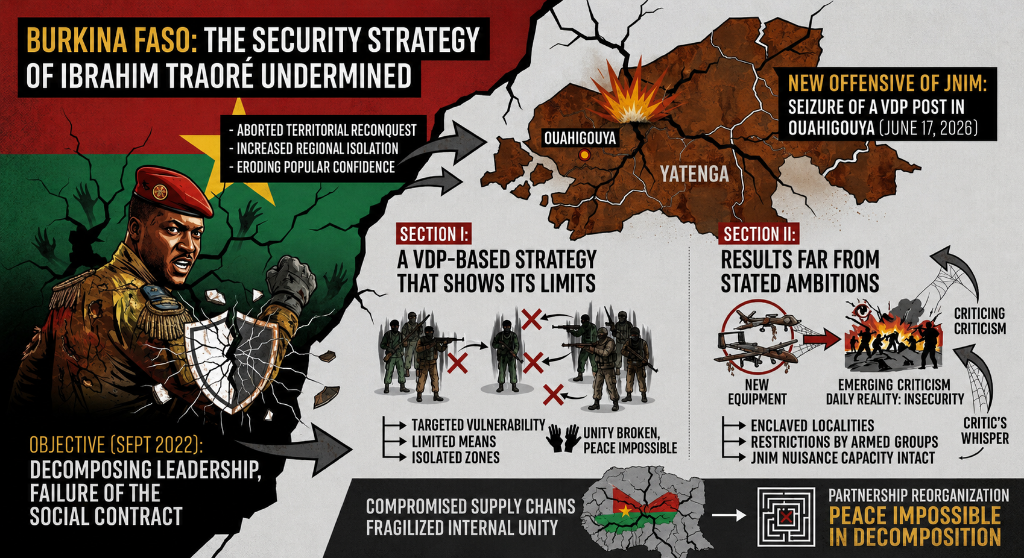
Burkina Faso’s security strategy falters after JNIM assault in Ouahigouya
The security landscape in Burkina Faso continues to deteriorate as the Group for the Support of Islam and Muslims (JNIM), affiliated with Al-Qaïda in the Sahel, claimed responsibility for an attack on a Volunteers for the Defense of the Homeland (VDP) outpost near Ouahigouya on June 17, 2026. The assault occurred in the Yatenga province, northern Burkina Faso, underscoring persistent challenges in the region.
Mounting setbacks for the transitional government’s territorial recovery plan
The latest offensive represents another blow to the security strategy implemented by the transitional authorities led by Captain Ibrahim Traoré. Since assuming power in September 2022, Traoré has prioritized restoring state control over the entire national territory, yet recent events have cast doubt on the effectiveness of this approach.
Civil defense units exposed as primary targets
Faced with shortages in regular army personnel, Burkina Faso has increasingly relied on VDP units to bolster security efforts. However, these civilian defense forces, often deployed in remote and under-resourced areas, have proven vulnerable to coordinated attacks by armed groups. The Ouahigouya incident is the latest in a string of reversals that have highlighted the limitations of this strategy.
Despite ongoing military operations, several strategic positions remain precarious, with reports indicating that the JNIM maintains significant operational freedom in northern and eastern regions. Analysts suggest that the group retains both the capability and mobility to sustain pressure on state forces and civilian populations alike.
Gaps between official claims and ground realities
While government officials frequently highlight advancements in military capabilities—such as the acquisition of surveillance and combat drones—the daily lives of many Burkinabè remain dominated by insecurity. Entire communities remain cut off from essential services due to ongoing blockades imposed by militant factions, reinforcing a sense of abandonment among the populace.
The erosion of public confidence in the transitional government’s handling of the crisis has intensified scrutiny of its security policies. The very justification for the 2022 overthrow of the civilian administration—its failure to protect citizens—now resurfaces as a central point of contention in national discourse.
Regional alliances and the path forward
As Ouagadougou strengthens its collaboration within the Alliance of Sahel States (AES) framework and prepares to escalate military operations in 2026, the Yatenga attack serves as a stark reminder of the complexities inherent in countering asymmetric warfare through conventional means. The evolving dynamics underscore the need for a more comprehensive approach that addresses both military and socio-economic vulnerabilities in the Sahel.
