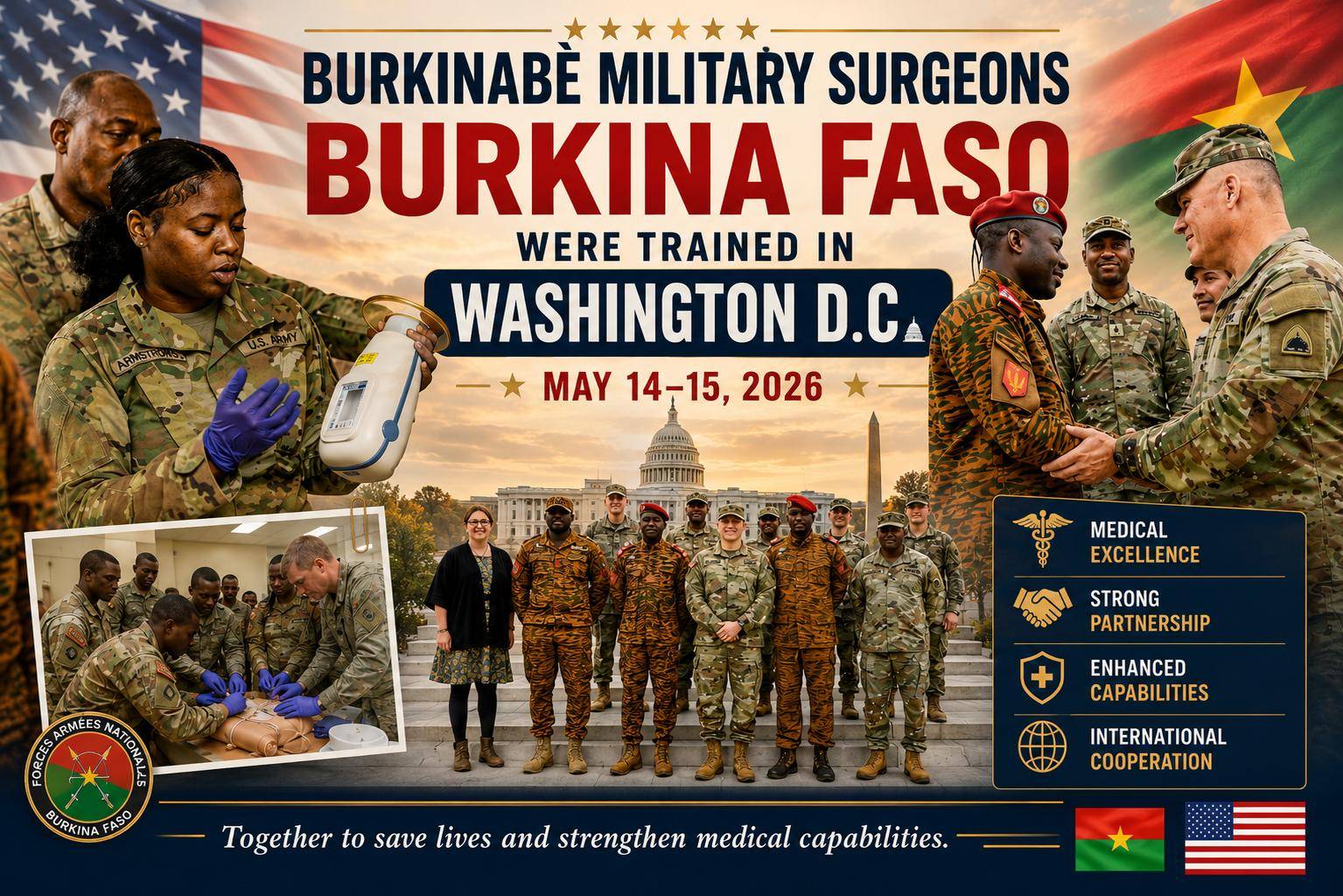
Burkina Faso military doctors train in the us amid shifting alliances
The diplomatic landscape of the Sahel is rarely as straightforward as it appears. Despite increasingly vocal criticism of Western powers within the Alliance of Sahel States (AES), recent actions reveal a far more pragmatic approach behind the scenes. In mid-May 2026, a delegation of Burkinabè military surgeons traveled to Washington D.C. for a high-level exchange with the U.S. National Guard, part of the State Partnership Program (SPP). Officially announced on June 6 by the U.S. Embassy in Ouagadougou, this medical collaboration raises a critical question: why do Sahelian nations, while deepening ties with Moscow, still rely on traditional Western partners they publicly condemn?
An unassuming yet high-stakes medical mission
The announcement, released in a concise communiqué, detailed a two-day visit by Burkinabè military surgeons to the U.S. capital. The objective was clear: to enhance expertise in wartime trauma care, combat surgery, and emergency medical protocols in hostile environments. For a nation grappling with an asymmetric conflict, this direct knowledge transfer is invaluable, offering life-saving skills to soldiers on the front lines.
The AES paradox: sovereignty vs. operational necessity
The timing of this mission underscores a glaring contradiction in Sahelian geopolitics. Since the formation of the AES—comprising Burkina Faso, Mali, and Niger—public rhetoric has grown increasingly hostile toward the West. Leaders have repeatedly accused former colonial powers, particularly France, of complicity in the region’s security crisis, alleging passive or even indirect support for terrorist factions.
Yet, behind closed doors, technical cooperation with the United States remains not only active but expanding. How can senior Burkinabè officers engage with U.S. institutions while their governments advocate for a clean break from Western influence? The answer lies in the harsh realities of warfare: operational pragmatism often trumps ideological posturing when lives are at stake.
Why Russian military medicine falls short in critical care
Since severing ties with France, Burkina Faso and its AES partners have heavily invested in collaboration with Russia. Moscow’s support includes combat equipment, air assets, tactical instructors, and direct security assistance. However, when it comes to advanced military medical training, the U.S. remains the preferred partner. The reason is simple: the American model of wartime medicine is unparalleled, refined through decades of global deployments and grounded in globally recognized academic standards.
Western military medical traditions also align seamlessly with Burkinabè protocols. From evacuation procedures to equipment formats and foundational training, compatibility is already established. In contrast, Russia’s military medical support tends to focus more on tactical field support and hard security, leaving gaps in specialized trauma care and surgical innovation. For now, Moscow’s offerings do not match the precision required to address Burkina Faso’s most pressing wartime medical challenges.
A discreet but mutually beneficial diplomatic strategy
For Washington, sustaining the SPP is a strategic imperative. As American influence wanes across the Sahel—evidenced by the forced withdrawal from neighboring Niger—the U.S. seeks to maintain a foothold in Burkina Faso through non-confrontational channels. Medical diplomacy allows for quiet engagement with the Burkinabè military elite, avoiding public backlash while preserving critical trust.
For Captain Ibrahim Traoré and his command, this collaboration is a lifeline. It demonstrates Burkina Faso’s refusal to isolate itself entirely, even as it champions AES solidarity and sovereign rhetoric. By selectively leveraging partnerships, the country secures the best tools available to strengthen its armed forces.
A sovereignty tailored to survival
The Washington medical exchange is a stark reminder that Sahelian geopolitics cannot be reduced to slogans or symbolic gestures. Beneath the noise of public declarations and global alliance games, the central priority remains the survival of the Burkinabè state in the face of terrorism.
By choosing U.S. military medical training over political consistency, Burkina Faso prioritizes the lives of its soldiers. It is a paradox that saves lives today, proving that in the art of war, health diplomacy follows a logic far removed from the rhetoric of podiums.
