
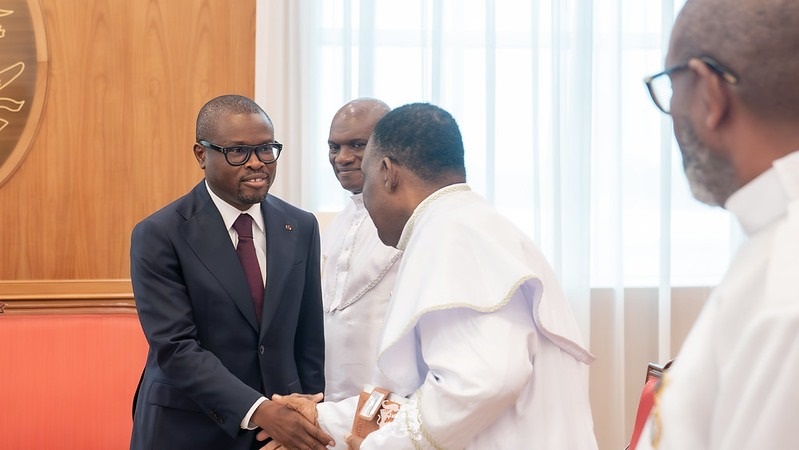
The June 4, 2026 meeting between newly elected President Romuald Wadagni and a delegation from the Celestial Christianity Church in Cotonou reveals an unprecedented political strategy: a seamless transition where outgoing President Patrice Talon and his successor orchestrate a continuity plan with surgical precision.
Beyond symbolic gestures, this dossier exposes the depth of Benin’s institutional maturity. The reunification process of the Celestial Christianity Church, though unfolding in theological consultation rooms rather than grand public stages, demands absolute state commitment. Any hesitation from authorities could signal fragility to the Church’s factions, potentially derailing a process that has mobilized millions across continents.
Two presidents, one dossier: the significance of their shared presence
Consider the moment when Patrice Talon and Romuald Wadagni stood side by side during the handover of the Superior Council of Labor’s conclusions. Talon, still in office, and Wadagni, already elected but not yet sworn in, delivered a powerful message: this dossier would not fall victim to election-cycle politics. Their proximity was no accident—it was a deliberate political signal that continuity had been negotiated long before the formal transfer of power.
«A president leaving office rarely involves their successor in such a sensitive file so early. This reveals how thoroughly they’ve approached the transition.»
The June 4 sequence demonstrated textbook coordination: Talon installed the Council tasked with implementing the Superior Council’s recommendations in the morning, while Wadagni hosted the same delegation that evening. The choreography was flawless: one legitimized the structure, the other activated it. The message was clear—Benin’s governance machine would not stall.
Facilitator and guarantor: a division of roles designed for impact
Patrice Talon assumed the role of facilitator—a mediator who creates dialogue conditions without imposing solutions. His historical legitimacy on this file stems from launching the process during his mandate, structuring it through the Superior Council, and delivering actionable recommendations. To the Church’s leadership, he remains the guarantor of this journey.
Romuald Wadagni, in turn, embodies active continuity. His engagement went beyond formalities. Delegation members noted how he probed deeply into the dossier, asked targeted questions, and demonstrated intimate knowledge. «He didn’t just listen—he engaged. This wasn’t a courtesy call; it was a strategic briefing.»
Testing the strength of Benin’s leadership cohesion
This dossier serves as a stress test for Benin’s top leadership. In many African transitions, files inherited from predecessors languish in institutional limbo—neither abandoned nor fully adopted. The temptation to reset agendas or let momentum fade is strong.
Here, the opposite occurs. By prioritizing a file initiated by his predecessor within weeks of taking office, Wadagni establishes a governance principle: state continuity outweighs agenda disruption. Observers call this «the real transition test»—one that could define his presidency’s early tone.
A diplomatic ripple beyond Benin’s borders
Reducing this dossier to domestic politics would miss its global implications. The Celestial Christianity Church, with followers across continents, could see its reunification become an international milestone. As the Church’s country of origin, Benin is positioned as the epicenter of a religious reconciliation that transcends Cotonou.
The two presidents’ involvement elevates this from a local governance story to a soft power showcase. By mediating a religious reconciliation rather than wielding hard power, Benin asserts influence through moral authority—a distinct form of diplomacy in West Africa.
Thus, the June 4 audience wasn’t merely a religious courtesy. It was an act of foreign policy, national cohesion, and concrete proof that Benin’s transition has moved beyond protocol to substance.