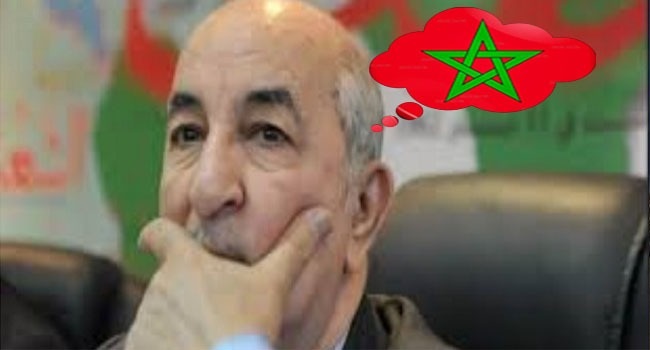
Algeria’s political landscape: when anti-Morocco sentiment becomes a political currency
A relentless contest of vilification and an escalation in hostile rhetoric appear to have been unleashed from the highest echelons of Algerian power, driven by a singular obsession: Morocco. Critics within Algeria, observing this disturbing trend, assert that this public display of animosity, openly embraced and fostered by President Abdelmadjid Tebboune’s administration, is a relatively recent development.
Conversely, some observers contend that this underlying hostility towards Morocco has always existed, with its current eruptive manifestation merely amplified by the pervasive influence of social media. However, this perspective often overlooks a crucial parallel: the Tebboune government’s establishment of AL24 News, a television channel whose editorial direction seems predominantly dedicated to extolling President Tebboune while simultaneously unleashing torrents of vitriol against Morocco.
Viewers tuning into its broadcasts, whether live or via social media platforms, cannot help but notice the disturbing level of morbid glee displayed by some of its propagandist “journalists” when the subject of Morocco arises. Each presenter seemingly strives to craft the most cutting remark, the most impactful “punchline” to disparage the Kingdom’s image, without any restraint or oversight, exhibiting an overwhelming excess of zeal. The factual basis of these attacks seems inconsequential; the primary objective is simply for the insult to land its intended blow.
Regarding Morocco, the official Algerian media’s communication has plummeted to ludicrous depths. It has reached a point where the very name of the Kingdom is deliberately omitted in certain sports summaries, presumably in a misguided attempt to avoid “glorifying the country.” This peculiar situation first gained prominence during the World Cup in Qatar, when the Moroccan national team achieved a semi-final berth—a feat celebrated globally by nearly everyone, save for Algerian television. Today, a similarly bleak scenario unfolds with the upcoming 2026 World Cup, where Morocco’s name and achievements have once again become unmentionable.
“One such commentator recently spiraled into acute delusion, asserting that Lionel Messi, who scored three goals against the Algerian team, was manipulated by “the Jewish lobby” and that this entity was orchestrating events to make Algeria pay for its “support for Western Sahara and the Palestinian cause.”
If shame could induce deafness, Algerian leaders would scarcely hear themselves breathe. How can one push such baseness and blind hatred to the extent of banning a country’s name from public airwaves, merely to avoid acknowledging its significant sporting achievements?
These outrageous excerpts, widely translated into French and English, underscore a particularly alarming trend with potential international repercussions. The Algerian regime appears not only to be a purveyor of animosity towards its neighbors but also a promoter of state-sponsored antisemitism, given that public television actively broadcasts and amplifies such extremist views. In the current global climate, this can be perceived as exceptionally serious on the international stage.
Evidently, Tebboune has unleashed a torrent of hate speech within Algeria. He seems to have contributed to forging a new, neurotic identity grounded in the logic: “Tell me who you hate, and I will tell you who you are.” This shift has also manifested in the proliferation of numerous social media influencers, widely perceived as close to the regime, who disseminate this discourse with barely concealed glee.
The animosity directed at Morocco has transformed into a lucrative political commodity in Algeria. It is a trade so profitable that, to ascend the ranks of power or secure positions of responsibility, one seemingly needs to demonstrate neither expertise nor skill, but merely an unyielding hatred for Morocco. This, it appears, has become the most valuable credential for rapid advancement within the circles of power. And, as reported, examples of this phenomenon are abundant.
