
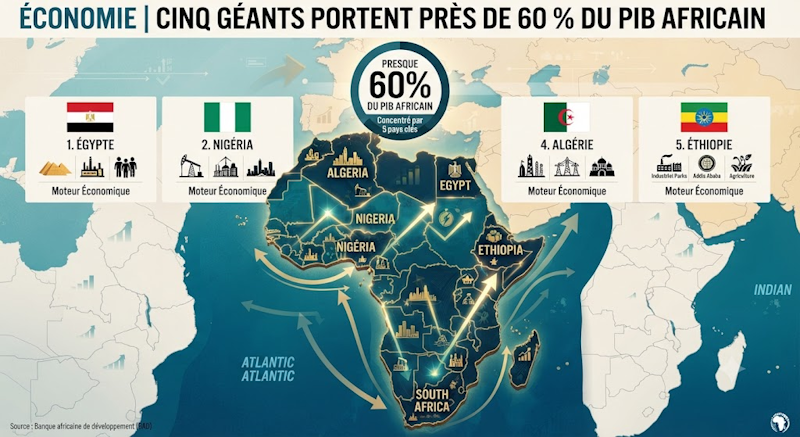
Fresh data from the African Development Bank reveals a striking imbalance: five African nations together account for nearly 60% of the continent’s gross domestic product. These economic heavyweights are the Egypt, Nigeria, South Africa, Algeria and Ethiopia—each playing a pivotal role in shaping Africa’s financial future.
This concentration of economic power underscores why these countries are often called the continent’s growth engines. Their combined influence stems from vast natural wealth, massive domestic markets, robust industrial bases and strategic infrastructure investments. Without their momentum, Africa’s overall economic progress would slow significantly.
What makes these five economies stand out?
Each of these nations brings a unique advantage to the table:
- Egypt and Nigeria benefit from enormous populations and increasingly diverse economic activities, reducing reliance on single sectors.
- South Africa remains the undisputed leader in industry and finance, acting as the continent’s financial nerve center.
- Algeria leverages its vast energy reserves and sustained public investment programs to fuel steady expansion.
- Ethiopia has emerged as a manufacturing and infrastructure powerhouse, with rapid industrialization and large-scale projects transforming its economic landscape.
A tale of two Africas
While these five nations pull the continent forward, the disparity in economic performance is impossible to ignore. Many African countries still struggle with industrial underdevelopment, weak economic diversification, limited access to capital and chronic unemployment. The gap between the continent’s top performers and those lagging behind continues to widen.
Economists warn that unless steps are taken to redistribute growth more evenly, the imbalance could deepen, leaving large parts of the continent behind. The challenge ahead is clear: how to translate the success of these economic giants into broader, inclusive prosperity across all 54 African nations.