
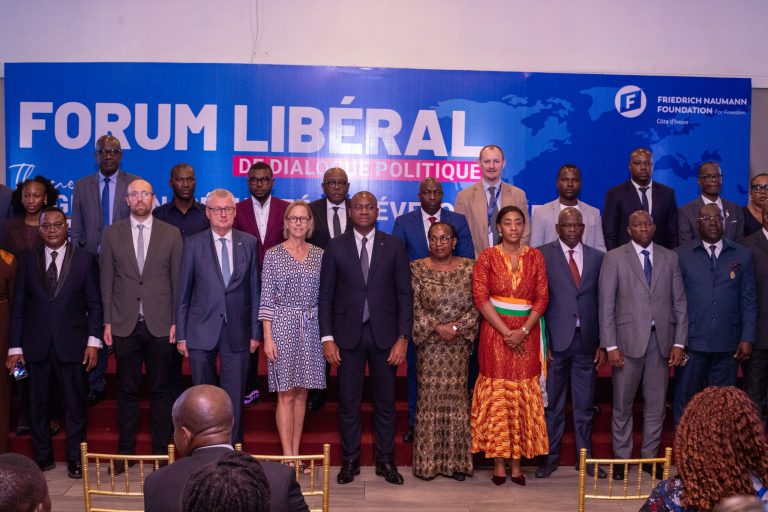
Abidjan played host to a pivotal political dialogue forum from July 15 to 16, 2026, where Sidi Touré, Vice-President of the Liberal International and Côte d’Ivoire’s Minister of Animal and Fisheries Resources, joined forces with Alexandra Heldt, Regional Director for West Africa at the Friedrich Naumann Foundation, to advocate for a fresh perspective on Africa-Europe migration dynamics.
During the opening of the Liberal Forum on Political Dialogue, centered on the theme “Migration, Security and Development: Rethinking the Africa-Europe Partnership”, the two leaders emphasized the need to move beyond restrictive security narratives that often overshadow the true nature of human mobility.
Migration as a natural phenomenon, not a crisis
Sidi Touré challenged the prevailing notion of migration as a problem, framing it instead as an inherent expression of human freedom. Citing United Nations data, he pointed out that migrants make up only 3.7% of the global population, while over 96% of people spend their entire lives within their country of birth. “The world is not being overwhelmed,” he asserted, urging a more nuanced understanding of migration patterns.
The Minister highlighted that 70% of African migration occurs within the continent itself, using the bustling daily movements at Adjamé’s main bus station as a real-life example. “This isn’t a crisis—it’s life,” he declared, while celebrating Côte d’Ivoire’s long-standing tradition of hospitality, encapsulated in the welcoming term Akwaba.
Regional tensions and the erosion of free movement
Addressing the withdrawal of Mali, Burkina Faso and Niger from ECOWAS, Sidi Touré expressed concern over the ripple effects on regional mobility. “Regardless of political differences, our peoples remain brothers, our economies are intertwined, and free movement represents a heritage we must safeguard,” he stressed. He urged participants to produce actionable recommendations, culminating in a policy paper to guide future cooperation.
Confronting xenophobia and embracing shared responsibility
Alexandra Heldt took the floor to condemn xenophobic rhetoric, both in Africa and Europe, drawing attention to recurring violence against migrants in South Africa since 2008. “No nation can build its future by blaming migrants for economic struggles,” she argued, while noting the paradox of European labor shortages amid rising anti-immigration sentiment.
She painted migration as a catalyst for exchange, innovation and entrepreneurship, emphasizing its role in bridging divides rather than erecting barriers. “Migrations foster connections between people far more than they create divisions,” she observed.
Calling for an “equitable Africa-Europe partnership rooted in mobility, shared accountability and democratic values,” she urged policymakers to shift the conversation from fear to trust, and from exclusion to collaboration.
Hospitality as a strategic asset
Sidi Touré closed the session by reaffirming that “hospitality is not a sign of weakness—it is a strength and a deliberate policy choice.” He underscored his commitment to positioning migration as a tool for shared prosperity, ensuring that the dialogue’s momentum translates into tangible outcomes.
The forum continued with in-depth panels exploring the legal, geopolitical and humanitarian dimensions of migration, fostering a space for robust exchange among stakeholders.