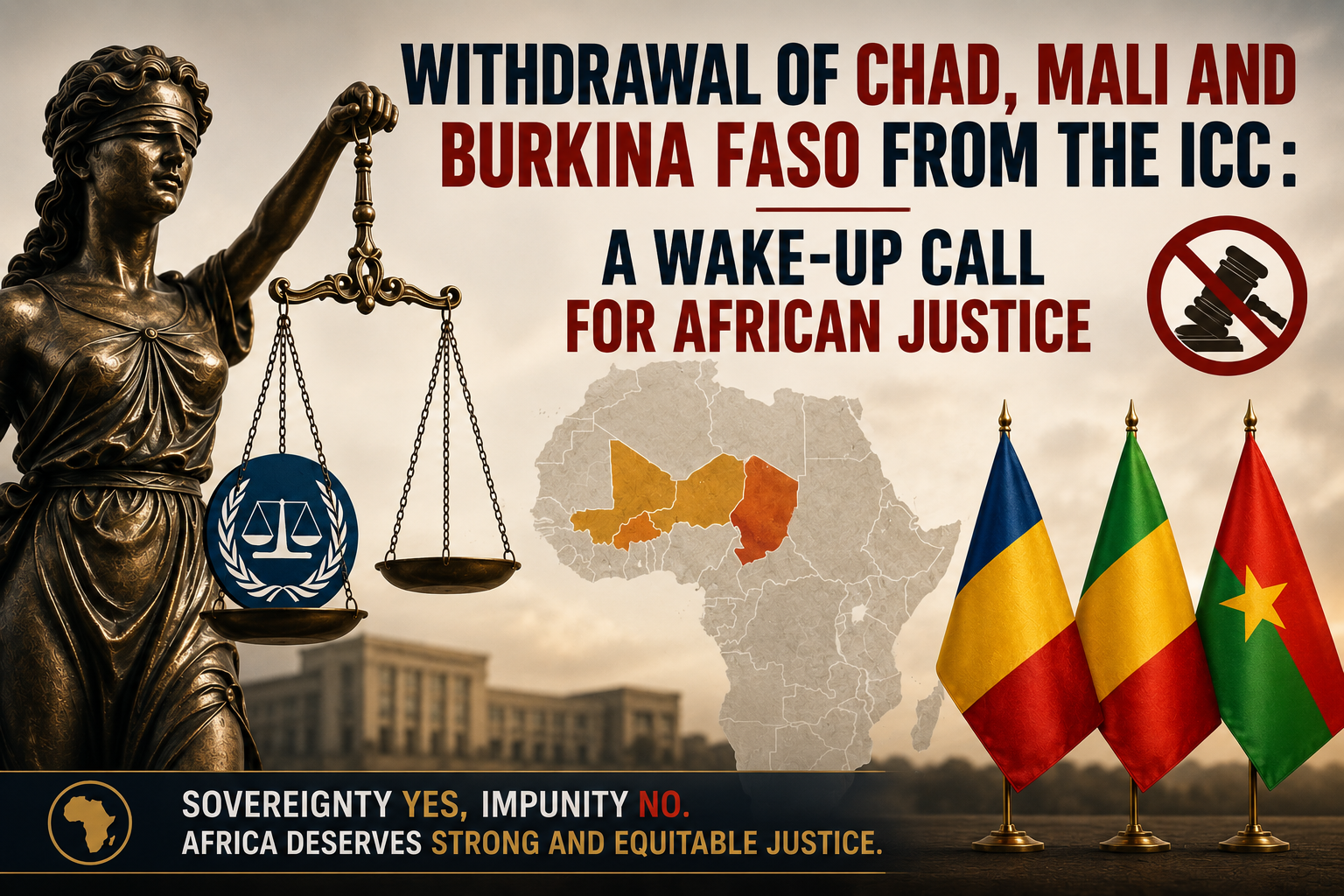
Withdrawal from the ICC raises critical questions for Sahel justice
The recent decision by Chad to withdraw from the Rome Statute of the International Criminal Court (ICC) follows similar moves by Mali, Burkina Faso, and Niger, marking a significant shift in the political and institutional landscape of the Sahel. While the withdrawal process for Chad was initiated on July 27, 2026, the legal implications of such a decision extend far beyond the immediate geopolitical implications.
Beyond Legal Disputes: A Crisis of Confidence
This collective departure from the ICC is not merely a legal dispute but reflects a deeper crisis of trust between certain African governments and international judicial institutions. The primary justification cited sovereignty raises critical questions: if these nations critique the ICC’s perceived ineffectiveness and selective application of justice, why have they not first established robust national and regional judicial mechanisms to address the same crimes?
The criticism of the ICC is not unfounded. Since its inception, the Court has faced recurring allegations of focusing disproportionately on African cases while major global powers remain outside the Rome Statute. The debates surrounding its operations, independence, and effectiveness are legitimate and demand serious consideration.
The Looming Threat of a Judicial Void
The withdrawal of these nations from the ICC does not erase the crimes within its jurisdiction crimes against humanity, war crimes, and grave violations of international law persist regardless of a state’s legal status. This concern is particularly acute in the Sahel, where conflicts have led to widespread allegations of atrocities committed by both armed groups and state forces.
Human rights organizations have long documented violence against civilians and highlighted systemic barriers to justice and reparations. The potential withdrawal of the ICC in these contexts could further deprive victims of avenues for truth, accountability, and redress.
Can National Justice Fill the Gap?
A strong national judiciary can indeed address grave crimes more effectively, offering victims proximity to justice, faster proceedings, and solutions tailored to local realities. However, this requires absolute independence from political influence, adequate resources, and the capacity to investigate all parties involved in a conflict.
Without these safeguards, the principle of judicial sovereignty risks becoming a shield for impunity rather than a tool for justice.
The ICC Withdrawal: A Temporary Respite
It is essential to clarify that withdrawal from the Rome Statute does not immediately absolve a state of its obligations. The Statute outlines a precise withdrawal procedure: for Chad, the notification was submitted on July 27, 2026, with the formal exit taking effect one year later. During this period, the country remains bound by its obligations. Additionally, the Court retains jurisdiction over crimes committed prior to the withdrawal’s effective date.
This nuance underscores that exiting the ICC is not a swift mechanism to evade accountability. However, it also begs the question: once withdrawal is complete, what systems will ensure that perpetrators of international crimes cannot exploit weakened oversight?
The Promise and Pitfalls of African Justice
Proponents of withdrawal often advocate for a more independent African justice system, better aligned with the continent’s realities. While this aspiration is commendable, it must move beyond political rhetoric to tangible action.
A credible African justice system must possess the capacity to investigate crimes committed by all parties, including state actors. It should guarantee judicial independence, witness protection, victim access to justice, and the ability to prosecute high-ranking officials without political interference.
The trial of Hissène Habré serves as a testament to what African judicial mechanisms can achieve. The challenge now is to institutionalize this capacity across the continent.
The Danger of Politicized Justice
In contexts where power is concentrated and political freedoms are restricted, the risk of justice becoming a tool of the ruling elite is high. Sovereignty, in this sense, cannot be a one-sided argument—it must also encompass the right of citizens to hold powerful figures accountable.
If a government withdraws from the ICC under the pretext of defending sovereignty, it must demonstrate an unwavering commitment to an even more robust and impartial judicial system at home. Otherwise, sovereignty risks being invoked solely to shield leaders from scrutiny.
The Human Cost of a Fractured Justice System
For families in conflict zones, the debates in The Hague may feel distant. Yet the question remains starkly real: who will investigate these crimes, who will listen to witnesses, and who will deliver justice? The ICC, despite its flaws, represents an additional layer of protection when national institutions fail or refuse to act.
The erosion of this safety net could have dire consequences for victims of grave violations.
This is not to suggest that the ICC is beyond reproach. Criticisms of its operations must be acknowledged and addressed to demand meaningful reforms. However, abandoning international justice mechanisms wholesale is not the solution to perceived injustices.
A Fragile International System
The successive withdrawals from the ICC occur at a time when the Court itself faces significant institutional challenges, including international pressure and leadership renewal difficulties. Each departure further diminishes the Court’s political and geographical reach, risking a future where states only engage with international institutions when it serves their interests.
This trajectory undermines the very foundation of a rules-based international justice system, which must apply universally and impartially.
Building a Credible Alternative
The withdrawal from the ICC should not be an endpoint but a catalyst for stronger, more accountable judicial systems. For Sahel nations seeking to assert sovereignty through justice, the path forward requires concrete actions: empowering national courts, ensuring judicial independence, protecting witnesses, documenting atrocities, providing reparations for victims, and establishing regional mechanisms capable of prosecuting the gravest crimes.
Only by fulfilling these commitments can the rhetoric of judicial sovereignty transition into a tangible reality.
Otherwise, the risk is clear: moving from an imperfect international system to one where victims have fewer recourses and perpetrators face fewer consequences. The true test of sovereignty lies not in rejecting oversight but in building a justice system that holds everyone regardless of power or status accountable under the law.
