
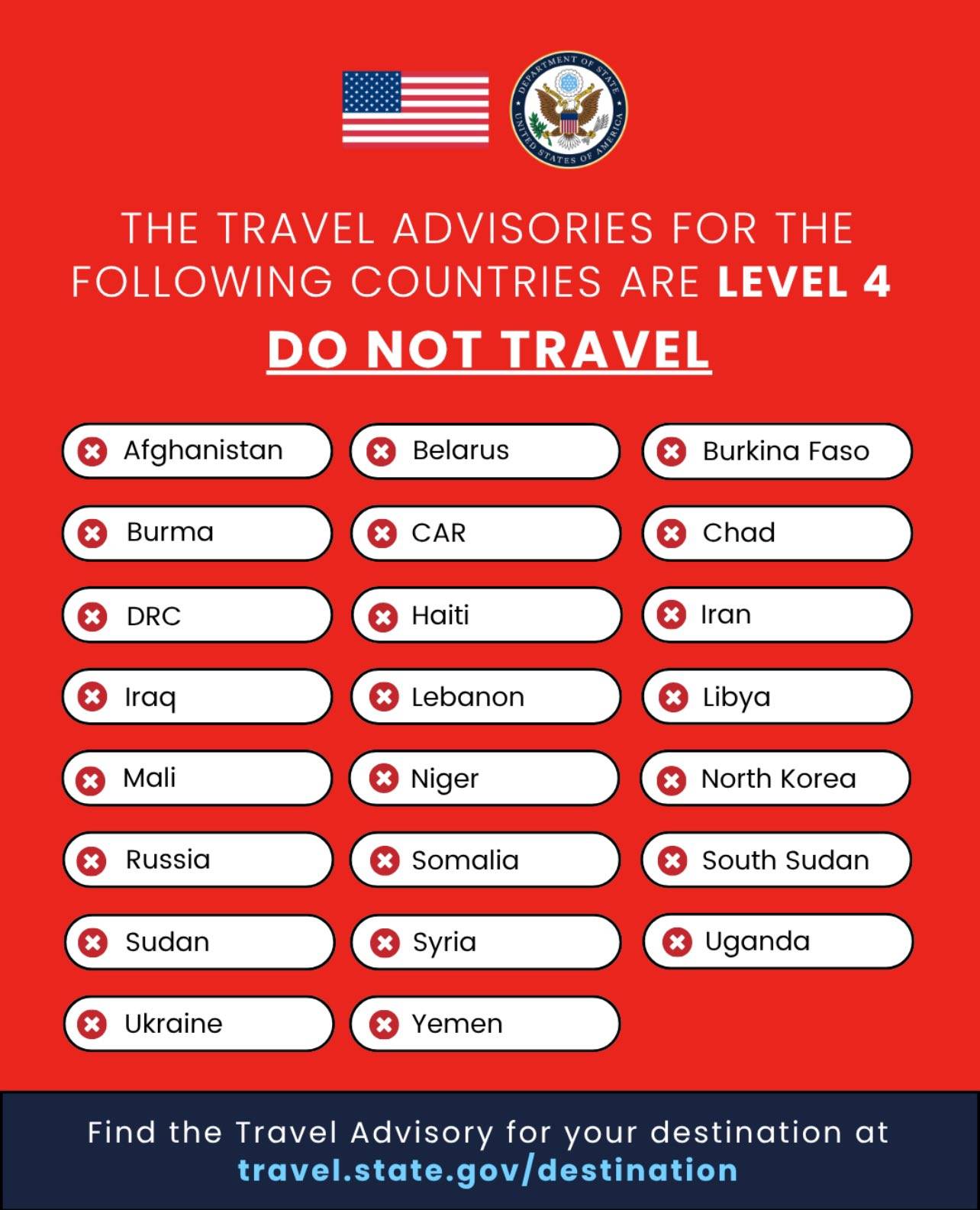
The United States Department of State has once again updated its global travel advisory, placing 23 countries under the highest risk level—Level 4: Do Not Travel. Among the nations facing this severe classification are Russia, the Democratic Republic of the Congo (DRC), Chad, and notably the three Sahel nations within the Alliance of Sahel States (AES): Burkina Faso, Mali, and Niger. The driving force behind this decision is an unprecedented security crisis fueled by the relentless expansion of terrorist networks across West Africa’s Sahel region, now widely recognized as a global hotspot for instability.
Washington’s stern warning: what Level 4 means for travelers
The U.S. government’s travel advisory system uses a four-tier scale to assess safety risks, with Level 4 representing an extreme threat. When a country is classified at this level, it is effectively off-limits to American citizens, as the State Department strongly advises against all travel there. The rationale behind this warning is the near-total absence of consular or emergency medical assistance for U.S. nationals in these high-risk zones. Many diplomatic missions have scaled back operations or relocated essential staff, leaving travelers without critical support in emergencies.
This updated advisory underscores a stark geopolitical reality: large segments of the globe are slipping from state control, leaving Western citizens increasingly vulnerable to kidnapping, terrorist attacks, and hostage situations.
The AES in the crosshairs: Burkina Faso, Mali, and Niger face existential threats
The collective placement of Burkina Faso, Mali, and Niger under the highest alert level reflects the deepening instability gripping the region. These nations, united under the Alliance of Sahel States (AES), are grappling with overlapping crises—military transitions, severed ties with traditional Western allies like France and the European Union, and a security vacuum exploited by armed groups.
The roots of this turmoil are deeply entrenched. Weak state presence in remote and border areas, systemic poverty that fuels recruitment by militant factions, and shifting military alliances—particularly the withdrawal of Western forces and the embrace of new partnerships with Russia—have created a volatile environment. The effectiveness of these new alliances remains unproven, leaving local populations and foreign observers alike in the dark about the region’s future stability.
The unrelenting advance of terrorism
The primary justification for the U.S. State Department’s Level 4 designation for the AES countries is the accelerating territorial expansion of terrorist organizations. Groups such as the Support Group for Islam and Muslims (JNIM), affiliated with Al-Qaeda, and the Islamic State in the Greater Sahara (EIGS) are no longer confined to isolated desert sanctuaries. They now conduct coordinated attacks and steadily extend their influence, posing an ever-growing threat to civilians and security forces alike.
Country-specific crises: a closer look at the Sahel’s collapse
Burkina Faso: a nation under siege
Burkina Faso stands as the most severely impacted nation within the AES. Large swathes of its territory are either under militant control or encircled by armed groups, subjecting entire communities to strict blockades. Access to food, medical supplies, and basic services is severely restricted in these besieged areas. Daily assaults on military convoys and outposts have triggered massive internal displacement, displacing hundreds of thousands of civilians who now live in makeshift camps or overcrowded urban centers.
Mali: from north to south, violence spreads
In Mali, the security situation has deteriorated sharply following the departure of the United Nations Multidimensional Integrated Stabilization Mission in Mali (MINUSMA) and the resurgence of hostilities between the Malian armed forces and northern rebel factions. Terrorist groups have seized on this power vacuum to intensify violent incursions. What was once considered a relatively safe zone—including the capital, Bamako—now faces mounting threats, with militant activity creeping closer to urban centers.
Niger: the triple-border battleground
Niger finds itself squeezed between two major insurgencies. To the west, along the volatile tri-border area shared with Mali and Burkina Faso, and to the southeast, near Lake Chad, where Boko Haram and the Islamic State’s West Africa Province (ISWAP) remain active. Despite efforts to reorganize its military, Niger continues to struggle with endemic insecurity. Regional diplomatic tensions further hamper cross-border cooperation, leaving Niger vulnerable to attacks and complicating efforts to stabilize the region.
Global instability: beyond the Sahel
While the Sahel dominates the headlines, the U.S. travel advisory extends its warnings to a broader array of countries grappling with high-intensity conflicts and political instability. Russia, for instance, remains at Level 4 due to the ongoing war in Ukraine, arbitrary detentions of foreigners, and the unpredictable enforcement of local laws. Meanwhile, eastern Democratic Republic of the Congo (DRC) remains a battleground for dozens of armed factions, including the M23 rebel group, which has been linked to widespread civilian massacres and kidnappings. Chad, sandwiched between the Sahel and Sudan’s war-torn landscape, faces spillover threats from terrorism, border conflicts, and the looming risk of civil unrest.
The ripple effects: economic and humanitarian fallout
A Level 4 classification carries severe economic and humanitarian consequences that extend far beyond tourism. For the AES nations, already struggling with fragility, this designation acts as a deterrent to foreign investment. Multinational corporations hesitate to deploy executives or launch infrastructure projects due to exorbitant insurance costs and safety concerns. The impact on humanitarian organizations is equally devastating. Strict security protocols imposed on international aid workers severely limit access to vulnerable populations, depriving communities of life-saving food, medical care, and educational opportunities.
No easy solutions: the Sahel’s security deadlock
The U.S. State Department’s decision to maintain the AES countries at Level 4 highlights the failure of past stabilization efforts. Despite political upheavals and realigned geopolitical strategies in Bamako, Ouagadougou, and Niamey, the security landscape remains dire, with civilians bearing the brunt of the crisis. Military solutions alone have proven insufficient. Until governance, social justice, economic development, and access to essential services are addressed, the Sahel’s map will likely remain painted in shades of red—a stark reminder of the region’s unyielding turmoil.