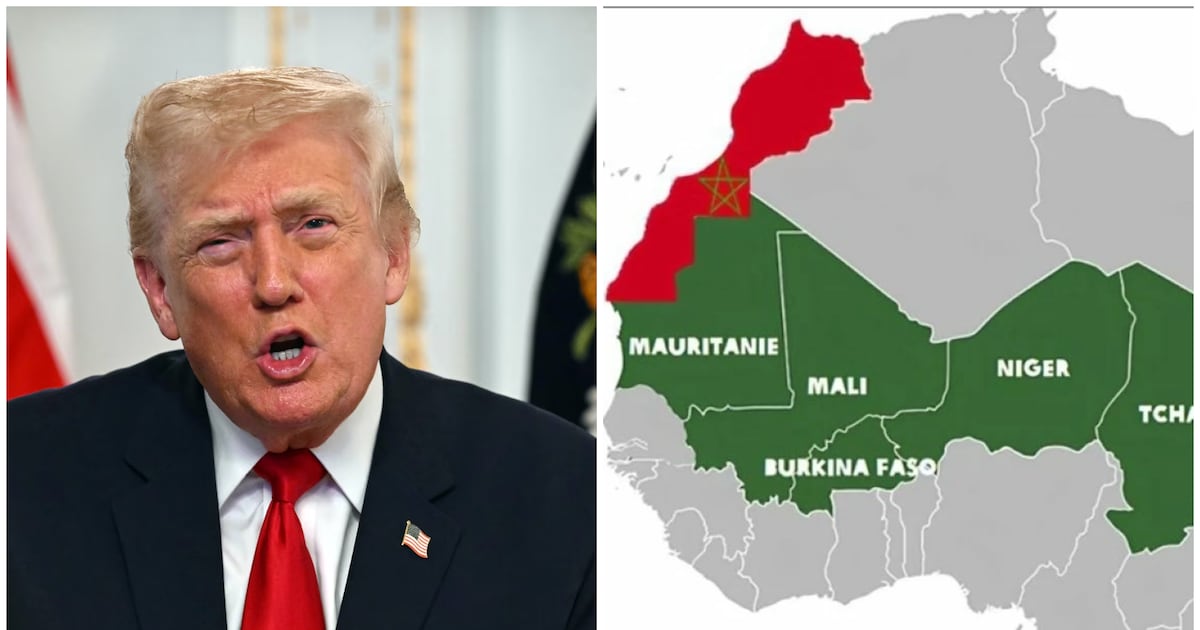
Us strategy in the Sahel: Morocco as the quiet power behind american influence
The geopolitical landscape of the Sahel is quietly shifting as traditional power players recalibrate their strategies. While European forces have gradually exited Mali, Burkina Faso, and Niger, and Russia has expanded its footprint through quasi-state entities, the United States appears to be regaining momentum in the region. However, according to Emmanuel Dupuy, president of the Institute for Prospective and Security in Europe (IPSE), this isn’t a full-scale return but rather a strategic repositioning. “It’s not a resurgence, but confirmation that they never truly left. They simply waited for the erosion of other influences before making their move,” he explains.
Dupuy argues that Washington has not abandoned the Sahel but has instead adopted a more discreet approach, allowing internal dynamics to realign and rival powers to weaken. This strategy aligns with the United States’ long-standing tradition of pragmatic engagement, where ideological differences take a backseat to security and economic interests.
Pragmatism over ideology: how the US navigates the Sahel
Dupuy emphasizes that American diplomacy prioritizes tangible outcomes over alignment with like-minded partners. “The Americans are transactional. They engage with actors whose values they may not share, as long as it serves their strategic goals,” he notes. This approach extends to their relationship with Russia, which Washington does not view as a direct threat but rather as a complementary player in the region’s evolving power structure.
“They see Russia not as a rival but as a counterpart that has filled the vacuum left by European withdrawals,” Dupuy adds. Rather than confrontation, the US and Russia appear to be operating in a space of mutual adjustment, each leveraging the gaps left by the other’s absence or weakening presence.
The United Nations’ waning credibility and Russia’s struggles to curb armed groups in the Sahel have created an opening for Washington to expand its influence indirectly. Dupuy highlights a key aspect of US methodology: structured engagement with local authorities, regardless of how they came to power. “This is the same approach they used in Afghanistan—dialogue first, negotiation later, even with groups like the Taliban,” he points out.
Morocco: the silent partner in US-Sahel strategy
Dupuy identifies Morocco as a critical but often overlooked player in this realignment. The strengthening ties between Rabat and Washington span military, economic, and diplomatic spheres, with potential for deeper cooperation in the Sahel. “Morocco is the ideal partner the US needs—a stable, well-regarded actor capable of engaging with post-coup governments in Mali, Niger, and Burkina Faso,” he states.
This partnership is further bolstered by Algeria’s diminishing influence in the region. Dupuy notes that Algeria’s strained relations with Bamako, particularly over religious and political alliances, have weakened its once-strong regional position. Meanwhile, Morocco’s religious diplomacy—through institutions like the Mohammed VI Institute for Training Imams—has become a subtle yet powerful tool for influence. Since 2015, this institute has trained religious leaders across the Sahel, promoting a moderate, Maliki-Sufi Islamic framework that aligns with US interests in countering extremism.
Economically, Morocco offers logistical and infrastructural solutions that few other actors can match. Dupuy points to long-term projects like trade corridors connecting Burkina Faso, Niger, and Mali through Mauritania, with investments in southern Morocco. However, he cautions that these developments are still years away. “This is a decade-long vision, not an immediate reality,” he clarifies.
Security outsourcing and the role of private actors
A defining feature of US strategy in the Sahel is the outsourcing of security operations to private entities. Dupuy explains that this allows Washington to avoid direct military involvement while still advancing its interests. “The US will rely on private military contractors, just as they did in the Democratic Republic of the Congo or Rwanda. This is the Blackwater model,” he says.
This indirect approach extends to mediation efforts, such as in Sudan, where the US is reportedly facilitating talks between rival generals using local proxies rather than deploying troops. Such tactics enable the US to maintain a presence without the political costs of overt intervention.
Economic levers and the African Growth and Opportunity Act
Beyond security, the US is leveraging economic tools to deepen its footprint. The African Growth and Opportunity Act (AGOA), which provides duty-free access to US markets for 30 African countries, is one such instrument. Dupuy sees this as part of a broader strategy to anchor US influence economically, complementing its security objectives.
Algeria’s fading influence and the Sahara dossier
Dupuy is skeptical about Algeria’s ability to shape the Sahel’s future. He argues that Algeria’s diplomatic leverage has waned, particularly on the Sahara issue, where the US has reaffirmed its support for Morocco’s autonomy plan. “The Americans have made it clear: the only viable framework is the autonomy initiative,” he states. Algeria’s attempts to disrupt this consensus have yielded little, as regional alliances and global priorities shift in favor of Rabat.
Dupuy describes the Madrid meeting as a turning point in the Sahara dispute, shifting focus from ideological debates to practical implementation. Discussions now center on local governance, economic development, maritime zones, and agricultural production—areas where Morocco’s vision aligns with US interests.
In this fluid environment, the Sahel is emerging not just as a battleground for security rivalries but as a strategic chessboard where extractive interests, private military operations, religious diplomacy, and logistical corridors intersect. Washington is recalibrating its approach, and Morocco is stepping into the role of a pivotal regional partner, bridging the Atlantic, Mediterranean, and African spheres.
