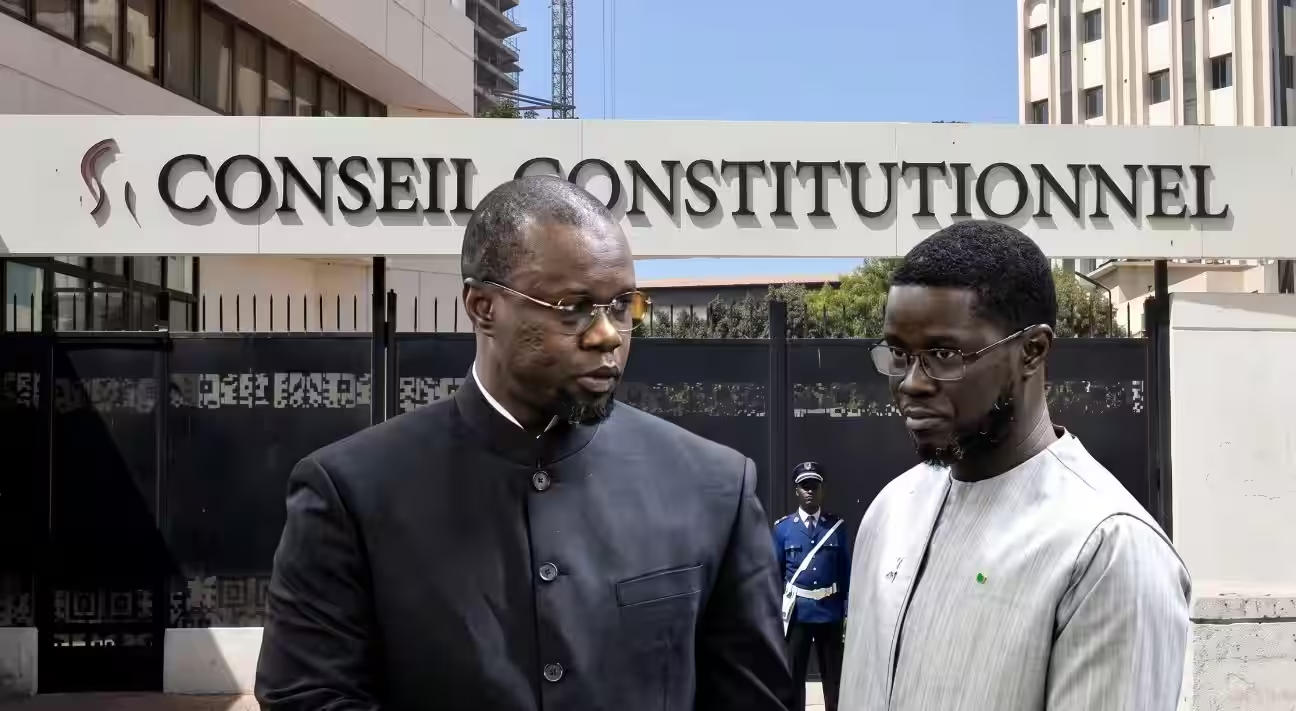
Unexpected insights into the constitutional council’s ruling on Ousmane Sonko
On June 17, 2026, the Constitutional Council of Senegal delivered a ruling that has sparked intense debate across the nation’s legal landscape. The decision, which reinstated opposition leader Ousmane Sonko to his seat in the National Assembly, has been met with sharp criticism and contrasting interpretations. While the Council justified its verdict on procedural grounds—citing technical ineligibility—many legal scholars argue that the ruling reveals a subtle but significant shift in constitutional jurisprudence.
a procedural ruling with deeper implications
At first glance, the Council’s decision appears to be a straightforward application of legal formalities. By dismissing the case on the basis of procedural grounds, the judges avoided engaging with the broader political and constitutional questions surrounding Sonko’s exclusion. However, this approach has left many observers questioning whether the ruling signals a retreat from the Council’s previously expansive role in safeguarding institutional stability.
In 2024, the Council had demonstrated a more assertive posture, intervening decisively in constitutional disputes to preserve the balance of power. The contrast between these two moments has led legal analysts to speculate about a possible infléchissement—a deliberate narrowing of the Council’s interpretative scope. Critics argue that the June 2026 ruling prioritizes legal technicalities over the Council’s broader mandate to uphold constitutional principles.
institutional consistency under scrutiny
The decision has also reignited debates about the Council’s consistency in applying constitutional norms. While the judges cited a lack of jurisdiction in Sonko’s case, their reasoning has been perceived as inconsistent with the Council’s earlier jurisprudence. For instance, during the February 2024 political crisis, the Council had taken bold steps to safeguard democratic institutions, setting a precedent for judicial activism. The recent ruling, by contrast, raises concerns about whether the Council is retreating from its role as a guardian of institutional integrity.
Legal scholars are divided over whether the June 2026 decision represents a necessary correction to prevent judicial overreach or a worrisome erosion of the Council’s authority. Some argue that the ruling reflects a cautious approach to avoid political entanglement, while others see it as a missed opportunity to clarify the boundaries of constitutional interpretation in Senegal.
what’s at stake?
- Institutional credibility: The Council’s reputation as a neutral arbiter is under scrutiny, with critics questioning its ability to maintain consistency in constitutional adjudication.
- Legal precedent: The ruling could influence future cases involving constitutional disputes, setting a precedent that prioritizes procedural rigor over substantive justice.
- Political fallout: The decision has reignited tensions between the government and opposition, raising concerns about the Council’s role in mediating political conflicts.
the road ahead
As Senegal’s legal and political communities grapple with the implications of the June 17 ruling, one thing is clear: the debate over the Constitutional Council’s role is far from over. Whether this decision marks a temporary adjustment or a permanent shift in jurisprudence remains to be seen. What is certain, however, is that the Council’s actions will continue to shape the nation’s constitutional landscape for years to come.
